Architects
Harry Seidler
Part 1 - childhood in Vienna :: escape to England :: internment :: studies in North America :: the Rose Seidler House in Sydney
Part 2 - skyscrapers :: back to Vienna :: his public persona
Harry Seidler (1923-2006) was born in a hospital in Vienna’s 9th District. His grandparents were one of the many Jewish families who moved to Vienna in the latter part of the 19th century from eastern parts of the Austro-Hungarian Empire. His earliest fascination with design happened when he watched the work of the architect and designers whom his parents had contracted to renovate their apartment.[1]
In March 1938 Seidler went on a school trip with his classmates to a week-long skiing camp in Saalbach, in the Austrian state of Salzburg. During this skiing trip Hitler’s soldiers marched into Austria and occupied the country, submerging it into Nazi Germany (this take-over of Austria is known as the Anschluss – annexation). On the very morning when Hitler’s armed forces moved into Austria, the teacher in charge of Seidler’s skiing camp separated the Jewish pupils from the non-Jewish pupils and took the latter outside to salute the flag of Nazi Germany – Seidler wondered how this flag was already available in a small mountain village.[2]
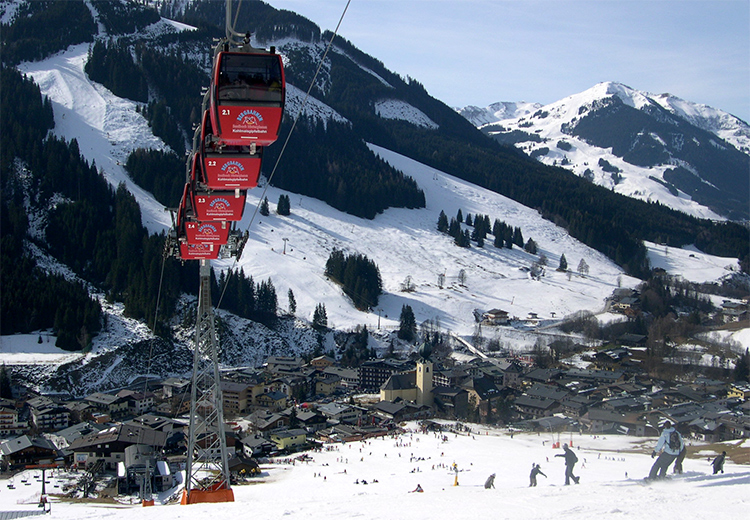
The former aerial cable car 'Kohlmaisbahn', above the ski slopes of the village of Saalbach in Saalbach-Hinterglemm (Austria), photographed in 2007.
Photo source: User:F30, CC BY-SA 2.5, via Wikimedia Commons

When Seidler and his classmates returned early to Vienna the following weeks were a tense time for Seidler and his parents. He had an unpleasant time when he encountered some SS officers on the street one day when he was coming home from school.[3] His older brother Marcell was already in Cambridge in the UK as a student and worked hard to find a sponsor who would accept Harry there. Eventually Harry received a new German passport (with a “J” on the front cover – short for Jude [Jew]), as the Austrian state no longer existed. Harry travelled by train and ship to England – when the train stopped just before the Belgian border he and other Jewish travellers received some abusive treatment from German border guards.[4] Seidler’s parents Rose and Max managed to get out of Austria before it was too late and settled in London, where Max found some work.
Harry Seidler's sponsors in Cambridge were Lady Edith MacAlister and her sister, Miss Anne MacAlister. ('Sponsor' meant the British person served as a guarantor for the overseas student, hosting him/her and covering the costs of their maintenance and care.) Seidler lived with the MacAlister sisters at their family home in Cambridge for two years on a student visa. Lady MacAlister was also the guarantor for Harry's parents, who were living in London. When Seidler arrived in Cambridge he could hardly speak any English, but he learned quickly and soon copied aspects of the English lifestyle and way of speaking. He attended the Cambridgeshire Technical School and this was where he first developed an interest in architecture and design.[5]
When the British government feared that a German invasion of Britain was imminent, it decided that the risk of German spies was too great and all Germans were interned, including refugees who had fled Germany for their own safety. Seidler’s parents were not interned, but their hope was to be allowed to move to Australia, where they hoped to be able to reestablish the family’s textiles business.
Seidler and his brother Marcell were soon sent to the internment camp on the Isle of Man (in the Irish Sea between England and Ireland), and later they and many other internees were sent by ship to an internment camp in Canada, a new internment camp known as 'Camp L' at Cove Fields in the province of Quebec. When the camp was built it was originally supposed to be a military barracks. In the months after the camp opened it became obvious that it was not satisfactory as an internment camp and it was closed late in the year. In October 1940 Seidler was transferred from Cove Fields to Camp 42 (Sherbrooke, also in Quebec).
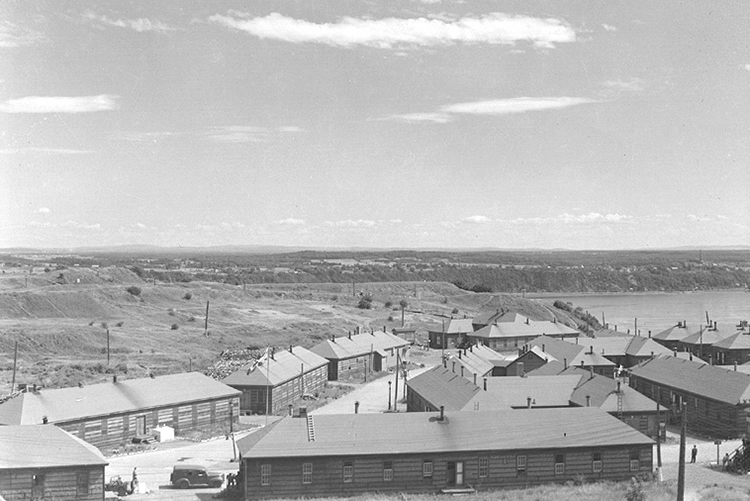
The former Camp L buildings in 1945. The building in the immediate foreground was the camp administration office.
Photo source: “Les casernes militaires à Cove Fields à Québec, 1945”, BAnQ Québec, Fonds Ministère de la Culture et des Communications, (03Q,E6,S7,SS1,P26901), Paul Carpentier. Creative Commons CC BY-NC-ND 4.0 (non-commercial use).
Seidler resented his experiences in internment camps greatly and considered it very unfair – this tainted his attitude to Great Britain for a long time.[6] Harry Seidler applied for enrolment in architectural studies at the University of Manitoba in Winnipeg and was accepted. He was released from internment in 1941. Initially he was not certain how he could afford this university study, but he won a scholarship which meant he could go ahead with his studies, which he completed with great success in 1944. This qualification meant that he could work in any country in the British Empire, but his main aim was to go to the USA and do postgraduate study there.
Seidler completed a Masters degree at Harvard University’s Graduate School of Design, which was led by Walter Gropius, a famous German architect who had left Germany after the Nazi government came to power. Just after the First World War Walter Gropius had founded the Bauhaus, a radical arts and crafts school focused on modern design and ideas, in Weimar. According to Neil MacGregor, a former director of the British Museum, the Bauhaus “reshaped the world. Our cities and houses today, our furniture and typography, are unthinkable without the functional elegance pioneered by Gropius and the Bauhaus”.[7] Walter Gropius had a significant influence on Seidler’s ideas about architecture and design.
After World War Two Seidler’s parents and his brother Marcell moved to Sydney and reestablished the family textiles business there. Although his parents hoped that he would also move to Sydney, Harry Seidler had no interest in moving to Australia – he believed his professional future lay in the USA.[8] However, his mother managed to lure him to Australia by asking him to design a house for his parents, a request that he could not resist. He enjoyed the climate of Sydney and the views and scenery surrounding the harbour so much that he ended up settling in Sydney.
The house that he designed at Wahroonga for his parents became known by the name Rose Seidler House, and during the planning phase Harry experienced frustration with the local council, the Ku-ring-gai Council, which in Harry’s opinion did not understand modern design at all. When the house was completed in 1950 it was a sensation and generated a large amount of media coverage. Seidler brought Modernism to Australia – nothing like the Rose Seidler House had been seen before in the style of homes in Australia. It was ‘the most talked about house in Sydney’ and resulted in many more design jobs for Seidler, and more frustrations with local councils, who were used to more conventional bland home designs. The Rose Seidler House is now a heritage-listed house museum and is open to the public. At the time when Seidler gifted the house to the state of New South Wales, the assistant Government Architect, Andrew Andersons, said of the house: “It is right up there with the best that the world had to offer; straight from the Bauhaus, via America, to Australia.”[9]
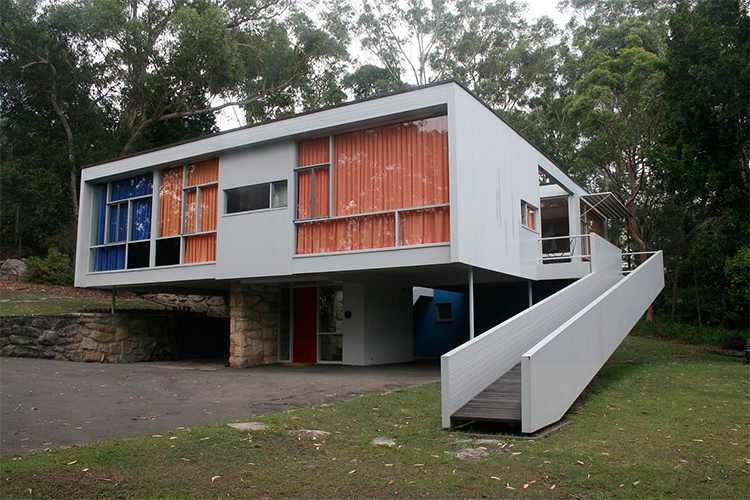
The Rose Seidler House in Wahroonga NSW, designed by Harry Seidler, completed in 1950.
Photo source: Rory Hyde, CC BY-SA 2.0, via Wikimedia Commons

The October 1950 edition of People magazine hailed Seidler as "high priest of the 20th century", dazzling Australia with his "shiny American ideas".
Elizabeth Farrelly, in the Sydney Morning Herald
In 1954 Seidler was able to persuade his Harvard mentor Walter Gropius to come to Sydney to make a speech at a conference for architects. His success in arranging Gropius’ participation in the conference enhanced Seidler’s reputation in Australia’s community of architects and designers. While Gropius and his wife Ise were in Sydney, Seidler took them to Wahroonga for a dinner party at his parents’ home in Rose Seidler House, where they all chatted with each other in German.[10]
♦ Notes:
1. O'Neill (2016), p.20
2. O'Neill (2016), p.32
3. O'Neill (2016), pp.39-40
4. O'Neill (2016), p.43
5. O'Neill (2016), p.52
6. O'Neill (2016), p.292
7. MacGregor, Neil. (2017). Germany. Memories of a Nation. New York: Vintage Books. p.356
8. O'Neill (2016), pp.111, 117
9. O'Neill (2016), p.291
10. O'Neill (2016), pp.140, 142
♦ References:
Farrelly, Elizabeth. (2006, March 10). When Harry met Sydney. Sydney Morning Herald. Accessed online here.
O'Hagan, Michael. POWs in Canada. Website - see the page about Camp L.
O'Neill, Helen. (2016). A Singular Vision: Harry Seidler / Helen O'Neill. Sydney : HarperCollins
Tampke, Jürgen and Colin Doxford. (1990). Australia, Willkommen. Kensington (NSW): New South Wales University Press. pp.258-259