Names
Former Australian Placenames of German Background
Grovedale/Germantown, Victoria
Grovedale (formerly Germantown) is a southern suburb of Geelong, approximately six kilometers from the centre of Geelong.
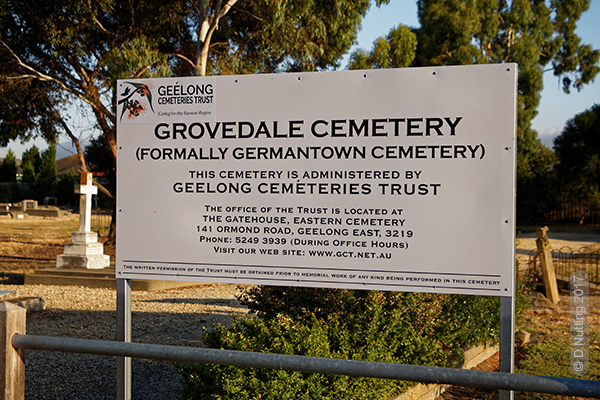
Information sign at the entrance to the Germantown cemetery in Grovedale, Victoria.
Dr Alexander Thomson got the immigration agent Eduard Delius to recruit Germans to come to Geelong, work for him on his property ‘Kardinia’, and set up a vineyard there. They were passengers on the Emmy. On 31 December 1849 the Melbourne Daily News reported that Dr. Thomson ‘intends to make an effort to establish a German village in the neighbourhood of the town [of Geelong]’.[1] Another significant person who did much for the German immigrants in offering them work and eventually selling them land was Charles John Dennys (1817-98). Dennys had been educated in Germany and had arrived in the Geelong area in 1842. Dennys had bought land from the Crown in the Parish of Duneed in 1849. Some of the German arrivals were able to get land by working for Dennys.[2]
The land that some Germans acquired from Dennys became known as Germantown. The historians Tom Darragh and Robert Wuchatsch were able to trace the first use of the name back to March 1852 – in the form of Germans Town.[3]
Many of the first families in Germantown came from villages on both sides of the Oder River in eastern Germany. They were soon followed by a steady stream of other Germans, including some Wends, and, unlike the German communities of South Australia, this is one of the few examples of German chain migration in Victoria (chain migration is where immigrants from a particular area follow others from that area who have already gone to the “new” destination).[4] Farmers and market gardeners at Germantown supplied the Ballarat goldfields as well as the shops of Geelong with food (Geelong was not far away and already a major town). Germantown became economically successful and over the years people from other areas of Germany settled there, as well as a few non-Germans, usually English people. Despite the greater mix of people at Germantown, “it continued to function as a magnet for Germans”.[5] The Geelong Advertiser reported in 1868 that “Germantown presents (…) a picture of prosperity”.[6]
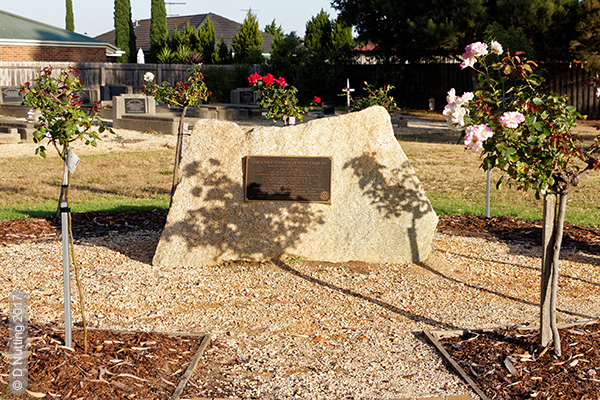
Memorial plaque honouring the early German residents of Germantown (Grovedale), in the Germantown cemetery.
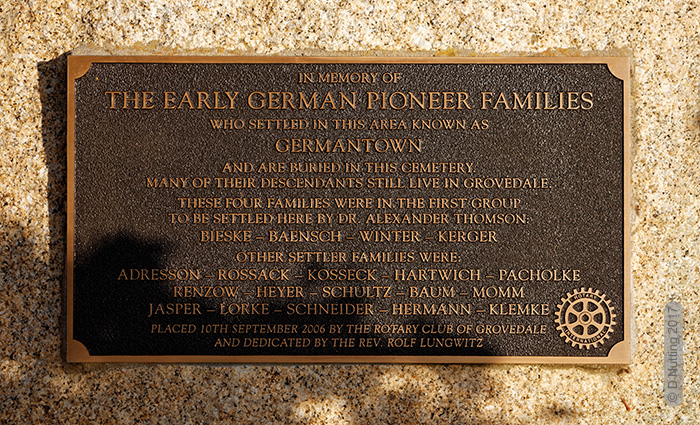
Memorial plaque in the cemetery at Germantown (Grovedale), close-up view.
The anti-German atmosphere of World War One caused a name change in 1915. The South Barwon Shire Council, along with some locals, wanted to change the name Germantown. At its meeting on 2 July 1915, the South Barwon Shire Council discussed alternative names for the Germantown area including Cornwall, Marlborough, Grovedale and Dennys. Cr Winter presented a petition that had been signed by 52 ratepayers, who wanted the new name to be Dennys in honour of one of the first European settlers in Germantown (this was Charles Dennys, who had encouraged German migrants to settle in the Geelong district and who had sold some of his land to early German settlers). Around 90 percent of the local residents went to the council meeting where ‘there was practically a unanimous desire that either Cornwall or Marlborough should be selected, the first one for preference.’ Council President Blyth's personal preference was the name Grovedale, which was the name of the ‘Grovedale’ estate of former Councillor J.E. Matthews. The final vote at the council meeting was unanimously for the name Cornwall (the name of the furthest south-western county of England), but authorities stated that there was already a place named Cornwall in another state (Tasmania), so the Germantown area ended up being renamed Grovedale.[7]
The present-day State School No. 283 Grovedale Primary School was originally known as Germantown. It is one of Victoria's oldest public schools - it was established in 1854 as a mud-walled, grass roofed Lutheran church, built by community effort. This church was also used as a school by the Lutheran community. The school became a state school at some stage between 1873 and 1878.[8]
A cottage in Grovedale is one of the rare intact remnants of Victoria's earliest German settlement. It is at 222-224 Torquay Road in Grovedale and is known as the German Cottage. The Victorian Heritage Register states that the cottage "represents a rare and fine example of the building techniques introduced by German settlers in the area" in the 19th century, and is "an interesting example of adaptive building construction representing a merging of two building traditions, north German and British Colonial". The cottage was built around 1857 for Johann Sohr. 'The house and land was purchased in 1881-2 by a Danish Lutheran, Johann Andressen who was married to a German. The Andressen family lived there until the 1940s.'[9]
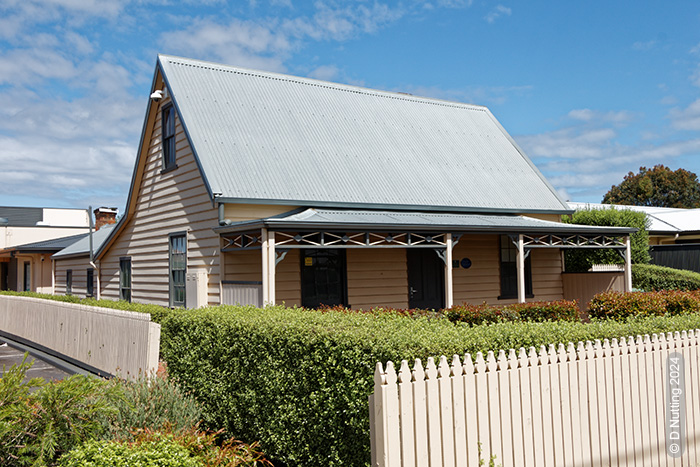
The German Cottage at Germantown (Grovedale).
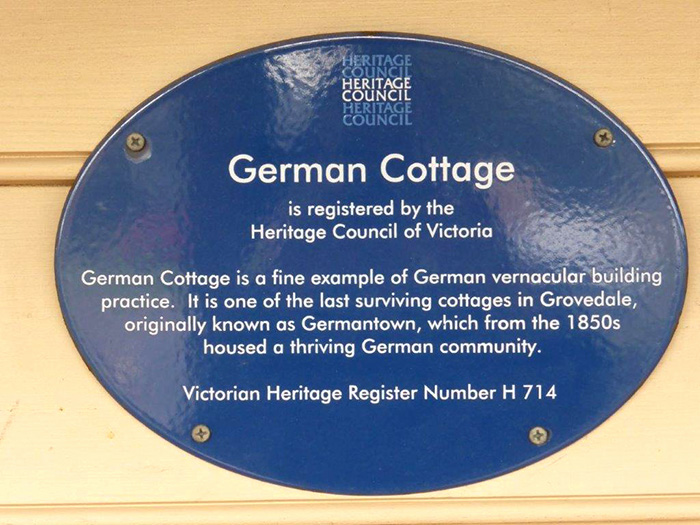
Heritage plaque on the wall of the German Cottage, Germantown (Grovedale).
Photo courtesy of Liz Ray
Several streets in Grovedale and in nearby suburbs or localities are named after the early German settlers of Germantown: Bieske Road, Heyers Road, Winter Street, Kerger Court, Klemke Court, Hartwick Court, Baum Park (Waurn Ponds), Kossecks Place (Belmont) and Baenschs Lane in nearby Connewarre.
♦ Notes:
1. Rowe (2021), p.777 / Melbourne Daily News, 31 December 1849, p.2
2. Darragh & Wuchatsch (1999), p.120
3. Darragh & Wuchatsch (1999), p.122
4. Wehner (2018), p.73
5. Wehner (2018), p.75
6. Wehner (2018), p.75
7. Rowe (2021), p.778
8. Blake, L. J & Blake, L. J. (Leslie James), 1913-1987, (ed.) & Victoria. Education Department (1973). Vision and realisation : a centenary history of state education in Victoria. Melbourne: Education Department of Victoria. Volume 2, p.1009
9. 'German Cottage' (222-224 Torquay Road Grovedale, Greater Geelong City). Victorian Heritage Register (VHR) Number: H0714. The Victorian Heritage Database entry for this house is at <https://vhd.heritagecouncil.vic.gov.au/places/561>. Accessed 03/07/2023.
♦ References:
Darragh, Thomas & Robert Wuchatsch. (1999). From Hamburg to Hobson's Bay: German emigration to Port Phillip (Australia Felix) 1848-51. Heidelberg (Victoria): Wendish Heritage Society.
Rowe, David & Greater Geelong (Vic.). Council, issuing body. (2021). About Corayo : A Thematic History of Greater Geelong. Retrieved February 19, 2023, from <http://nla.gov.au/nla.obj-3043741189>. Theme Six - Building the city, suburbs & outlying towns.
Wehner, Volkhard. (2018). The German-speaking community of Victoria between 1850 and 1930 : origins, progress and decline. Münster : LIT Verlag