Names
Australian Placenames of German Background
Carlsruhe & Elsternwick, Victoria
Carlsruhe is a village 80km north-west of Melbourne. Elsternwick is a suburb of Melbourne, 10km south-east of the city centre.
These placenames are associated with Charles Hotson Ebden, who was born in the Cape Colony in 1811, also known as the Cape of Good Hope. The Cape Colony was a British colony in present-day South Africa. Ebden's mother's surname before she married was Kirchmann, which indicates there was probably some German heritage in her family background. Ebden's parents were wealthy people and in his youth they sent him to the city of Karlsruhe in south-western Germany for his education. His later life seems to show that he had pleasant memories of his time in Germany.[1]
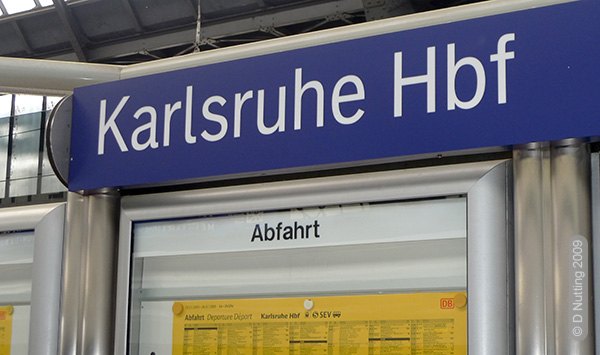
Railway station sign and trains timetable on a platform of the central station (Hbf = Hauptbahnhof) in Karlsruhe, Germany
In 1832 Ebden moved to Australia and set up as a businessman in Sydney. By 1835 he became a grazier (sheep-farming) and moved thousands of sheep south across the River Murray into the Port Phillip District (later known as Victoria). By 1837 he had set up a large sheep farm on land that had been home to the Dja Dja Wurrung Indigenous people, on the Campaspe River west of Mount Macedon. He called the area around his farm Carlsruhe, after the German city of Karlsruhe where he had lived for a while earlier.
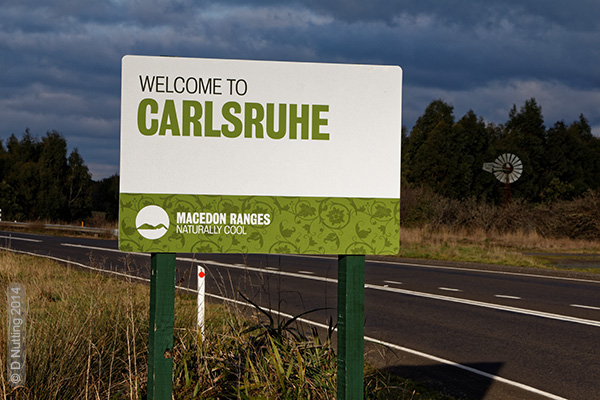
Placename sign at the roadside in Carlsruhe, Victoria
Later he became active in colonial politics in Melbourne and was a well-known public figure. He bought and sold large farming properties and was very wealthy. Ebden was Victoria's first Auditor-General, after separation from the colony of New South Wales. In the late 1840s he helped William Westgarth bring German immigrants to Victoria (Victoria had seen how successful German immigration was in South Australia and wanted to encourage groups of Germans to immigrate to Victoria).
In the 1850s Ebden had a house south-east of central Melbourne and named it 'Elster', the German word for 'magpie'. The suburb Elsternwick was named after his house.[2] 'Wick' is a Scandinavian word for ‘village’ or ‘inlet’ (the Elster Creek flows through Elsternwick). The German plural form of the noun Elster is Elstern.
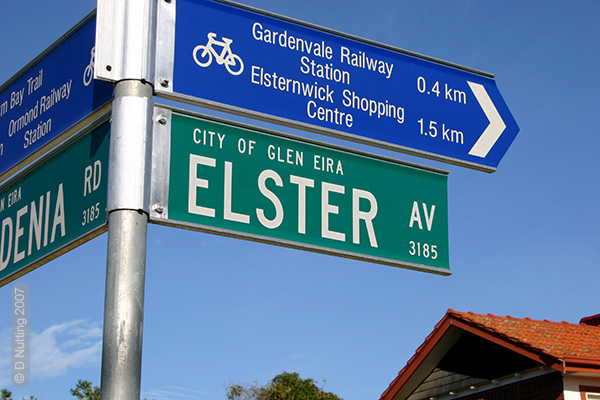
street sign: Elster Avenue
The funeral procession for Mr Ebden in 1867 "was one of the largest that has been witnessed in Melbourne for some time past", according to an obituary in the Leader newspaper at that time.[3]
♦ Notes:
1. Serle (1966)
2. Murray, Peter & Wells, John & Caulfield (Vic.) Council (1980). From sand, swamp and heath : a history of Caulfield. Blackburn (Victoria): J. & D. Burrows for City of Caulfield. p.264
3. DEATH OF MR EBDEN. (1867, November 2). Leader (Melbourne, Vic. : 1862 - 1918, 1935), p. 18. Retrieved February 3, 2023, from <nla.gov.au/nla.news-article196635917>
♦ References:
Serle, Geoffrey. 'Ebden, Charles Hotson (1811–1867)', Australian Dictionary of Biography, National Centre of Biography, Australian National University, <adb.anu.edu.au/biography/ebden-charles-hotson-2018/text2479>, published first in hardcopy 1966, accessed online 28 January 2023.
Elsternwick:
Appleton, Richard. & Appleton, Barbara. (1993). The Cambridge Dictionary of Australian Places. Cambridge: Cambridge University Press. p.98
Jowett, Des F. & Weickhardt, Ian G. & Rosstown Historical Research Group. (1978). Return to Rosstown : railways, land sales and sugar beet ventures in Caulfield. Mordialloc (Victoria) : Rosstown Historical Research Group. p.16
Carlsruhe:
Blake, Les. (1976). Place names of Victoria. Adelaide: Rigby. p.62
Carr, Howard. (2006). The Calder Highway : Melbourne to Mildura: opening the Victorian inland. Barkers Creek (Vic.): Howard A. Carr. p.40
Hutchinson, Garrie. & Victoria. Department of Health (2009-2014) issuing body. (2014). In memoriam : a guide to the history and heritage of Victoria's cemeteries. Richmond (Victoria) : Hardie Grant Books; State of Victoria, Department of Health. [Available online here - accessed 05/02/2023] p.280