Names
Australian Placenames of German Background
Brunswick, Victoria
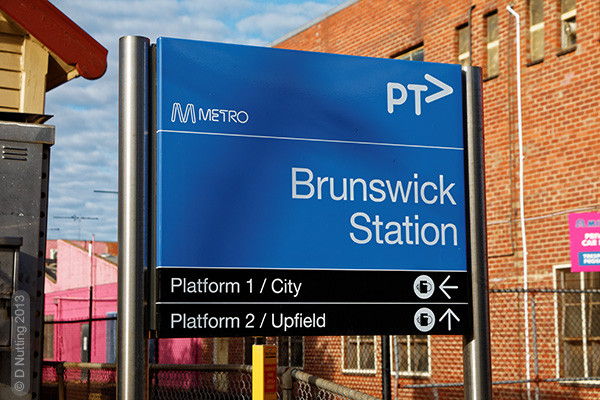
Sign at the entrance to Brunswick Station, Victoria.
A publication produced for the City of Moreland, entitled Thematic History, explains the local background to the name Brunswick:
The name ‘Brunswick’ is associated with early settler, Thomas Wilkinson. He and his business partner, Edward Stone Parker, bought land along Sydney Road in 1841 and proceeded to subdivide it into allotments for sale or lease. They also developed two roads to service the allotments, naming them Victoria Street and Albert Street. (...) Wilkinson is probably better known for being the ‘Father of Brunswick’. He was an active campaigner for the rights of Caroline, Duchess of Brunswick, the estranged wife of King George IV of England, and named his Brunswick estate in her honour. When the area’s first post office opened in 1846, it adopted the name of Wilkinson’s estate, establishing the name for the broader locality.
City of Moreland. Thematic History.
➽ You can read more in this article about this German princess, Caroline of Brunswick (Caroline Amalie Elisabeth von Braunschweig-Wolfenbüttel) and how her family background produced a few place names in Australia.
Thomas Wilkinson is believed to have been one of the many common English people who supported Caroline of Brunswick. He was 21 years old and still living in England at the time of the controversial coronation of George IV in 1821.[1]
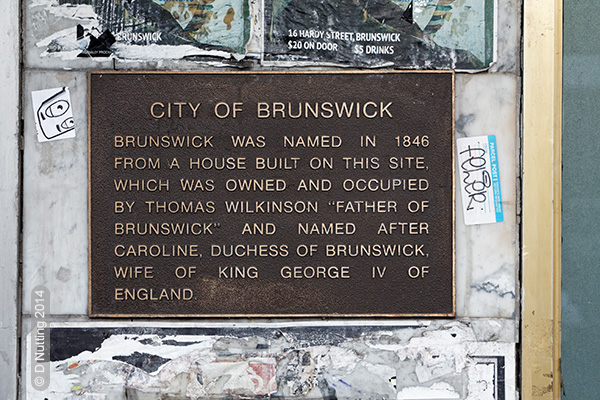
Plaque on the wall at the site of Thomas Wilkinson's house in Sydney Road, Brunswick.
The plaque reads: "City of Brunswick. Brunswick was named in 1846 from a house built on this site, which was owned and occupied by Thomas Wilkinson "Father of Brunswick" and named after Caroline, Duchess of Brunswick, wife of King George IV of England."
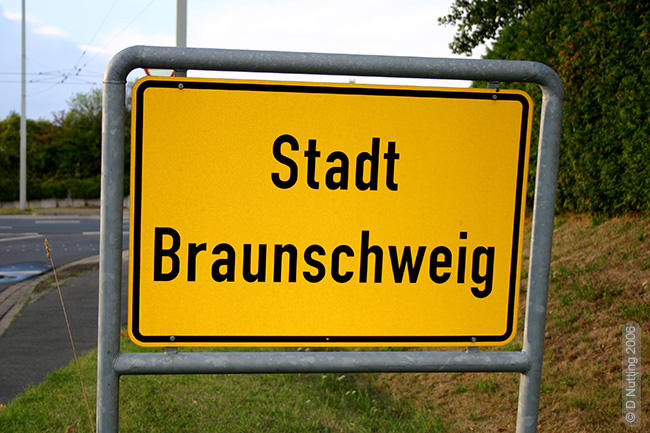
City name sign on the edge of Braunschweig (Brunswick), Germany
♦ Notes:
1. Penrose (1994), p.54
♦ References:
Extent Heritage Pty Ltd. (2020). City of Moreland. Thematic History. Moreland City Council. p.74
Penrose, H (ed.). (1994). Brunswick: One history, many voices. South Melbourne: Victoria Press.