Names
Australian Placenames of German Background
Wartburg, Queensland
Wartburg is a rural locality approximately 60km north-west of Bundaberg. German immigration into Queensland was slow in the early years of the 20th century, only about 25 per year. The number of German immigrants arriving in Queensland increased rapidly from 1908 onwards, mainly because of the efforts of two German pastors, J.F. Niemeyer of the Hatton Vale Apostolic community, and M. Bernoth of the Gattan Methodist church. Pastor Niemeyer initially came to Queensland as a missionary, and later established Apostolic church communities in the Hatton Vale, Mount Beppo and Esk region of Queensland. In 1906 Niemeyer visited Germany to encourage immigration to Queensland and held talks in Apostolic communities. He persuaded almost 500 members of Apostolic communities to go to Queensland. Many of them settled in the Baffle Creek area on the Bundaberg-Gladstone railway line.[1] The first settlers at Baffle Creek had to wait a while until official confirmation of their land ownership came from the government, and they set up camp on a hill they named Wartburg Hill.[2]
A sugar mill was established at Baffle Creek, and ‘Wartburg’ was the name of the mill manager’s house. As there were already other state schools in the district that had the words ‘Baffle Creek’ in their name, the school which opened near the mill in 1913 received the name Wartburg State School.[3]
The school and the locality still carry the name Wartburg. The German settlers at Wartburg most likely knew of the Wartburg fortress in eastern Germany, near the town of Eisenach. Wartburg fortress is one of the most famous castles in Germany, and has played a role in several well-known episodes in German history. The Wartburg fortress is perhaps most famous as the place where the religious reformer Martin Luther translated the New Testament of the Bible into German. From May 1521 to March 1522, Martin Luther stayed hidden in the castle; soldiers of Frederick the Wise secretly took him there for his safety after Pope Leo X had effectively declared Luther to be an outlaw.
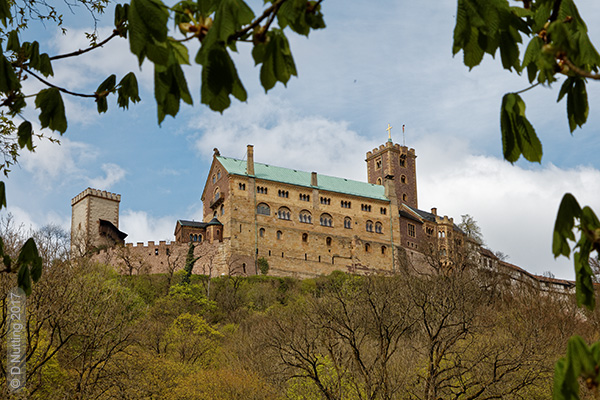
The Wartburg castle in Germany.
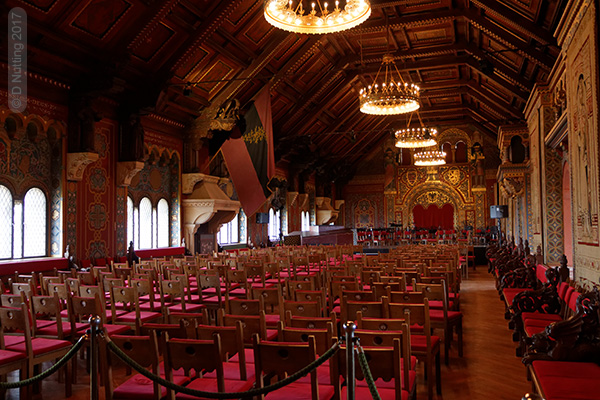
The ceremonial Rittersaal (knights' hall) in the Wartburg castle in Germany.
Wartburg Castle is inscribed on the UNESCO World Heritage List because of its quintessential medieval architecture and its historical and religious significance.
♦ Notes:
1. Tampke, Jürgen and Colin Doxford. (1990). Australia, Willkommen. Kensington (NSW): New South Wales University Press. pp.174-175
2. Heritage statement for the Baffle Creek Sugar Mill. Local Heritage Register. Gladstone Regional Council. <www.gladstone.qld.gov.au/downloads/file/302/baffle-creek-sugar-mill>
3. History. (n.d.). Wartburg State School website. <https://wartburgss.eq.edu.au/our-school/history>
♦ Reference:
Imgrund, Bernd. (2014). 101 deutsche Orte, die man gesehen haben muss. Darmstadt: Konrad Theiss Verlag. 4. Auflage. p.198