Names
Former Australian Placenames of German Background
Witta/Teutoburg, Queensland
The rural town of Witta, seven km north-west of Maleny in the Sunshine Coast region, used to be called Teutoburg. On 17th October 1887 fourteen Germans selected land at Teutoburg.[1]
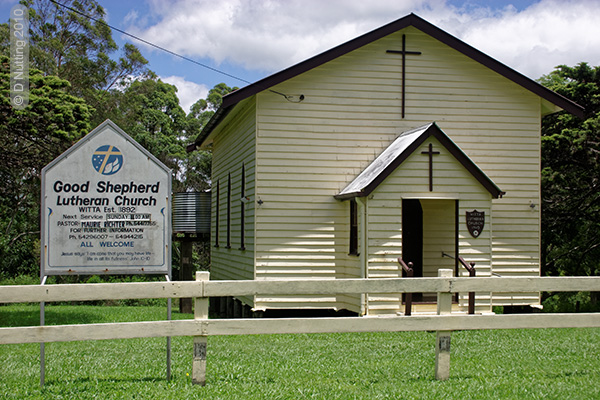
The Lutheran church at Witta. This was the second Lutheran church built at Teutoburg, completed in 1911.
An important early German settler
Councillor Carl Martin Nöthling was born in 1863 at Berlin and emigrated to Australia at the age of 17 with his parents Julius and Emilie. They arrived on the ship Runnymede and were the only passengers on board.
On his farm near Maleny he bred dairy cattle and horses and made wine also. Mr Nöthling built the house himself from timber from his own farm, and made all the 'tasteful' furniture and even the picture frames himself. He had many roles and positions in the community, Justice of the Peace, councillor of the local shire, director of the Maleny Butter Factory, elder of the local Lutheran church etc. He "is generally regarded as the founder and father of Teutoburg, establishing the first post-office and giving its name to the settlement."[2]
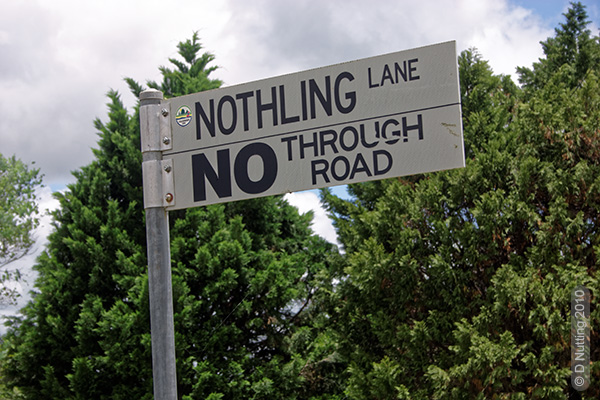
This road name, 'Nothling', honours the family who were among the first residents of this German settlement.
Spelling the name
The German name of the settlement has been spelled in two ways. Queensland’s Post Office Directory pre-World-War-I spells the name 'Teutoburg' (the same as the forest in Germany). It was also spelled this way on a map published in 1913 by the Brisbane Survey Office of the Department of Public Lands, and in a book about the history of Queensland published in 1919. However, the name was occasionally spelled 'Teutoberg'.[3]
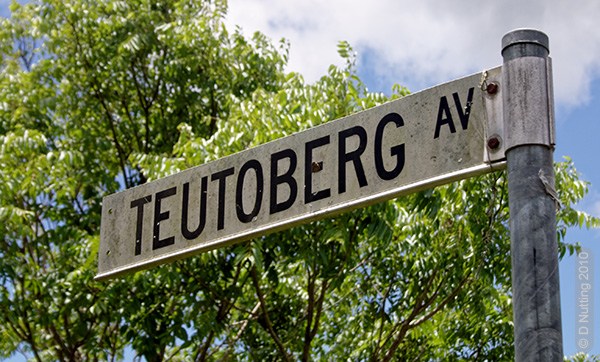
This road name, 'Teutoberg', is a reminder of the earlier name of the German settlement.
Because of the anti-German atmosphere during World War I the name Teutoburg was changed. At a public meeting held in Teutoburg early in 1916, to discuss a name change, the discussion became quite emotional. In May 1916 the Queensland Government Gazette announced the name change to Witta, without giving a reason for the change.[4] The German names of roads at Teutoburg did not change.[5]
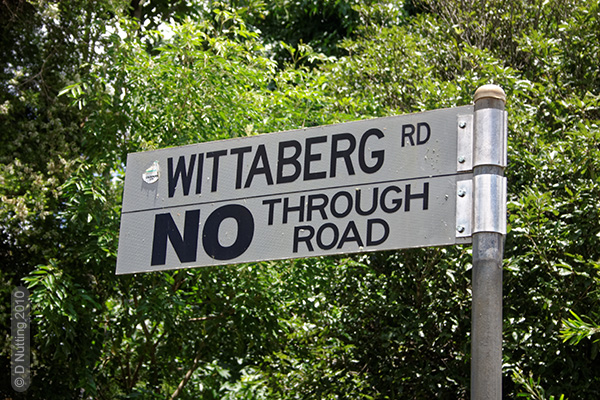
This road name, 'Wittaberg', seems to be a blend of Witta and Teutoburg.
Why the name Teutoburg?
Carl Nöthling and the other German settlers presumably named their village Teutoburg after the Teutoburg Forest, a range of hills in the modern-day German states of Lower Saxony and North Rhine-Westphalia. They perhaps felt some patriotic pride about the name of this forest, which is famous for the Battle of the Teutoburg Forest in the year 9 A.D. At that time the Roman Empire was trying to extend its rule further into the area known today as northern Germany, but the Roman army experienced a shock defeat in the Teutoburg Forest. "The annihilation of three veteran legions at the hands of the Germanic tribes shook the Roman Empire to its core."[6] According to a television documentary produced in the year 2001, the Battle in the Teutoburger Forest "shaped the continent, helped define modern Germany, and in halting the advance of the Roman Empire, brought its greatest emperor, Augustus, to his knees. (…) One tenth of Rome’s total military strength perished in that dark forest. Rome, the world’s superpower, was on her knees."[7] The defeat marked the birth of a first German 'national hero', whom the (Roman) historian Tacitus was soon to dub the 'liberator of Germania'.[8]
The Germanic tribes were led by the chieftain Hermann (known to the Romans as Arminius the Cherascon). A gigantic statue commemorating Hermann's victory, the Hermannsdenkmal, stands on a high outcrop of the forest, and shows him ten times life size. This monument was completed in 1875, after German unification, at a time when nationalism was growing in Germany. Nationalism was increasing in many European countries at that time, and several countries built a large monument to commemorate a legendary historical figure.[9]
Examples of such monuments include: the statue of Joan of Arc in Paris’ Place des Pyramides, the statue of Richard I (nickname: the Lionheart) outside London’s Palace of Westminster[10], the National Wallace Monument in Stirling, Scotland (commemorating William Wallace, a 13th- and 14th-century Scottish hero) and the statue of Wilhelm Tell at Altdorf on the Urnersee section of Lake Lucerne, central Switzerland.
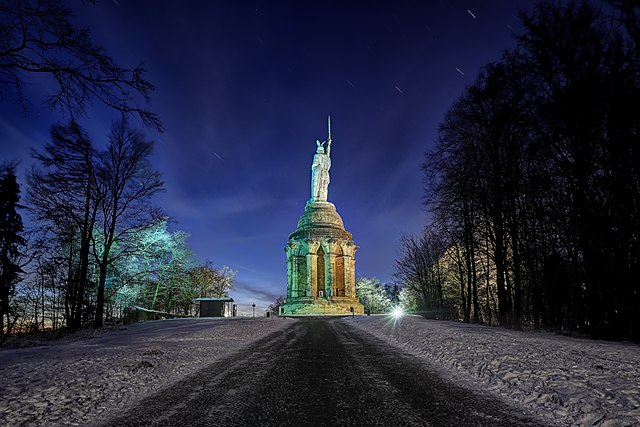
The Hermannsdenkmal in winter, in the southern part of the Teutoburg Forest, Germany
Photo source: Falko Sieker, CC BY-SA 4.0, via Wikimedia Commons
"In its first years and decades [i.e. after 1871], the German Empire busied itself to build monuments to ancient legends that were supposed to give meaning and collective memory to the newly formed Germany."[11] The Hermannsdenkmal is certainly an example of that. It became "a strong focus for popular national sentiment" in Germany.[12]
The first settlers of Teutoburg in Queensland arrived after the Hermannsdenkmal was completed, and would have known of the famous large monument, and may have seen pictures of it.
♦ Notes:
1. Maleny and District Centenary Committee. (1978). By Obi Obi Waters : stories and photographs of early settlement in the Maleny district, Blackall Range, south eastern Queensland. Maleny (QLD) : Maleny and District Centenary Committee. p.14
2. Fox (1919), p.860
3. Queensland State Archives. (2016, May 23). What’s in a name – Teutoberg or Teutoburg? NO … it’s Witta! Stories from the archives. Online here.
4. Chaddock, Steve & Jacobsen, Dale Lorna. (2022). Teutoburg to Witta : how European settlement helped make Maleny. Maleny (QLD) : Express Print and Mail. pp.88-90
5. Maleny Visitor Information Centre Staff. (2012). From Mud to Magic: A History of Maleny. Maleny: Maleny Visitor Information Centre.
6. Hudson, M. (2019, August 22). Battle of the Teutoburg Forest. Encyclopedia Britannica. <www.britannica.com/event/Battle-of-the-Teutoburg-Forest>
7. Odyssey – Ancient History Documentaries. (2021, February 3rd). The Lost Legions of Varus. [Video]. YouTube. <https://youtu.be/93Wb9aa0-6Q> (Producer/Director: Tony Bulley, a Granada Production)
8. Imgrund, Bernd. (2014). 101 deutsche Orte, die man gesehen haben muss. Darmstadt: Konrad Theiss Verlag. 4. Auflage. p.186
9. Davies, N. (1997). Europe. A History. London: Pimlico. p.827
10. John, Simon. (2019). Statues, Politics and The Past. In History Today. Volume 69 Issue 9. <www.historytoday.com/archive/behind-times/statues-politics-and-past>
11. Hoyer, Katja. (2022). Blood and Iron. The rise and fall of the German Empire 1871-1918. Paperback edition. Cheltenham (UK): The History Press. p.8
12. MacGregor, Neil. (2017). Germany. Memories of a Nation. New York: Vintage Books. p.175
♦ References:
Fox, Matt J. (1919). The history of Queensland, its people and industries : an historical and commercial review, descriptive and biographical facts figures and illustrations, an epitome of progress. Brisbane: States Publishing Co., Brisbane, <http://nla.gov.au/nla.obj-268958674> pp.859-860