Names
Former Australian Placenames of German Background
German Bridge, Queensland
Holland Park is a southern suburb of Brisbane, approximately 9km from the CBD. Part of Holland Park was known as German Bridge for a long time.
Several German families were among the early settlers who established small farms along what is now the Logan Road, including the Glindemann, Eikendorff, Lutz, Eberhardt and Steigmann families.[1] The brothers Andreas and Johann Heinrich Conrad (known as Conrad) Glindemann arrived on the ship Caesar Godeffroy from Hamburg in 1863 with their sister and with Andreas’ wife, Sophia, and their two children. Conrad married Magdalena Kuder the year after he arrived.[2]
In the mid-1860s Andreas and Conrad bought land alongside each other facing the Logan Road, at the foot of Holland Park Hill. Conrad established a dairy farm, which became well-known as the Mount Gravatt Dairy, the first commercial dairy in the area. A bridge was built over a creek at the foot of Holland Park Hill, and due to the number of Germans living nearby, the bridge became known as German Bridge.[3] The name German Bridge initially referred just to the bridge itself, but soon people used the name to refer to the surrounding area.[4]
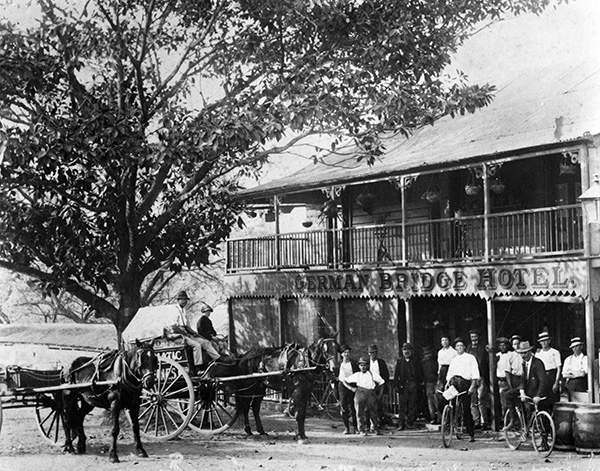
German Bridge Hotel, Mount Gravatt, ca. 1914. (2009). John Oxley Library, State Library of Queensland.
In 1880 Andreas Glindemann received permission to establish a two-storey hotel on his family’s land at the foot of Holland Park Hill, and named it the German Bridge Hotel. The German Bridge Hotel became a well-known landmark in the district and was a rest stop for Cobb & Co. coaches and bullock wagons. The hotel continued to operate as a pub until 1927. The old timber bridge was demolished in 1947.
The street Glindemann Drive and a large park named Glindemann Park honour the history of this local family.[5]
The Brisbane Courier reported in April 1916 that the Stephens Shire Council had met on April 11th. Alexander Clark wrote [to the Council] “suggesting that German Bridge and other Teutonic nomenclature should be renamed, and the council decided to alter the name to Barter Bridge.”[6] The anti-German mood during the First World War no doubt caused this decision by the Council.
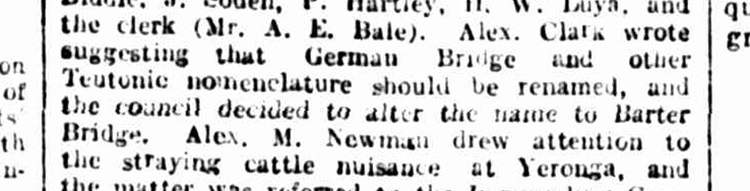
From a report in The Brisbane Courier in April 1916.
Source: screenshot via Trove at the National Library of Australia
However, this appears to be a rare case where a local council’s war-time decision to change a place name did not change the general public’s use of the name. It is difficult to find references to ‘Barter Bridge’. A personal advertisement appeared in The Telegraph newspaper of Brisbane in 1922, offering around an acre of land for sale, “near Barter Bridge”.[7] However, the name German Bridge persisted in common use for at least four decades after 1916.
The German Bridge Hotel was not renamed as it is listed in the electoral rolls and newspapers for some years afterwards. So the hotel name probably continued to reinforce the name German Bridge in the conversations of local people.[8]
In 1938 German Bridge appeared in a table of distances in Bartlett’s Street Directory of Brisbane.[9]
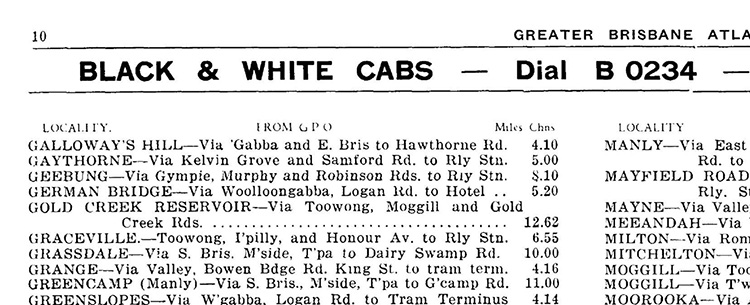
An extract from Bartlett’s Street Directory of Brisbane in 1938.
In 1954 the employment advertisements pages of the Courier-Mail included an advertisement from the W.T. Rawleigh Co. Ltd., a company that was looking for a salesman to represent the company in the area of “Holland Park, German Bridge, and Mt Gravatt”.[10] It seems that people commonly called the locality German Bridge, though it wasn’t an official name. There is no evidence it was ever an official suburb name.[11]
The locality of German Bridge was eventually absorbed into Holland Park, which is an official suburb name, and the name German Bridge fell out of use, long after the decision made by the Stephens Shire Council in 1916.
♦ Notes:
1. 'Local History - Mount Gravatt.' (2009, May 6). ABC Local. <www.abc.net.au/local/stories/2006/05/19/1641487.htm> Accessed 18/03/2023.
2. Taylor (The history of a Holland Park house)
3. 'Glindemann Farmhouse' (Brisbane City Council)
4. Taylor (The history of a Holland Park house)
5. 'Glindemann Farmhouse' (Brisbane City Council)
6. STEPHENS SHIRE COUNCIL. (1916, April 12). The Brisbane Courier (Qld. : 1864 - 1933), p.8. Retrieved September 2, 2021, from <http://nla.gov.au/nla.news-article20124066>
7. (1922, June 30). The Telegraph (Brisbane, Qld. : 1872 - 1947), p. 11 (SECOND EDITION). Retrieved March 17, 2023, from <http://nla.gov.au/nla.news-page19667173>
8. Raymond, Kerry. (2021, October 12 & 13). Personal communication. (Freelance historian).
9. Bartlett's directory atlas & street guide of greater Brisbane area. (1938). Brisbane: George S. Bartlett. p.10.
10. Advertising (1954, June 18). The Courier-Mail (Brisbane, Qld. : 1933 - 1954), p. 12 (fourth column). Retrieved March 18, 2023, from <http://nla.gov.au/nla.news-article50603500>
11. Raymond, Kerry. (2021, October 12 & 13). Personal communication. (Freelance historian).
♦ References:
'Glindemann Farmhouse'. (revised 2020). Local Heritage Places. Brisbane City Council.
<https://heritage.brisbane.qld.gov.au/heritage-places/910>. Accessed 18/03/2023.
Taylor, Marianne. (n.d.). The history of a Holland Park house. The House Detective. (Architectural historian). <www.housedetective.com.au/hollandpark>