Victoria
Baron Ferdinand von Mueller
🔸 An Introduction: Part 1 | Part 2
In the second half of the 1850s Mueller undertook research and exploring expeditions in Victoria's High Country as well as in the east of Gippsland - East Gippsland's biological richness attracted him.[1] He visited also the mouth of the Snowy River. In the middle of the 19th century it was very difficult to travel through the rugged forests of East Gippsland, and Mueller visited the forests east of the Snowy River by boat.[2] The names Mueller Link Track (a remote unsealed road in the Croajingolong National Park) and Mueller Inlet in East Gippsland celebrate these journeys. The Mueller River reaches Bass Strait at Mueller Inlet. You can read a list of things and places named after Mueller.
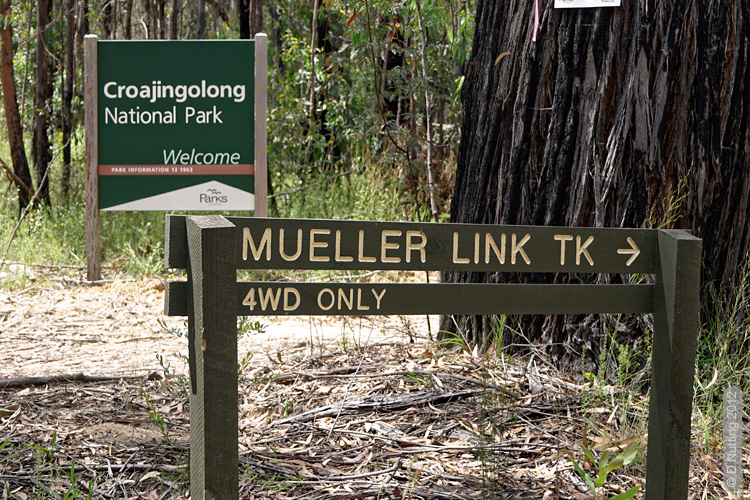
Mueller Link Track (Route sign in Croajingolong National Park)
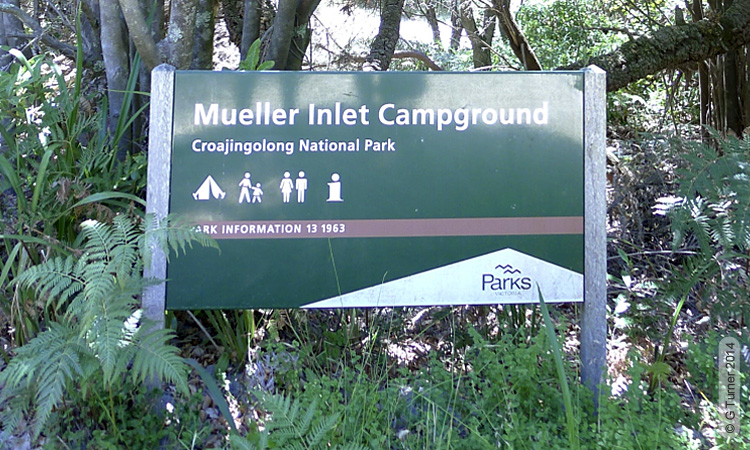
Sign at the camping site of Mueller Inlet
(Photo provided by G Turner)
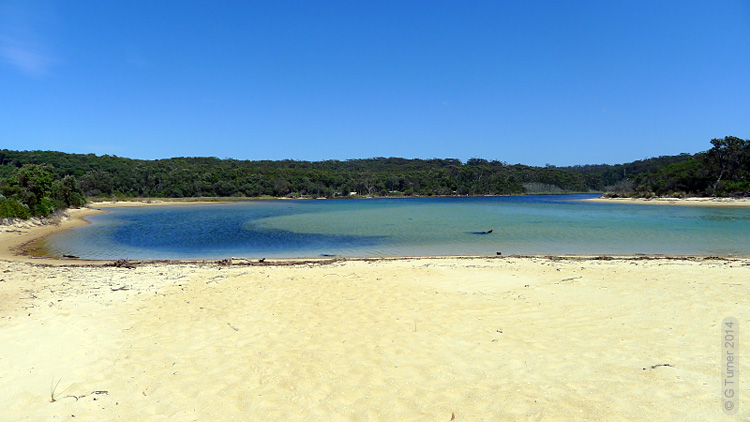
Coastal landscape at Mueller Inlet, Victoria
(Photo provided by G Turner)
In December 1860 Mueller was the first non-Aboriginal person to ascend Mount Baw Baw in the Victorian High Country.[3] The photo shows Mueller's Bush Pea - pultenaea muelleri - a plant named after Mueller (by the English botanist George Bentham) and which is found on Mt Baw Baw and in other alpine and subalpine forests mainly in the east of Victoria.[4]
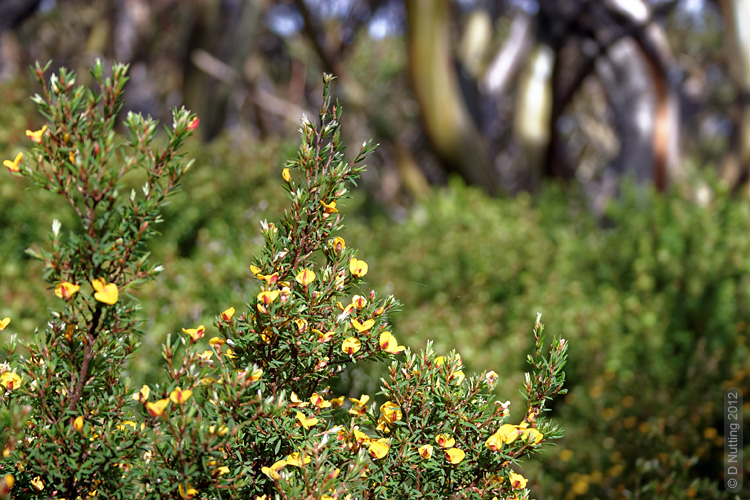
'Mueller's Bush Pea' on Mount Baw Baw, Victoria
Mueller was a member of the organising committee for the "Burke & Wills Victorian Exploring Expedition", though he didn't want Burke to be leader.[5] Despite his long hours of work, Mueller also took part in the activities of the Melbourne German Club.
By the late 1860s there was more and more dissatisfaction in certain parts of Melbourne society with the way the Botanic Gardens were being managed. To Mueller the Gardens had an important scientific and educational role to play, but influential people in Melbourne (and their opinions were heard in the Victorian parliament) wanted the Gardens to be a picturesque place for recreational use. This public pressure grew until the government replaced Mueller as Director of the Botanic Gardens with W R Guilfoyle, who landscaped the Gardens in an aesthetic style with lawns and lakes and ornamental features that provided attractive views for the people of Melbourne who wished to relax there. Mueller retained his position as Government Botanist and the same level of salary, but always felt that he had suffered a great injustice.[6]
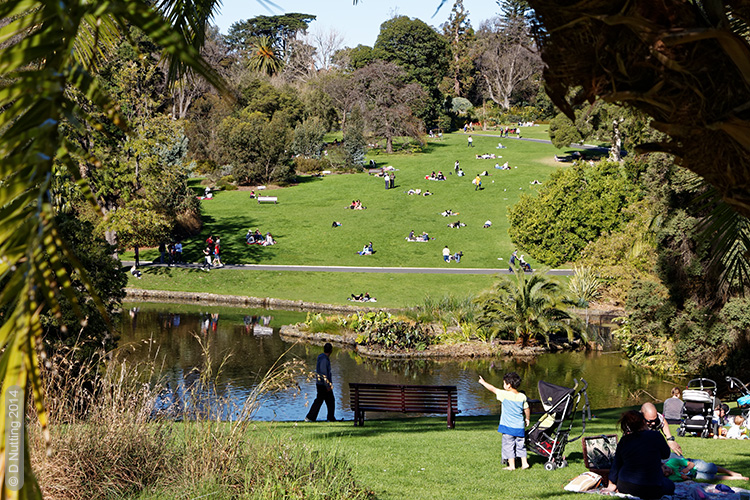
View of the present-day Botanic Gardens of Melbourne
The suburb of Subiaco, in Perth, Western Australia, had a public park called Mueller Park, named after the botanist. In December 1916 during the anti-German atmosphere of the First World War the park was renamed Kitchener Park (Lord Kitchener was Britain’s Secretary of State for War in the early part of the war). In 1981 the City of Subiaco reinstated the name Mueller Park for the eastern part of Kitchener Park, and installed a memorial tablet honouring Ferdinand von Mueller, who had given advice to the colonial government of Western Australia.[7] The memorial states: “In his time he was probably the most famous scientist in the southern hemisphere.”
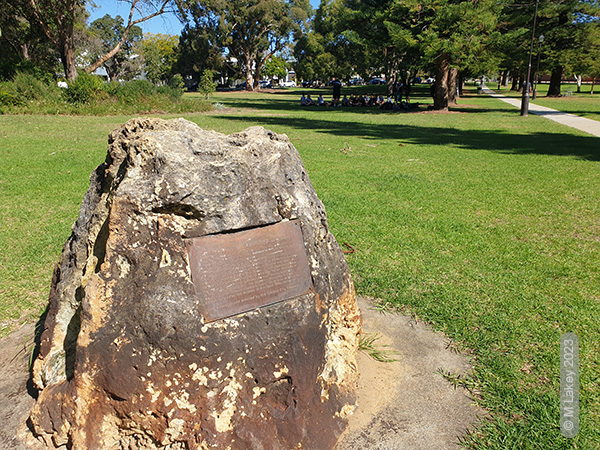
The memorial for Ferdinand von Mueller in Mueller Park, Subiaco, W.A.
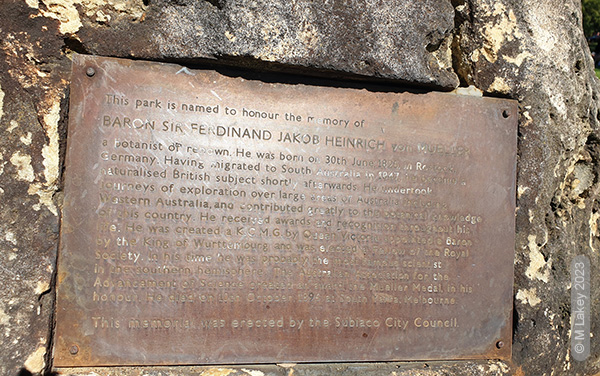
The memorial plaque for Ferdinand von Mueller in Mueller Park, Subiaco, W.A. (close-up)
Sign at the National Herbarium, Melbourne
As Government Botanist Dr Mueller's advice was valued and sought-after in communities around Victoria, as well as in other parts of Australia and overseas. In Warrnambool in south-west Victoria there were massive erosion problems along the sand dunes in the 1880s - the wind blew sand up into the streets of the town so that it was difficult to move through the street. Ferdinand von Mueller suggested planting the sand dunes with marram grass from western Europe, and this eventually stabilised the sand dunes. The Borough Council at Port Fairy, west of Warrnambool, received seeds of marram grass from Dr Mueller in 1883 in order to successfully tackle erosion of the sand dunes there.[8]
Not everything Mueller did was successful; he strongly promoted the introduction of the European blackberry into Australia, which is now a noxious pest, although it is being controlled by a rust fungus and by herbicide sprays.
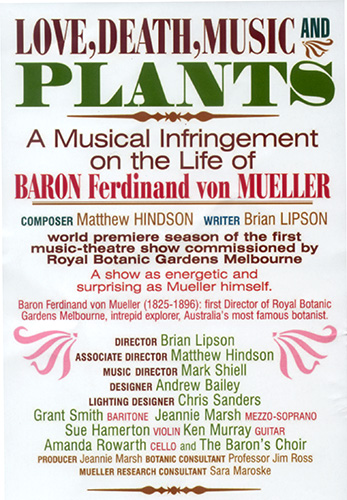
Partial view of the promotional flyer for Love, Death, Music and Plants
In 2003, for the 150th anniversary of Mueller’s establishment of the National Herbarium of Victoria, a musical theatre tribute to the life and work of Mueller was performed in Mueller Hall at the Herbarium. This work, entitled Love, Death, Music and Plants, was performed during a two-week season up until the 30th November, and featured the baritone singer Grant Smith in the role of Baron von Mueller. Jeannie Marsh, the producer, described the 80-minute play as being “somewhere in a new zone between opera and music theatre”. Work on developing this musical play began several years earlier, when Jeannie Marsh was searching for an Australian historical figure who would make a good subject for music theatre.[9]
This piece of music theatre also included the blossoming of Mueller’s romantic relationships, none of which led to marriage. It seems that Mueller’s considerable dedication to his work was a complicating factor.
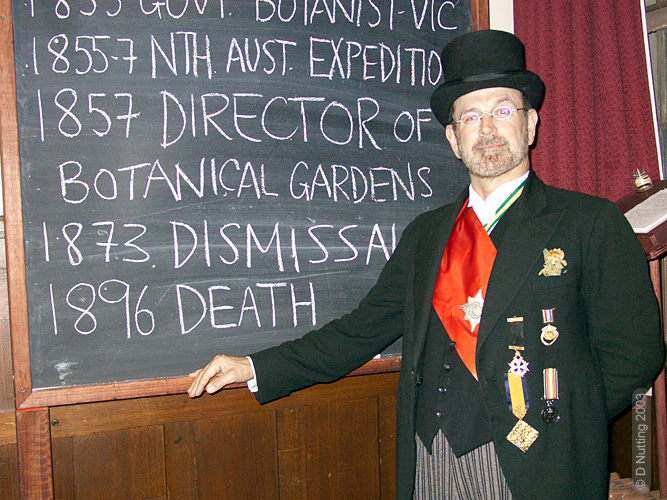
The baritone singer Grant Smith as Mueller, after a performance of Love, Death, Music and Plants.
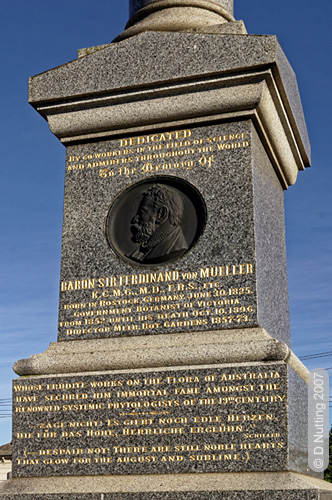
Mueller's gravesite with inscription (St Kilda Cemetery)
Mueller's gravesite at St Kilda Cemetery is an impressive monument. The first three lines of the inscription reflect Mueller's reputation among scientists in Australia and overseas.
At the end of the inscription is a quote from the famous German playwright, poet, and philosopher Friedrich Schiller.
The inscription reads:
Dedicated
by co-workers in the field of Science
and admirers throughout the world
To the Memory of
Baron Sir Ferdinand von Mueller
K.C.M.G., M.D., F.R.S., etc
Born in Rostock, Germany, June 30, 1825
Government Botanist of Victoria
From 1852 until his death Oct. 10, 1896
Director Melb. Bot. Gardens 1857-73.
Whose erudite works on the flora of Australia
have secured him immortal fame amongst the
renowned systemic phytologists of the 19th century
„Zage nicht: es giebt noch edle Herzen,
die für das hohe, herrliche erglühn.“ – Schiller
("Despair not: there are still noble hearts
that glow for the august and sublime.")
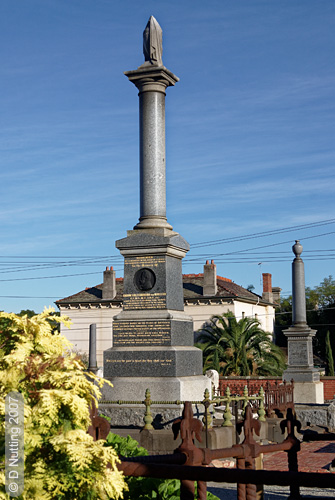
Mueller's gravesite - a tall column of grey polished granite, with an urn on the top. On one side of the column is an inset medallion of Ferdinand von Mueller.
The community group 'Friends Of St Kilda Cemetery' states in a biography of Mueller on their website:
It is difficult to grasp the enormous contribution of Baron von Mueller to Australian science. His astonishing output indicates a workaholic mentality and the physical constitution of a bullock.
Friends Of St Kilda Cemetery
See also the following sources:
For students and teachers the curriculum package Bäume, Büsche, Blumen is also of interest (Royal Botanic Gardens Education Service, teachers of German, Directorate of School Education and Goethe Institut Melbourne, 1996).
♦ Notes:
1. National Estate Report. Department of Agriculture, Water and the Environment. (Australia)
2. Gillbank, Dr Linden. (University of Melbourne) personal communication, 23/01/2014
3. Waters, W. F. (1967). 'The Baw Baws, a short history of the Plateau, from its discovery to the present day'. In: Melbourne Walker, magazine of Melbourne Walking Club. p.35; Baw Baw National Park. Australian Alps National Parks. (accessed 10/02/2022); Gillbank (1992), p.482
4. Mueller's Bush-pea. In: VicFlora (2022). Flora of Victoria, Royal Botanic Gardens Victoria, <https://vicflora.rbg.vic.gov.au> (accessed 09/03/2022)
5. Phoenix, Dave. (2017). "More Like a Picnic Party": Burke and Wills: an analysis of the Victorian exploring expedition of 1860-1861. PhD Thesis (James Cook University). pp.163 & 168
6. Tampke & Doxford (1990), p.56
7. Spillman, Ken. & Subiaco (W.A. : Municipality). (1985). Identity prized : a history of Subiaco. Nedlands (W.A.) : University of Western Australia Press for the City of Subiaco. pp.209-210, 350
8. Sparrow, Kevin. (2007). Plants of South-west Victoria. Newsletter, issue #43, Friends of Warrnambool Botanic Gardens. (Warrnambool, Victoria) p.2; Pretlove, Chris. (2012). David Boyle's tree The Baron. Warrnambool, Vic. : C. Pretlove. pp.27, 29
9. Webb, Carolyn. (2003, November 14). Garden genius lauded in song. The Age (newspaper, online here)
♦ References:
Ferdinand von Mueller (ostsee.de INFO GmbH » Hansestadt Rostock » Berühmtheiten) (accessed 09/03/2022)
Friends of St Kilda Cemetery. (no date). 'The Botanist'. (accessed 13/05/2014)
Gillbank, Linden. (1992). Alpine botanical expeditions of Ferdinand Mueller. Muelleria: An Australian Journal of Botany. Vol. 7, #4: pp.473-489.
Lodewyckx, Prof. Dr. A. (1932). Die Deutschen in Australien. Stuttgart: Ausland und Heimat Verlagsaktiengesellschaft. pp.208-212
Morris, Deirdre. 'Mueller, Sir Ferdinand Jakob Heinrich von (1825–1896)', Australian Dictionary of Biography, National Centre of Biography, Australian National University, published in hardcopy in 1974 (accessed 13/05/2014)
Tampke, Jürgen and Colin Doxford. (1990). Australia, Willkommen. Kensington (NSW): New South Wales University Press. pp.53-56