Victoria
Baron Ferdinand von Mueller
🔸 An Introduction: Part 1 | Part 2
Ferdinand von Mueller has been described as Australia’s greatest botanist – I would go further and rate him as one of our most distinguished scientists.[1]
Professor Rob Wallis
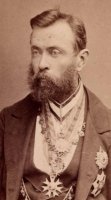
Ferdinand von Mueller in 1876. The photographer was the German-Australian J.W. Lindt.
Photo: La Trobe Picture Collection, State Library of Victoria)
Ferdinand Jakob Heinrich von Müller (1825-1896) was appointed Government Botanist in the Colony of Victoria in 1853. He had arrived in Australia at Port Adelaide six years earlier on 18th December 1847 on the Hermann von Beckerath, leaving Germany for health reasons.
Ferdinand Müller was born in the port city of Rostock on the 30th June 1825, the son of a customs commissioner. When Ferdinand was a boy his father died, and the family moved from Rostock to Tönning in the Duchy of Schleswig. At 15 years of age he became a pharmacist’s assistant in Husum and later studied Botany at the University of Kiel. While studying there he undertook plant-collecting trips through the countryside of Schleswig and on the island of Sylt. He completed his PhD with a dissertation on the plant life of the southern part of Schleswig.
Müller had difficulty with his lungs and a doctor advised him to move to a warmer climate. One of his sisters was also quite sickly, so he and his two sisters headed for South Australia in 1847. Immediately after arriving in Adelaide Müller found a job as an assistant to the pharmacist Moritz Heuzenröder, and he started exploring the hinterland of South Australia in his spare time, including the Flinders Ranges, an area that was not well-known at that time. On these journeys in the open air he also regained good health, and he gained experience which stood him in good stead for his later extended travels in the interior of Australia.
With his fellow-German Friedrich Krichauff (whom Mueller had got to know in Husum) he bought a piece of land of about eight hectares in size in December 1848, in the Bugle Ranges near Mount Barker. He built a hut there, in which he lived for a few months with his sister Klara. However, the life of a farmer did not suit him and he returned to his original job in Adelaide. After his naturalisation (becoming a British subject) in 1849 Müller changed the spelling of his name to Mueller.[2]
From 1857-73 he was director of the Melbourne Botanical Gardens and was a well-known personality. He travelled extensively in Australia collecting specimens of animal and plant life and classifying them for the scientific world. Several of his suggestions had practical benefits for agriculture in Australia. 'Typical of his times was Mueller’s pragmatic interest in plants — he was forever on the lookout for new useful plants. Plants of medicinal, food or timber value were of economic interest to the colony and mother England.'[3]
The Director's House, within Melbourne's Botanical Gardens, was built for Mueller in 1854 as his office and residence. The double-gabled house in the Italianate style was lived in by later directors of the Botanic Gardens also, until the year 1991.
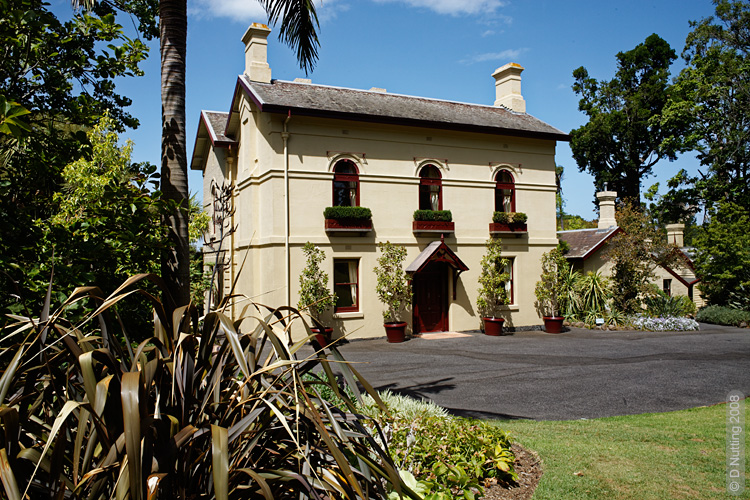
The director's house in the Botanic Gardens of Melbourne, which the government of Victoria built for Mueller
In 1855 he was appointed botanist of the North West Australia Expedition led by A. C. Gregory. On this journey of exploration that covered 8,000 km over 16 months Mueller collected nearly 2,000 species of plants. He sent huge amounts of plants and seeds to grateful public gardens, herbaria, institutes and individuals throughout the Australian colonies and overseas. Blue Gums in California are one result of his international exchanges of plant specimens.[4]
In 1996 Rita Erlich wrote about Mueller's contribution to public gardens in Victoria:[5]
The historic botanic gardens in Malmsbury, Castlemaine, Kyneton, Bendigo, Daylesford and Ballarat and other regional cities are a tribute to the great man. He died a century ago, on 10 October, 1896. But for him, public gardens all over the state would be lesser places.
Rita Erlich
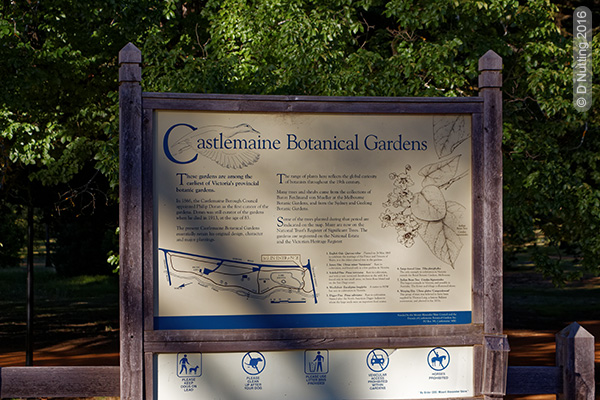
The information sign at the entrance to the Botanical Gardens of Castlemaine in Central Victoria - it mentions Mueller's contribution of plants and seeds.
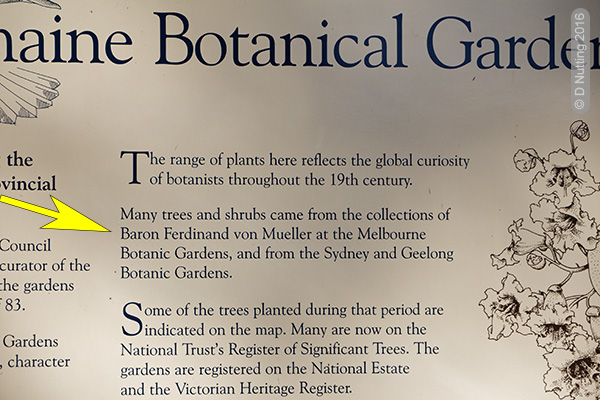
Close-up view: the sign at the Botanical Gardens of Castlemaine emphasises Mueller's contribution.
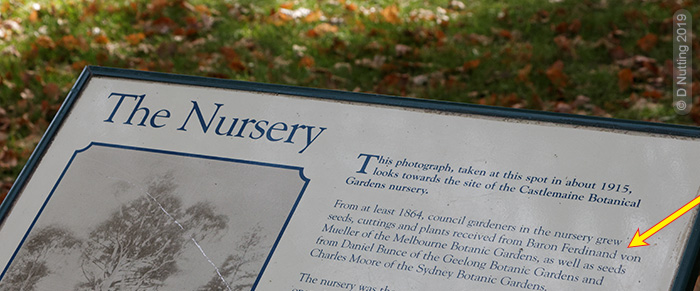
An information sign about the history of the nursery in the Botanical Gardens of Castlemaine notes Mueller's contribution to the development of the Gardens.
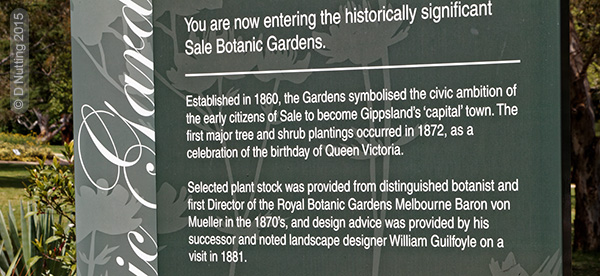
An information sign in the Botanical Gardens of the city of Sale in Gippsland honours Mueller's support of the Gardens.
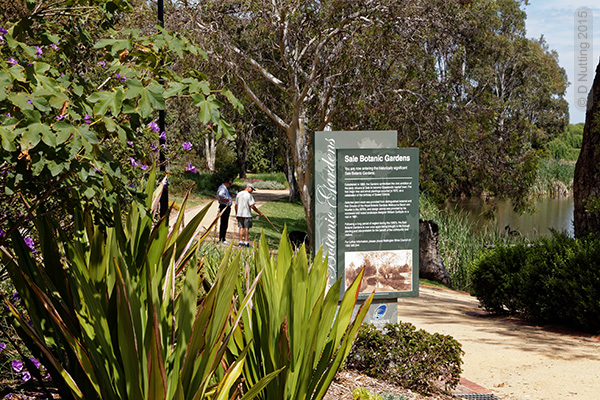
View of the Botanical Gardens in Sale (Gippsland)
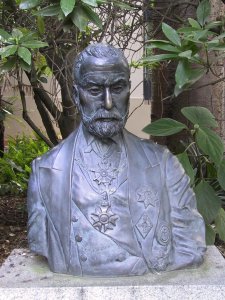
Bust of von Mueller in the Melbourne Botanical Gardens.
Here is the text on the plaque below the bust:
"This plaque commemorates the life work of one of the "fathers" of the Garden State. Baron Ferdinand von Mueller, K.C.M.G., 1825-1896. This distinguished botanist and explorer was the founder of the National Herbarium of Victoria. As Director of the Melbourne Botanic Gardens from 1857-73, he was directly involved in their laying out and planting. During this period he also supplied the highest quality plants to the regional botanic gardens throughout Victoria. His dedication to the concept of the Garden State is enshrined in the beauty of these gardens and by the many fine trees of his selections which remain standing today. Baron Ferdinand von Mueller's great contribution to our quality of life is honoured here by the following members of the German-Australian business community. Their generosity during Victoria's 150th year has enabled the re-labelling of plants and the rejuvenation of provincial botanic gardens throughout the State to be undertaken for the enjoyment of all Victorians."
He became well-known internationally, and King Karl I and Queen Olga of the
German kingdom of Württemberg made Mueller a Freiherr (baron) in 1871, in gratitude for his large donations of botanical specimens
from Australia. In the desert of central Australia there is a well-known group of soaring rock domes, which have always had the name Kata Tjuta. The first non-Aboriginal person to see them was the explorer Ernest Giles, in October 1872. Ferdinand von Mueller had organised the finance for Giles' expedition and asked Giles to name the impressive group of huge rocks after Queen Olga of Württemberg.[6] The rocks are known today by dual names, Kata Tjuta / Mount Olga.
In Giles' book about his expeditions he called Queen Olga of Württemberg and her husband, King Karl I, "enlightened royal patrons of science".[7]
Mueller received decorations and titles from many small and great European countries. His German and other European scientific contacts were of immense value to Australian science.[8]
.jpg)
The European name of Kata Tjuta / Mount Olga is closely connected with Ferdinand von Mueller. The photo shows the famous rock formations at sunset (aerial view from the west).
Photo source: Wikimedia Commons / Dimageau [Creative Commons Attribution-Share Alike 4.0 International license]
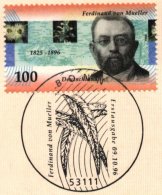
German stamp (1996) commemorating von Mueller
(Picture provided by Paul Griffin)
See also the following sources:
For students and teachers the curriculum package Bäume, Büsche, Blumen is also of interest (Royal Botanic Gardens Education Service, teachers of German, Directorate of School Education and Goethe Institut Melbourne, 1996).
♦ Notes:
1. Wallis, Rob. (2007). Baron Sir Ferdinand von Mueller – His Wide Influence as Director of Melbourne’s Botanic Gardens and Government Botanist. Newsletter, issue #43, Friends of Warrnambool Botanic Gardens. (Warrnambool, Victoria) p.3
2. ostsee.de INFO GmbH
3. Gillbank (1992), p.474 <https://www.biodiversitylibrary.org/page/51351191>
4. Morris (1974) - ADB
5. Erlich, R. (1996, October 05). Man of flowers and trees; Victoria: [late edition]. The Age. Accessed at the website of proquest.com.
6. Giles, Ernest. (1889). Australia twice traversed: the romance of exploration, being a narrative compiled from the journals of five exploring expeditions into and through central South Australia and Western Australia from 1872 to 1876. London : Sampson Low, Marston, Searle & Rivington. Introduction, p.l (Roman numeral 50)
7. Giles (1889), p.100
8. Morris (1974) - ADB
♦ References:
Ferdinand von Mueller (ostsee.de INFO GmbH » Hansestadt Rostock » Berühmtheiten). (accessed 09/03/2022)
Friends of St Kilda Cemetery. (no date). 'The Botanist'. (accessed 13/05/2014)
Gillbank, Linden. (1992). Alpine botanical expeditions of Ferdinand Mueller. Muelleria: An Australian Journal of Botany. Vol. 7, #4: pp.473-489.
Lodewyckx, Prof. Dr. A. (1932). Die Deutschen in Australien. Stuttgart: Ausland und Heimat Verlagsaktiengesellschaft. pp.208-212
Morris, Deirdre. 'Mueller, Sir Ferdinand Jakob Heinrich von (1825–1896)', Australian Dictionary of Biography, National Centre of Biography, Australian National University, published in hardcopy in 1974 (accessed 13/05/2014)
Tampke, Jürgen and Colin Doxford. (1990). Australia, Willkommen. Kensington (NSW): New South Wales University Press. pp.53-56