Names
Australian Placenames of German Background
Lobethal, South Australia
Lobethal is a town in the Adelaide Hills, about 25km east-northeast of the centre of Adelaide.
In May 1841 almost 300 people under the leadership of Pastor Gotthard Fritzsche boarded river barges at Tschicherzig (now in western Poland and called Cigacice in Polish) for the trip to Hamburg, and on 11 July their voyage to South Australia on the ship Skjold began. They arrived at Port Adelaide on 27th October 1841. Some of those people established a village which they called Lobethal.[1]
When the 18 German families arrived at the Onkaparinga River, where they established Lobethal, Pastor Fritzsche held an open-air service of thanksgiving on 4th May 1842. He read out the following verse from the bible, from Martin Luther's German translation of the bible:
And on the fourth day they assembled themselves in Lobethal; for there they blessed the Lord.
Therefore the name of the same place was called Lobethal unto this day.(Book 2 of Chronicles, chapter 20, verse 26.)
(In many English translations of the bible the above verse calls the place Valley of Beracah = valley of praise = Lobethal.)
Therefore Pastor Fritzsche named the new settlement in the Mount Lofty Ranges Lobethal.
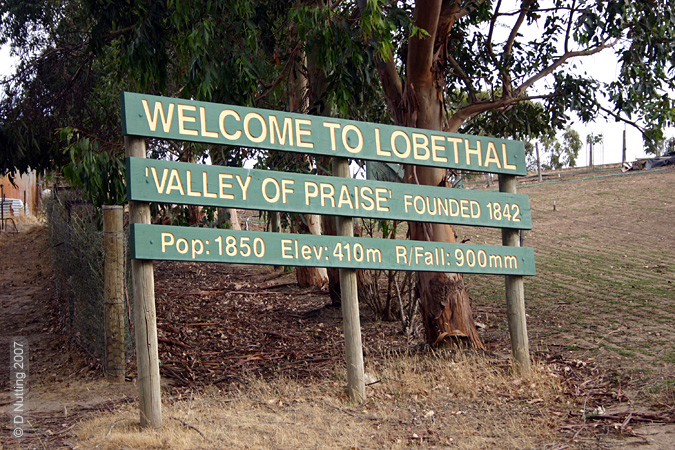
Town sign at entrance to Lobethal
In 1918 during the First World War the South Australian government passed a law that changed South Australian place names that were considered to be of “foreign enemy origin”. Lobethal was renamed Tweedvale.[2]
In the 20th century Lobethal was known among other things for the manufacture of cricket bats. The cricket bats in the photo below bear witness to the place name Tweedvale. The bats were manufactured during the years when the town was called Tweedvale. Carl Ferdinand 'Carpenter' Kumnick, born in the Flatow District in Prussia, ran a carpentry business in Lobethal. In 1895 his son Ewald Kumnick took over the carpentry business and began making cricket bats. In the beginning he used a corner of a disused church building but later moved to larger premises. At the business's peak it was producing over 15,000 bats a year and employed 16 men. Its cricket bats were sold all around Australia and even overseas. The factory finally closed in the 1950s.[3]
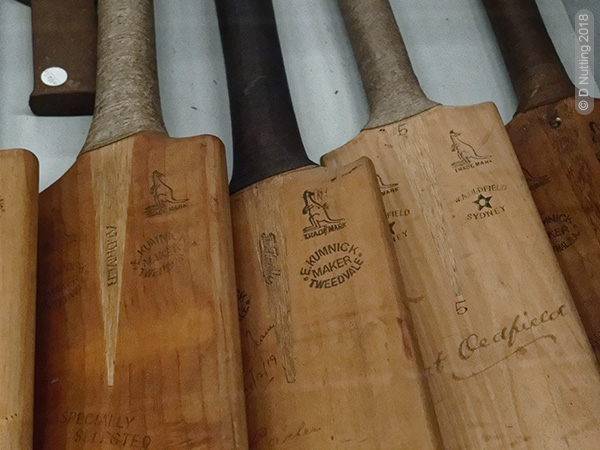
Cricket bats manufactured during the time when Lobethal was called Tweedvale.
A journalist for the Adelaide newspaper Chronicle wrote informal blog-style articles about South Australian towns in the 1930s. He was Harold O. Sexton but his writing appeared under the pseudonym “Our special representative”.[4] Sexton wrote about Tweedvale/Lobethal in 1933, and was not a fan of the name Tweedvale. He wrote: “To me the name "Tweedvale" will always be a meaningless abnomination —just as sensible as "Beerville," or "Tallowtown," or such, similarly descriptive nomenclature. (...) I much prefer the former name of Lobethal. Some day, I hope, we as a community will have sufficient sense to restore these old names, which have a real significance.”[5]
In December 1935, in the lead-up to the 100th anniversary of the State, the South Australian government reinstated the name Lobethal (as well as the names of Hahndorf and Klemzig).
◀ Placenames in South Australia...
♦ Notes:
1. Leske (1996), p.37
2. 'Report on enemy place names'. Parliamentary paper (South Australia Parliament); no. 66 of 1916, p. 1-4. In website SA Memory - South Australia : past and present, for the future. (State Library of South Australia).
3. 'Adelaide Hills German tradition of cricket bat making through the Kumnick and Fielke families since 1894'. Adelaide AZ website. Article online here.
4. Wilson, David. (n.d.). Our Special Representative. In SA history articles (website).
<https://sites.google.com/site/sahistoryarticles/sa-history-articles/our-special-representative>
5. TOWNS, PEOPLE, AND THINGS WE OUGHT TO KNOW (1933, October 12). Chronicle (Adelaide, SA : 1895 - 1954), p. 46. Retrieved September 9, 2023, from <http://nla.gov.au/nla.news-article90952203>. Subheading: "Tweedvale, Formerly Called Lobethal. STRIKING STORY OF A PROGRESSIVE HILLS CENTRE. By OUR SPECIAL REPRESENTATIVE."
♦ References:
Leske, Everard. (1996). For Faith and Freedom: the Story of Lutherans and Lutheranism in Australia 1838-1996. Adelaide: Openbook Publishers.