Victoria

J. A. B. Koch, architect

Johann (John) Augustus Bernard Koch (1845–1928), an architect, was born on 27 August 1845 in Hamburg. His family emigrated to Melbourne in 1855. On 26 October 1871 he married Anna Püttmann, who was from Switzerland, at the Melbourne Lutheran Church. Many of the buildings he designed, including homes and commercial properties, show distinctive German and European decorative features.
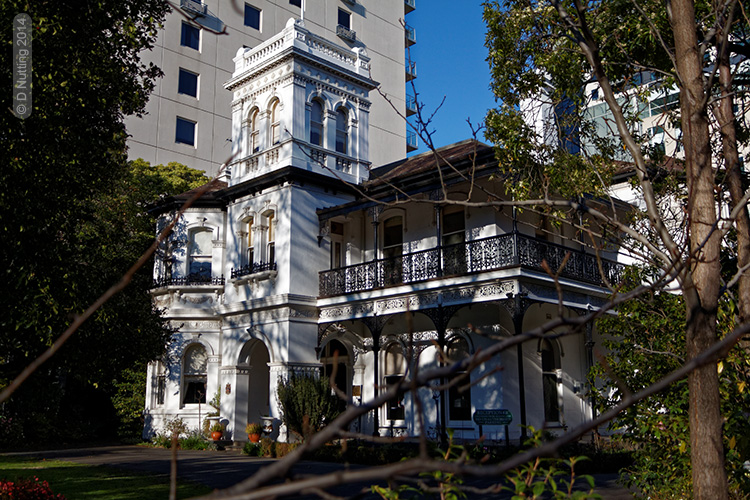
Photo © D Nutting: mansion

'Ulimaroa', St Kilda Road, Melbourne

'Ulimaroa'

Koch designed the house 'Ulimaroa' in the late 1800s for a successful businessman. It was one of many mansions with spacious grounds that were built on the prestigious St Kilda Road. It is historically important as it is one of the few surviving mansions of this type on St Kilda Road and "because of its fine architectural detailing, which is attributed on stylistic grounds to the architect JAB Koch".[1]

In 1873 Koch was appointed architect to the City of Melbourne. He was highly versatile, designing buildings in a range of styles such as Gothic, Renaissance, and Hellenistic. Many of his houses and shops featured classical Greek designs, often seen on parapets and rooftops.
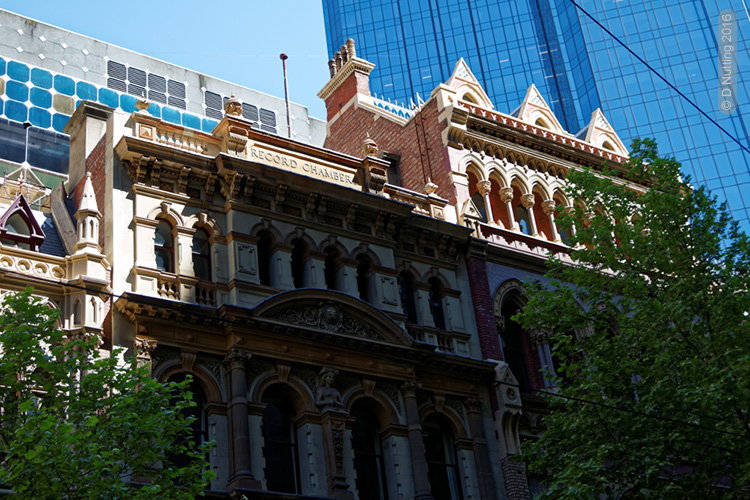
Photo © D Nutting: office buildings

The Record Chambers, Collins Street, Melbourne

Record Chambers

A bold expression of the economic success and the boom years of the colony of Victoria in the later years of the 19th century is the Rialto block of office buildings in Collins Street, Melbourne. The Rialto block consists of multiple buildings, designed by various architects.[2] One of those is the four-storey Record Chambers, "adorned with doric pilasters, dentil cornice, panelled frieze, floriated scrolls and caryatids."[3] In 1887 Koch designed this building in Collins Street for the printing and publishing firm of McCarron, Bird & Co., which was an important publisher of insurance and banking journals in Australia.[4]

Koch became a justice of the peace in 1866 and served as a Richmond city councillor from 1877 to 1885. From 1903 to 1904 he was president of the Royal Victorian Institute of Architects. He was also a prominent figure in Melbourne’s German community and designed the German Club building in Alfred Place in the city centre. Originally, the building had only one storey.
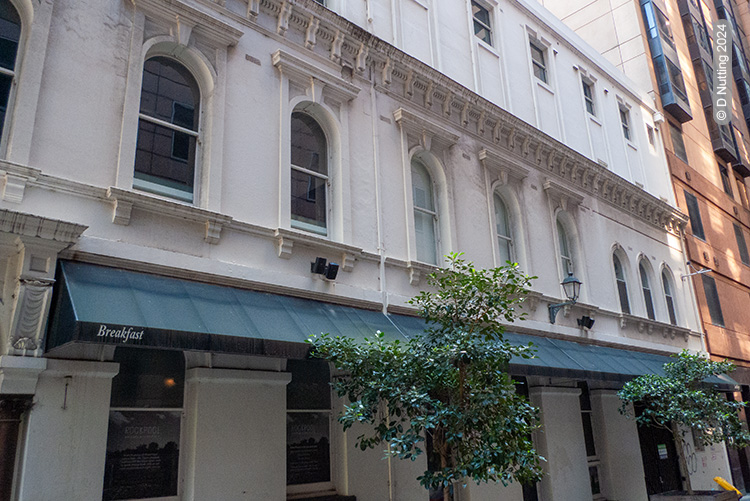
Photo © D Nutting: building

The former German Club, Alfred Place, Melbourne

German Club

The first floor of this building was built in 1885 for the German Club, and it included a lecture hall in which people like Ferdinand von Mueller delivered talks. Its facade is a fine example of the Renaissance Revival style. The anti-German atmosphere of the First World War forced the German Club out, and the building was later used by the Naval and Military Club (which was a meeting place for military officers), and still later by a restaurant named 'Mietta’s'. The building is among the small number of surviving 19th century club buildings in Melbourne.[5]

Koch’s grandchildren "loved him for his family dinners, German food and customs".[6]
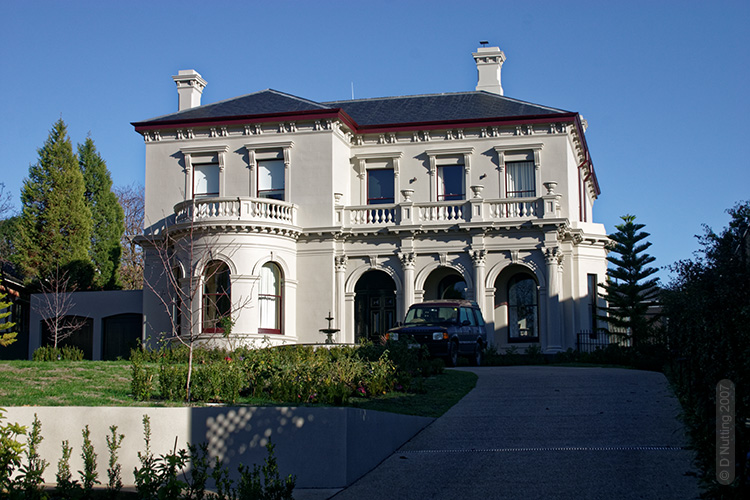
Photo © D Nutting: house

The house 'Borussia', Hawthorn, Victoria.
'Borussia'

The house `Borussia' in Hawthorn was built in 1879 to the design of J. A. B. Koch for William Alexander Brahe, a well-known lawyer and leader of the German community in Melbourne. Some parts of the house have been changed, but the arcaded single-storey verandah and the semi-circular bay window "display the bold use of architectural elements for decorative effect typical of Koch's work". W A Brahe's house, 'Borussia', was a centre of German cultural and social life in Melbourne from the time of its construction until the strong anti-German atmosphere of World War I suppressed German culture in Australia. The name Borussia is Latin for Prussia.[7]

Photo © D Nutting: mansion

'Labassa', Caulfield North, Melbourne
'Labassa'

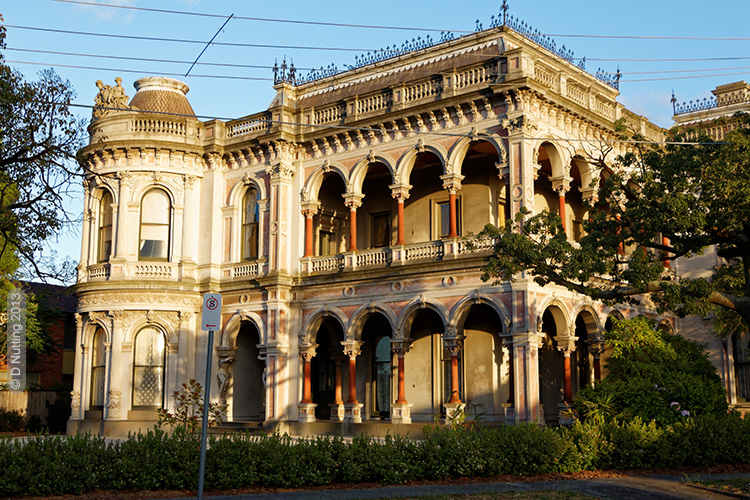
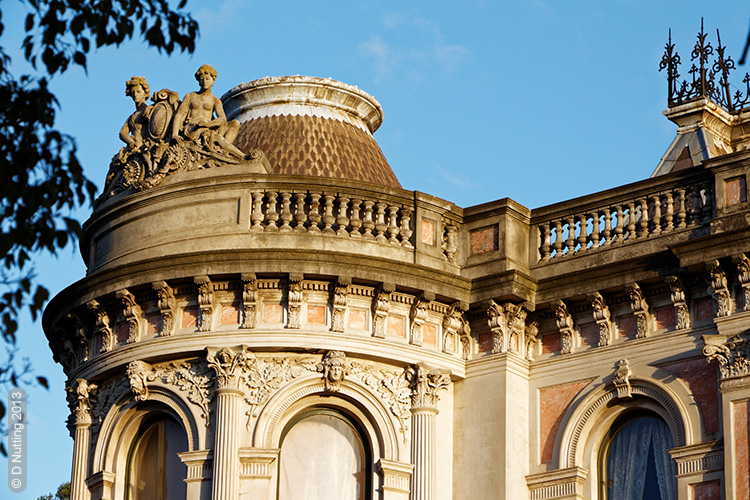
Perhaps the most famous home designed by Koch is Labassa in Caulfield, owned by the National Trust. Koch was commissioned in 1889-90 to extensively expand and remodel an existing house there and turn it into the thirty-five roomed mansion known today as Labassa. The Victorian Heritage Database describes Labassa as "one of Melbourne's most lavishly decorated nineteenth century mansions" and "the most prominent example of a small number of houses built in Australia in the French Renaissance style. It is of further note due to the German interpretation of the style and the use of Hellenistic sources, via Germany."[8]

Photo © D Nutting: mansion

'Labassa', Caulfield North, Melbourne
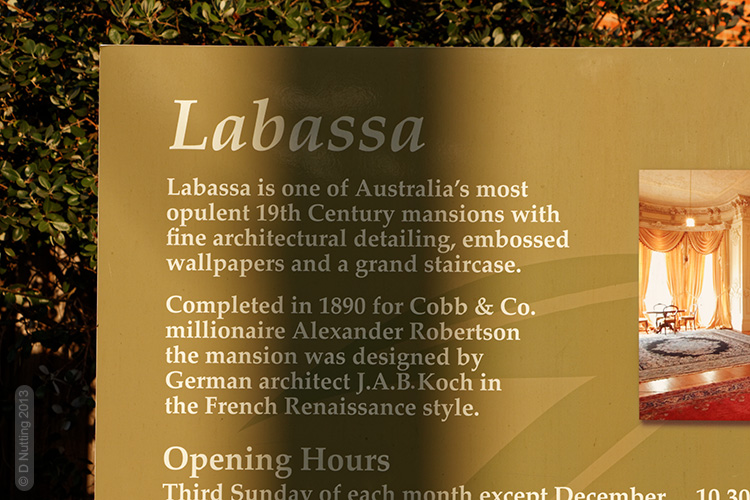
Photo © D Nutting: sign

Informational sign by the National Trust at 'Labassa', Caulfield North, Melbourne

♦ Notes:

1. Victorian Heritage Database Report. (2000). Ulimaroa. Listing on the Victorian Heritage Register. Accessed on 18/01/2025 from: <https://vhd.heritagecouncil.vic.gov.au/places/1120/download-report>

2. Jackson, Davina. (2022). Australian architecture : a history. Crows Nest (NSW) : Allen & Unwin. p.130

3. Forge (1983)

4. Victorian Heritage Register. (1999). Victorian Heritage Database Report. Record Chambers. <http://vhd.heritagecouncil.vic.gov.au/places/738/download-report> VHR #H0038. Accessed 21/11/2016.

5. Melbourne Heritage Action. 'Interiors'. <melbourneheritageaction.wordpress.com/current-campaigns/interiors/>. Accessed 18/01/2025. / Victorian Heritage Database. Former German Club, 7 Alfred Place, MELBOURNE VIC 3000 - Property No B5043. <vhd.heritagecouncil.vic.gov.au/places/64308>. Accessed 18/01/2025.

6. Forge (1983)

7. Victorian Heritage Database, Heritage Victoria. 'Borussia'. <vhd.heritage.vic.gov.au/places/result_detail/65142> Accessed 27/11/2014.

8. Victorian Heritage Database, VHR #HO135. 'Labassa'. <https://vhd.heritagecouncil.vic.gov.au/places/278> Accessed 24 November 2024.

♦ References:

Forge, W. (1983). 'Koch, John Augustus Bernard (1845–1928)', Australian Dictionary of Biography, National Centre of Biography, Australian National University, <https://adb.anu.edu.au/biography/koch-john-augustus-bernard-6995/text12159>, published first in hardcopy 1983, accessed online 23 November 2024.

Tampke, Jürgen. (2006). The Germans in Australia. Port Melbourne (Victoria): Cambridge University Press. pp.98-99