Cornelia Rau
Australian permanent resident in migration detention
Cornelia Rau emigrated with her parents from Hamburg to Australia in 1967 at the age of 18 months. The case of this 39-year-old mentally ill German-Australian permanent resident, who was at first locked up in prison and in the end kept in solitary confinement in a detention centre for allegedly illegal immigrants on the edge of the outback, caused consternation and headlines in Australia and around the world, because the case cast a light on conditions in Australia’s detention centres for asylum seekers.
Ms Rau was still working in the year 2000 as a flight attendant with the Australian airline Qantas, but in the first few years of the new century she became mentally ill and suffered from schizophrenia. On the 17th March 2004 she slipped away from the psychiatric wing of Manly Hospital in Sydney, and later the New South Wales Police put her on the list of missing persons.[1]
Ms Rau travelled from Sydney into tropical Far North Queensland (Cape York) and spent time near a settlement of indigenous Australians. They were concerned by the behaviour of Ms Rau (not least because she was travelling alone and it was the start of the wet season in that part of Australia) and they informed the local police of her presence. Cornelia Rau apparently was carrying no legal identity documents with her (or had false documents with her) and told the local police that she was a German citizen named Anna Schmidt, who was from Munich and travelling as a tourist. This was the origin of the suspicion that Cornelia Rau (who did not use her own name and used rather the made-up names Anna Schmidt and Anna Brotmeyer) was an illegal immigrant.[2]
The Honorary Consul for Germany in the north Queensland city of Cairns, Ms Iris Indorato, conducted a two-hour conversation with Ms Rau in German but could not establish her identity. The consul noticed Ms Rau’s child-like German, in terms of sentence structure and vocabulary. Subsequent attempts by the German Embassy to confirm Rau’s German identity were unsuccessful.[3]
As Cornelia Rau spoke German and because it was not possible to confirm her identity and she was considered to be most likely an illegal immigrant, the Australian immigration authorities initially sent her to the Brisbane Women's prison at Wacol in Queensland. Queensland had no detention centre for “illegal immigrants, and the women’s prison at Wacol had no separate area for asylum seekers – therefore the prison decided to accommodate her among the general prison population. She stayed there for six months without any court proceedings or charges being laid. Prison life caused a deterioration in her illness and made her nightmares and fears of persecution worse. The immigration authorities described her behaviour merely as ‘strange’. She “was showing distressing signs of what prison records called ‘unusual behaviour and poor hygiene’. She paced; she stared; she hoarded food; her moods swung about; she wouldn't wash”.[4] The authorities never investigated her mental state thoroughly. Instead Ms Rau was taken to the asylum seeker detention centre Baxter, located on the edge of the desert in the state of South Australia. At Baxter Cornelia Rau experienced solitary confinement.
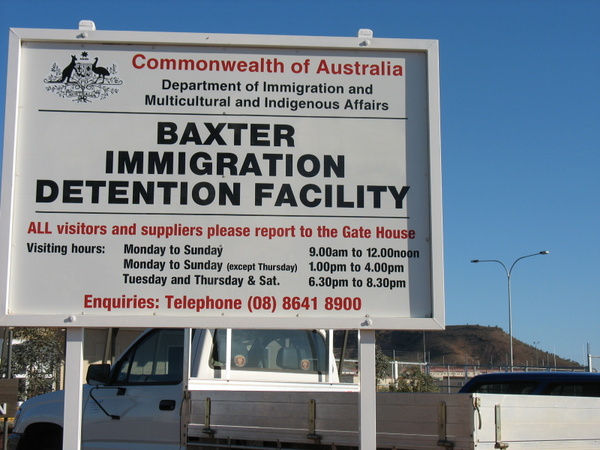
Sign in front of the Baxter Detention Centre, photographed on 04/08/2006 by Gerry Considine.
Image: Wikimedia Commons, Public Domain
On 20th January 2005 the German consulate informed the Australian immigration authorities that ‘Anna’ was in their estimation most likely a permanent resident who had been in Australia for many years, who had probably immigrated with her parents as a child. Four days later the consulate told the authorities (Department of Immigration and Multicultural and Indigenous Affairs) that they were not able to put any further work into the case according to international law, as there was no basis on which to conclude that ‘Anna’ was a German citizen.[5]
Other asylum seekers in the Baxter centre, for example from Iraq and Afghanistan, were concerned about the ill German-Australian and in the end told refugee advocates from Australian church organisations of their concern for the welfare of Ms Rau.
In January 2005 Pamela Curr, a particularly active advocate for refugees and detention rights, was very worried about the stories she had heard about a very ill young German woman. She went to great lengths to make information about ‘Anna’ accessible to the general public. This caught the attention of the journalist Andra Jackson and on 31st January an article about the strange story of Anna appeared in the major daily newspapers The Age (Melbourne) and Sydney Morning Herald. The article in The Age bore the title "Mystery woman held at Baxter could be ill."[6]
Cornelia’s parents Edgar and Veronika were on holiday in early February, und family friends sent them the newspaper article. Could this mysterious young German woman named Anna actually be Cornelia? Cornelia’s mother got in touch with the police in the Sydney suburb of Manly at 2pm on the 3rd of February. The Baxter detention centre sent the police by email a photo of Anna and the police passed the photo on to the Rau family. In that photo was their daughter Cornelia.
The South Australian police promptly collected Cornelia from Baxter and took her by plane to the Glenside Psychiatric Hospital near Adelaide
There was outrage in Australian society when Cornelia’s experiences in prison in Brisbane and later in the detention centre at Baxter became public knowledge. This led to the establishment by the government of a Commission of Inquiry led by former Australian Federal Police commissioner Michael John "Mick" Palmer into the unlawful detention of Cornelia Rau.
Report of the Commission of Inquiry
When the report of the inquiry was published the Australian Prime Minister John Howard apologised to Cornelia Rau. Mick Palmer strongly criticised the refugee policies of the government and various changes to procedures and policies were carried out.[7] Above all Palmer criticised the attitude and approach of the immigration officers: from the start they assumed that Ms Rau was an illegal immigrant, a backpacker who had overstayed her visa, and focused their efforts on deporting her rather than acknowledging the possibility that she might be Australian.
The report of the Commission of Inquiry ('Palmer Report') poses on its first page the questions as to how it could be that an Australian permanent resident of German origin could be detained in prison in Queensland for six months and at the Baxter Immigration Detention Facility for four months and not be identified for all that time, and how could it be that this person’s long-standing medical condition remained undiagnosed.[8] The report also mentions examples of some factors that made the case complicated:
- in various recorded interviews 'Anna' talked in accented English and also with no accent whatsoever.[9]
- a DIMIA (Department of Immigration and Multicultural and Indigenous Affairs) Canberra officer who visited the Baxter detention centre on the 20th October 2004 directly asked 'Anna' if she is Australian; Anna did not respond.[10]
- Cornelia's family reported her to the police as a missing person almost five months after she had been interviewed in Far North Queensland. "Although they were worried about Ms Rau, her family — knowing her behaviour patterns, including her resistance to treatment and the fact that in the past she had always made contact with them if she ran into trouble — did not immediately report her to police as a missing person."[11]
The report mentions three important factors which made it difficult to link 'Anna' with Cornelia Rau:
- the person Cornelia Rau presented as Anna does not exist.
- too much reliance, over too lengthy a period, was placed on the information Anna provided.
- the identification process was ad hoc, unstructured and unmanaged.
The report then emphasised the following: "Anna did not want to be found. We do not know why."[12]
♦ Notes:
1. Sydney Morning Herald (2005). Cornelia Rau: the verdict. pub. 18/07/2005. [accessed 17/12/2019]
2. Palmer, Mick (2005). Report of the Inquiry into the Circumstances of the Immigration Detention of Cornelia Rau. ("Palmer Report") p.9
3. Palmer Report, pp.10-11
4. Sydney Morning Herald (2005). Cornelia Rau: the verdict. pub. 18/07/2005. [accessed 17/12/2019]
5. Palmer Report, p.17
6. Palmer Report, p.19
7. Palmer Report, p.81
8. Palmer Report, p.1
9. Palmer Report, p.106
10. Palmer Report, p.15
11. Palmer Report, p.2
12. Palmer Report, p.95
♦ References:
Palmer, Mick (2005). Inquiry into the Circumstances of the Immigration Detention of Cornelia Rau (PDF archived online). Department of Immigration and Multicultural and Indigenous Affairs.
Manne, Robert (2005). The unknown story of Cornelia Rau. In: The Monthly (September 2005), pp. 20-33