Bendigo Town Hall
Wilhelm Vahland & Otto Waschatz
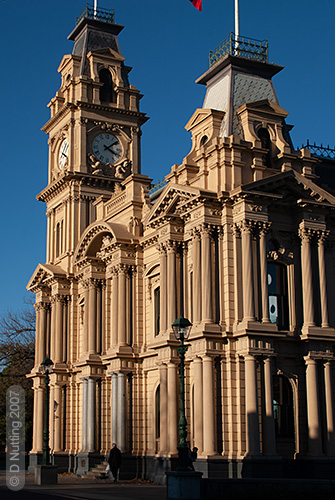
Bendigo Town Hall, Victoria (view from the front)
The original town hall, designed in 1859 by George Avery Fletcher, was a basic smaller two-storey building in the Italianate style. Additions, including a large room about the size of today's main hall occurred between 1866 and 1872, but the population of Bendigo was unimpressed by the building and felt that it did not reflect the status of the booming 'city of gold'. In the late 1870s Wilhelm Vahland was commissioned to restyle the town hall. He retained the existing walls but made the exterior and the interior more ornate, and he added towers, a mansard roof and made other improvements.[1] (mansard roof = a folded roof surface with a particularly steep lower section and a flatter upper roof - particularly associated with French architectural styles)
Vahland also commissioned Otto Waschatz to decorate the interior of the main hall. Waschatz was a German artist and plaster modeller, who had arrived in Australia in 1877 and was working as a lecturer at the Bendigo School of Mines. He had previously decorated the Royal Palace in Copenhagen, Denmark, and later he did the interior plaster work in the library of the Bendigo School of Mines, and he worked on the interior of the Melbourne Town Hall. He later set up a plastering business in Melbourne which was very successful by 1914. However, the anti-German hysteria of the First World War ruined his business.[2] Waschatz was a friend of another German in Victoria who decorated the interiors of buildings, the wood-carver Robert Prenzel.
The elaborately decorated Bendigo Town Hall demonstrates the prosperity of Bendigo as a provincial city, particularly in the 1870s and 1880s, and its interiors make the Town Hall one of the finest municipal buildings in Victoria.[3]
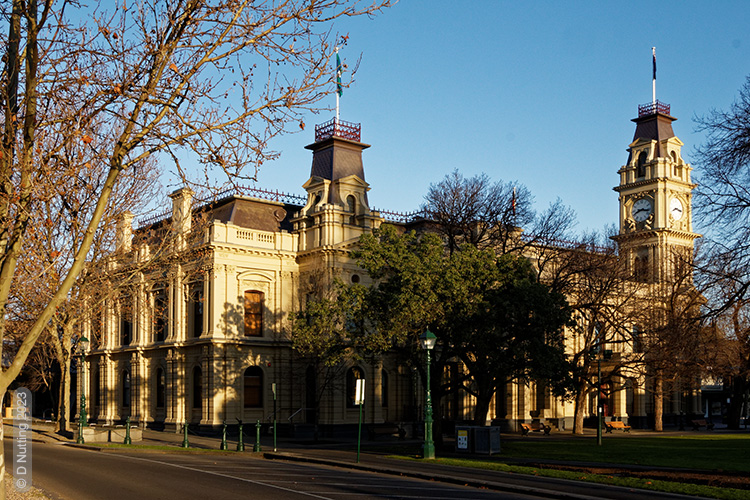
Bendigo Town Hall, Victoria (view from the rear)
A book about Victoria's central goldfields area described the interior of the Town Hall as follows: "Nothing can prepare the visitor for the impact of the hall within the building. There are gilt plaster cherubs above each doorway, a coffered ceiling with gilt pendants, and Gothic arches above each window. It is overwhelmingly beautiful, and expresses in an instant the fabulous wealth of the gold boom."[4]
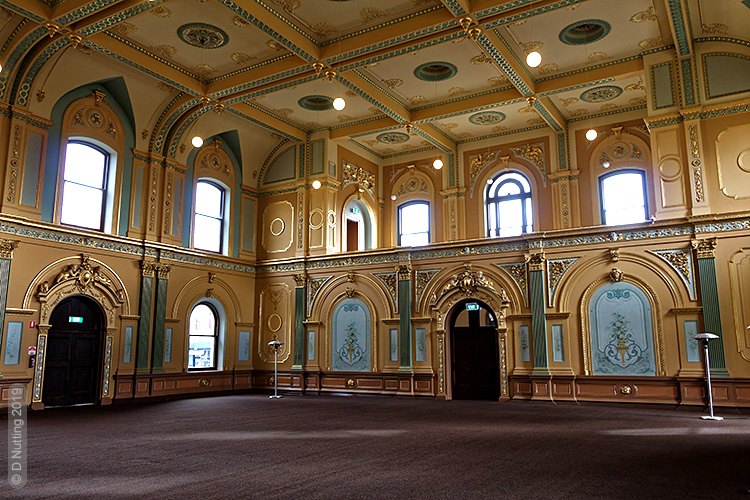
Bendigo Town Hall, Victoria (main hall, interior decoration by Otto Waschatz)
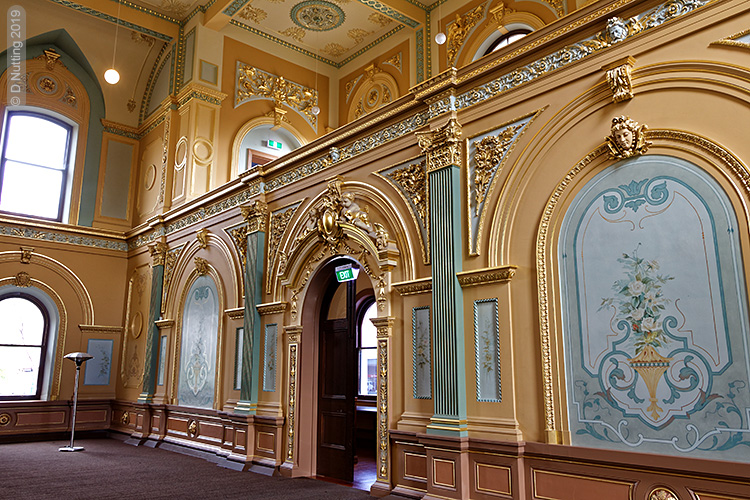
Bendigo Town Hall, Victoria (main hall, interior decoration by Otto Waschatz)
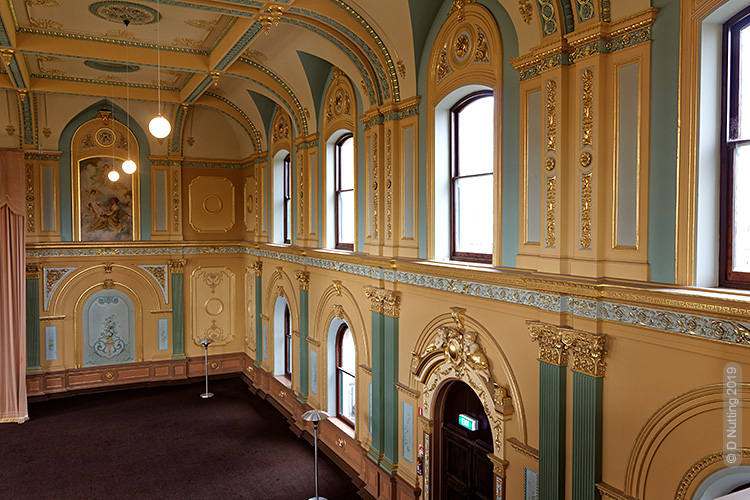
Bendigo Town Hall, Victoria (main hall, interior decoration by Otto Waschatz)
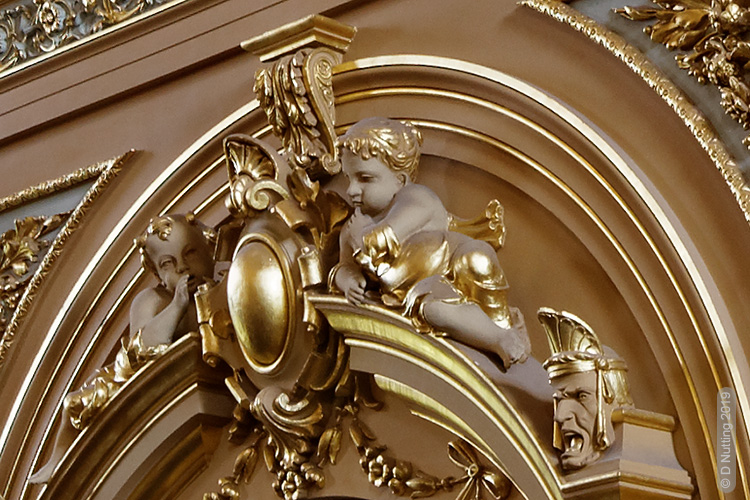
Bendigo Town Hall, Victoria (main hall, interior decoration by Otto Waschatz)
♦ Notes:
1. Butcher (2020).
2. Cluff, Caleb. (2015, May 25). Rediscovered bust tells a darker story. Written for ABC Local, Central Victoria. Available online at <www.calebcluffmedia.com/abc-local.html>
3. Bendigo Town Hall. Victorian Heritage Database Report. (Report generated 22/05/25). Victorian Heritage Register (VHR) Number H0117. <https://vhd.heritagecouncil.vic.gov.au/places/125/download-report>
4. Everist, Richard (2006). The traveller's guide to the goldfields : history & natural heritage trails through Central & Western Victoria. Geelong West (Victoria): Best Shot! Publications Pty Ltd. p.151
♦ References:
Butcher, Mike. (2020). A Hall of Fame: Bendigo Town Hall. History News (newsletter of the Royal Historical Society of Victoria Inc.). Issue 349. Melbourne: RHSV. pp.6-7