South Australia
Barossa-Germans and Wine
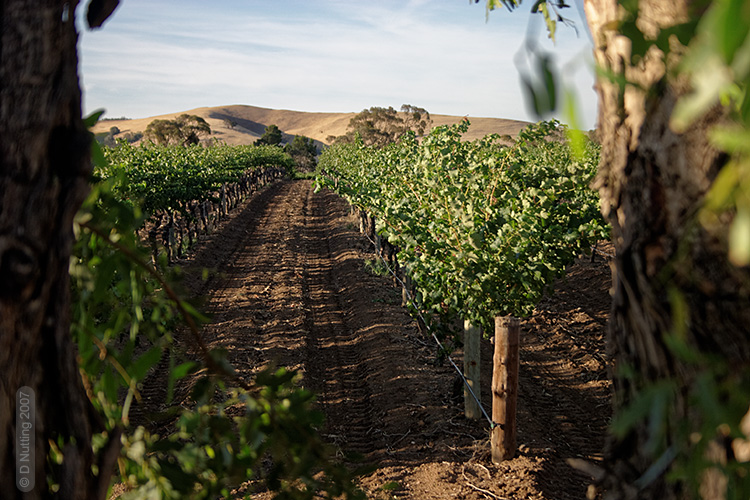
A vineyard in the Barossa Valley
The German mineralogist Johannes Menge was the first person who noticed the potential of the Barossa Valley (or New Silesia, as he called it) for wine-making. In 1840 he wrote to George Fife Angas of the South Australia Company to tell him that the climate and soils of the valley seemed well-suited to grape growing and wine-making.[1] German families in the Barossa in the 19th century did mixed farming, and many of them grew grapes and made wine for their own personal needs and for community celebrations rather than as a business operation. Many of the Lutheran immigrants in the valley were from Silesia and had knowledge and skills in wine-making; the vineyards of the hills around Grünberg in Silesia had long had a good reputation.[2]
The early winemaking companies in the valley relied on the wine-making knowledge and skills of the Germans and on the business investment of the English. The British settlers were mainly of the middle-class and had the money to establish commercial vineyards in order to sell wine.[3] Although the well-known names in the wine business in the valley today are usually part of large conglomerates who have operations in various parts of Australia, there are still small wineries that are run by descendants of the early German immigrants in the valley. For example, according to the winemaker Kym Teusner, the Riebke family have grown outstanding grapes in the Ebenezer district of the Barossa for six successive generations.
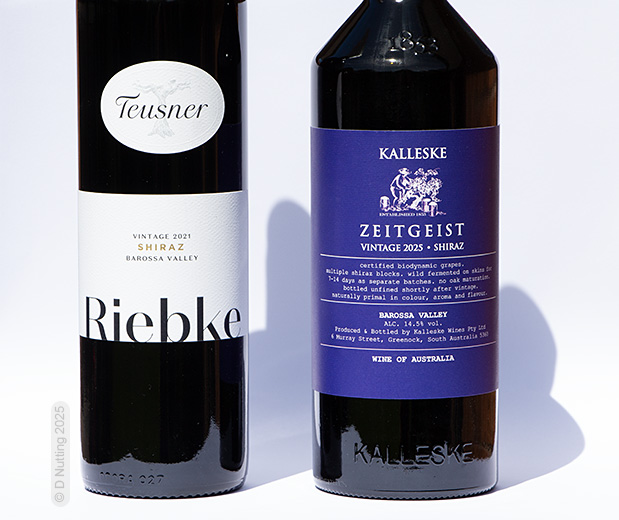
Two wine bottles as examples of relatively small wineries in the Barossa Valley that are run by German-descended winemakers.
The Silesian migrant Johann Christian Henschke established a mixed farm in 1861, and began making wine. Several generations of Henschkes later the family produces award-winning wines.[4] A particularly famous wine made by the Henschke family is a shiraz called 'Hill of Grace' (Gnadenberg in German). The small vineyard for this wine was planted in 1890 opposite the Zion Lutheran Church at Gnadenberg on the edge of the Barossa Valley.[5]
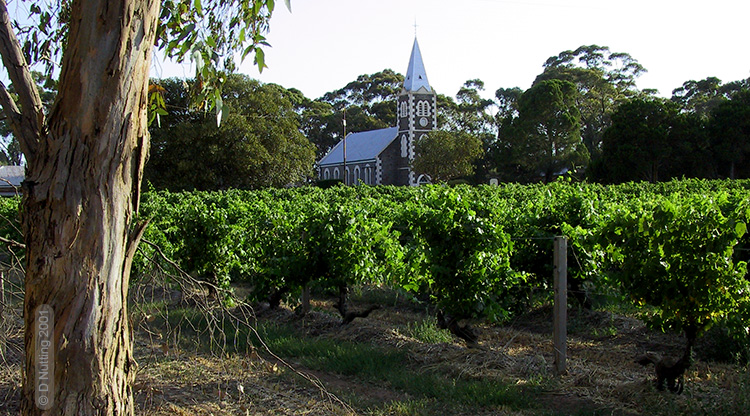
The Gnadenberg vineyard in front of the Zion Lutheran Church in the Barossa Valley
According to the winemaker Stephen Henschke, the early Barossa wine growers traditionally referred to their vineyard as their 'garden', and for this reason the Henschke family named one of their wines 'Johann's Garden' as as a tribute to the early Barossa Lutheran immigrants in the valley. Among these immigrants the males traditionally had Johann as their first name, and the first Henschke who made wine in the valley was also named Johann. (The German word Weingarten (literally 'wine garden') is another word for Weinberg (vineyard) and is perhaps used more often in southern Germany. There are also a few towns in southwestern Germany named Weingarten.)
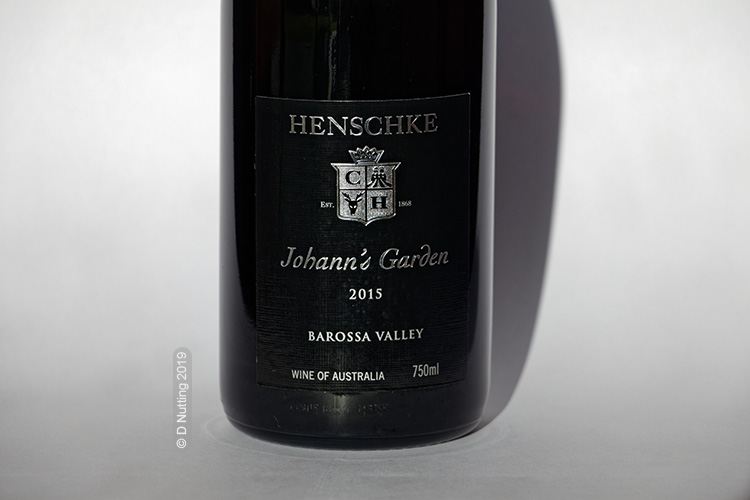
The label of the Barossa wine named Johann's Garden.
The first to grow grapes in the Barossa Valley was Johann Gramp, from the village of Eichig west of Kulmbach in northern Bavaria, who planted vines at Rowland Flat in 1847. Later Gramp's business became known as Orlando Wines. Joseph Ernst Seppelt, from the small town of Wüstewaltersdorf in Silesia, arrived in South Australia in 1849 with his wife Johanna Charlotte and their three children, and after initially trying to grow tobacco he established a successful vineyard at Seppeltsfield in the Barossa. Joseph Seppelt died in 1868 and his 21-year-old son Oscar Benno Pedro Seppelt took over the business with enthusiasm. Benno's wife bore 16 children, 13 of whom reached adulthood, and seven of the nine sons worked in the winery. Benno built up a very large wine-making company.[6] At the beginning of the 20th century Seppeltsfield had become the biggest wine-maker in the world and the Barossa Valley the 'vineyard of the Empire'.[7] Benno Seppelt was a pioneer in the use of mechanical equipment in his winery and he shared his knowledge with other winemakers in the Valley.[8]
Examples of later German names that became famous in the Barossa's wine-making industry are Hermann Paul Leopold Büring (who was born in Friedrichswalde in the state of Brandenburg in Germany, and whose wines are known by the name Leo Buring); Hermann Thumm, a German immigrant who established Chateau Yaldara in 1947; Peter Lehmann, who established Peter Lehmann Wines in 1979 (his father, Lutheran Pastor Franz Julius Lehmann, had himself planted a vineyard in the Eden Valley [adjacent to the Barossa Valley] in 1932); and Wolfgang Franz Otto Blass (Wolf Blass), who trained in wine-making in Germany before emigrating to Australia in 1961. In 1992 Blass received the International Winemaker of the Year award from the International Wine and Spirit Competition.
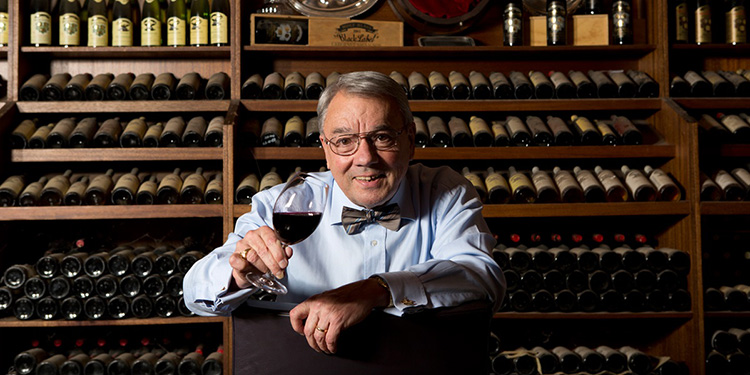
Wolf Blass
The photo appears here by kind permission of Wolf Blass Wines (2018).
♦ Notes:
1. Ioannou (2000), p.101
2. Ioannou (2000), p.102 / Munchenberg et al. (1992), p.54
3. Ioannou (2000), p.104 / Ward et al (2003), p.28 / Lodewyckx (1932), p.75
4. Ioannou (2000), p.108
5. Ioannou (2000), p.108
6. Munchenberg et al. (1992), pp.56-57
7. Schomann, Stefan. (1993). 'Kaiserstuhl im Barossa Valley'. In: GEO Special Australien. Nr. 6, Dezember 1993. Hamburg: Gruner + Jahr. p.80
8. Munchenberg et al. (1992), p.57
♦ References:
Ioannou, Noris. (2000). Barossa Journeys: into a valley of tradition. (Second edition) Sydney: New Holland Publishers.
Lodewyckx, Prof. Dr. A. (1932). Die Deutschen in Australien. Stuttgart: Ausland und Heimat Verlagsaktiengesellschaft. pp.75-76
Munchenberg, Reginald S et al. (1992). The Barossa, a Vision Realised. The Nineteenth Century Story. Barossa Valley Archives and Historical Trust Inc.
Ward, B. J. (Brian J.) & Heathcote, R. L. (Ronald Leslie) & Barker, Sue & Royal Geographical Society of South Australia. (2003). Discover the Barossa / editors: Sue Barker, Les Heathcote, Brian Ward. Adelaide : Royal Geographical Society of South Australia.