“Fancy” German beers no longer cool.
An impact of World War I on German Australia
Before the First World War beers from Germany (imported into Australia) and beers in German styles were considered the epitome of beer culture and the standard that Australian breweries should try to emulate. Australian brewers used the German names and the German spellings of beer styles because they were associated with high quality. An example of this can be seen in the spelling ‘bier’ used in this bar mirror produced by the Melbourne Brewery and Distillery Company towards the end of the 19th century.
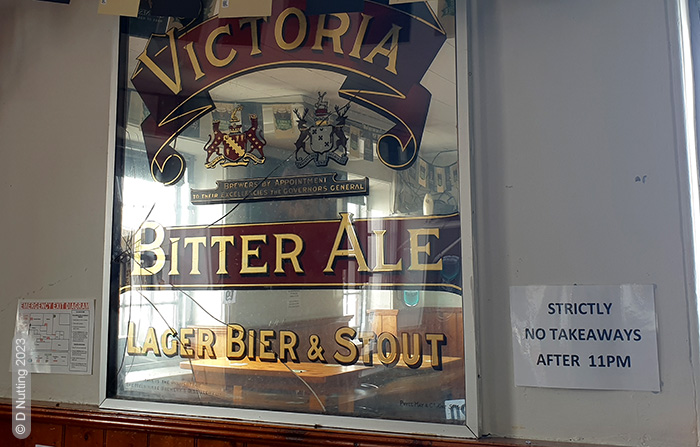
An Australian bar mirror of the late 19th century, with German beer terms.
It seems German lager was indeed prized by ‘Colonials’ in the late 19th Century, commanding a substantial premium over ‘colonial lager beer’ (...) Demand for imports even gave rise to a trade in counterfeit German beer.[1]
Matt Kirkegaard
In November 1914, not long after the start of the First World War, German beer culture became unfashionable in Australia. As John Molony (Emeritus Professor of History at the Australian National University) wrote: "Patriotism in many guises gripped scoundrels and the decent alike. Anyone or anything to do with Germany, whether person, place or product, suffered discrimination or internment, name change or rejection."[2]
As soon as the First World War began in 1914, the importation of beer to Australia from Germany ceased. Imported bottled lager had become fashionable during the preceding decade. Beck’s and Holsten, among other brands, were popular during the summer of 1913 – 14.[3]
Dr Brett Stubbs
In November 1914 the Australian Brewers’ Journal wrote patriotically about this change:[4]
Foster’s Lager
A big advertising campaign is just at present being conducted on behalf of Foster’s lager throughout Australia. The Teutonic brands which have been exported here by “the enemy” for some time past are taboo; but, fortunately, we have lager beers produced in our own country quite as equal if not better than the “fancy” brands. We refer to Foster’s, Victoria “Pilsener”, “Konig”, Resch’s (Sydney), and others, which are all wholesome, refreshing, pure, and sparkling beverages.
It seems the brewers could not dissociate themselves from German beer culture and brewing craft entirely; they still used the German words ‘lager’ and ‘Pilsener’ for specific beer styles and they celebrated Australian beer brands with German names (‘Konig’). The spelling of ‘lager’ with a lower-case “L” shows how the word was by then integrated into the English language.
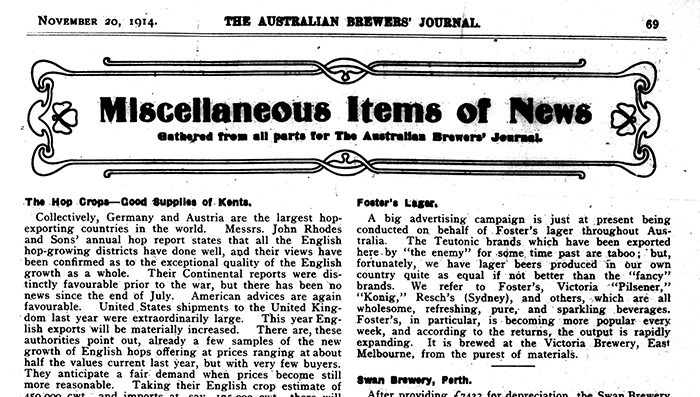
An extract of part of the Australian Brewers' Journal in November 1914.
However, “Carlton & United Breweries discontinued its Bismarck, Rheingold and Strasburg brands of lager beer in 1914. The more English-sounding Foster’s Lager was retained, but wartime advertising emphasised that it was ‘not manufactured or sold by Germans’ and that it was ‘manufactured and controlled purely by British people’”.[5]
♦ Notes:
1. Kirkegaard, Matt. (2012). What is the real history of Crown Lager? Australian Brews News. July 16, 2012. <http://www.brewsnews.com.au>. Accessed 30/11/2013 – no longer online.
2. Molony, John N. (1987). The Penguin bicentennial history of Australia : the story of 200 years. Ringwood (Victoria) : Viking. p.221
3. Stubbs, Brett. (2012). Beer and war in Australia. Australian Brews News. July 17, 2012. <http://www.brewsnews.com.au>. Accessed 30/11/2013 – no longer online.
4. 'Foster's Lager'. (1914, November 20th). In: The Australian Brewers' Journal. p.69
5. Stubbs (2012).
6. George, Angela. (2012). The Resch brothers, brewers & aerated water manufacturers. Aussie bottle blog. May 30, 2012. Online at Blogspot. Accessed 12/11/2013.