Germany - too much order and rules?
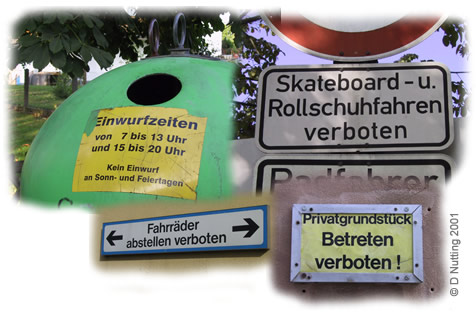
A collage of photos showing signs banning various activities, parking of bikes, specified times for throwing bottles into recycling bins etc.
Some German emigrants feel that Australia is a less rule-governed place than
Germany (e.g. Regine). Indeed, verboten
(prohibited) signs such as these (see the photos above) are not as widespread
in Australia as in Germany. A German proverb seems to indicate that the Germans
particularly like order and regulations: "Ordnung muss sein!" ("There
has to be order").
The photos show (clockwise from top-left): a public recycling bin for glass
- there are fixed times when you are allowed to deposit glass there; skateboards
and rollerskating prohibited; entry prohibited; parking of bikes prohibited.
Barbara is a well-known German street artist. With note paper, small placards and a lot of humour she modifies prohibition signs, information signs and advertising hoardings in German cities. She sticks card or paper over the original letters or words. The national daily newspaper Die Welt asked Barbara in 2015 (translated here): »Is there such a thing as a specifically German culture of bans and prohibitions?« Barbara answered: »Bans are found everywhere, some are definitely helpful and useful. However, I think that there's a particularly strong culture of order and regulation in Germany.«[1]
Australia no longer so laid-back?
Maybe there are more rules in the 21st century in Australia than earlier. In the lead-up to the annual Australian Grand Prix of 2010 the Australian F1 driver Mark Webber lost his cool about road traffic regulations in Australia. He made fun of the road rules and parking restrictions and drew a line from that to everyday life.
"I think we've got to read an instruction book when we get out of bed - what we can do and what we can't do … put a yellow vest on and all that sort of stuff," Webber told fans of his Red Bull Racing team. "It's certainly changed since I left here. It pisses me off coming back here, to be honest."
"It's a great country but we've got to be responsible for our actions and it's certainly a bloody nanny state when it comes to what we can do."[2]
Jochen Buchsteiner, correspondent for the German daily newspaper Frankfurter Allgemeine Zeitung, wrote an article for his paper titled: 'Kontrollieren, regeln, beschützen: Australien erstickt an seinen Vorschriften' (translation: 'Controlling, regulating, protecting: Australia is suffocating under its regulations').[3]
(In translation) Australia actually has a reputation for being "laid back", i.e. relaxed, even a little disorderly. Some even consider it unspoiled, if not wild, at least so wild that a "jungle camp" is organised there. But since Australians have become affluent and earn much more money than the average German, for example (in the EU they would be in second place with their per-capita-income), priorities have shifted. Now "Down Under" also has control, regulation and protection.
Jochen Buchsteiner
«« Reasons behind emigration from Germany
♦ Notes:
1. Paetow, Florian. (2015, April 26). „Bekleben verboten“ – Jetzt erst recht! Die Welt. Online here.
2. Litras, Peter, & Spits, Scott. (2010, March 29). Mark Webber attacks 'nanny state'. Sydney Morning Herald. Online here.
3. Buchsteiner, Jochen. (2011, February 8). Kontrollieren, regeln, beschützen: Australien erstickt an seinen Vorschriften. Frankfurter Allgemeine Zeitung. Online here.