Queensland
German Settlement in Queensland in the 19th Century - Overview
Part 1 | Part 2
From the middle of the 1860s numerous German immigrant families settled in the Lockyer Valley, which gave rise to villages named after places in Germany such as Minden and Prenzlau. The 'Neumann Haus' in Laidley (Lockyer Valley) is today a house museum. It was built in 1893 by Herrmann Neumann for his family. Neumann had come to Australia from Uckermark in Eastern Prussia in 1884 with his parents. He established a successful furniture-making business. Neumann's wife Annie was the well-educated daughter of an English woman and a German. Their home in Laidley was considered a cultural centre of the community.[1]
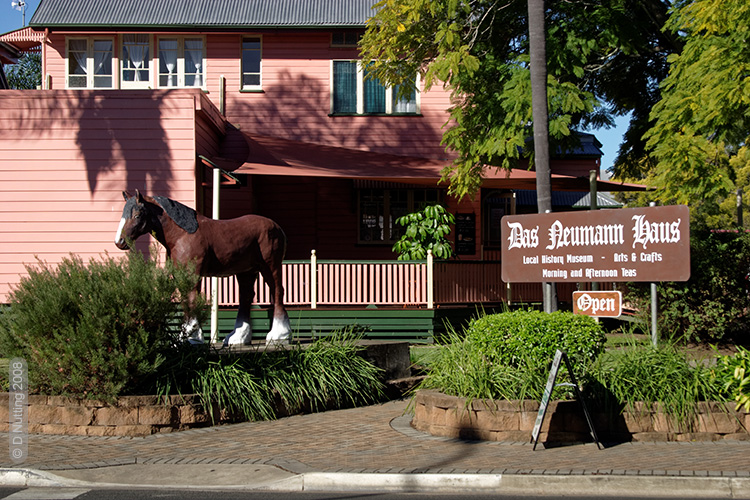
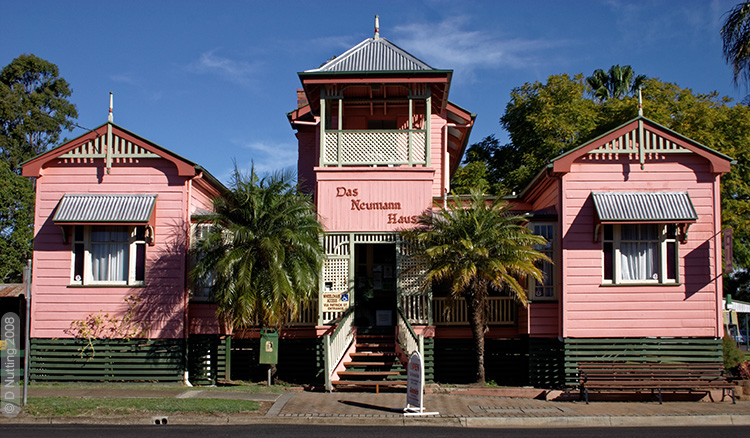
Many German immigrants also found work on the construction of the Ipswich-Toowoomba rail line. Where numbers of Germans were high enough, German schools, Lutheran churches, German associations (with the usual gymnastics and choral societies) were established. By 1900 the Darling Downs had around 700 German families, three Lutheran churches and a German association.[2]
Into the North
Although Germans initially settled in the south-east corner of the colony, soon some German immigrants moved from there to the north (and other immigrants from German-speaking Europe settled in the north of Queensland straight after arriving in the colony). Many were involved in sugar-cane growing in the Bundaberg area, Rockhampton, the Mackay area, and some gold-seekers went to Charters Towers.[3] In 1890 all six of the sugar mills in the Logan district were owned by or managed by Germans.
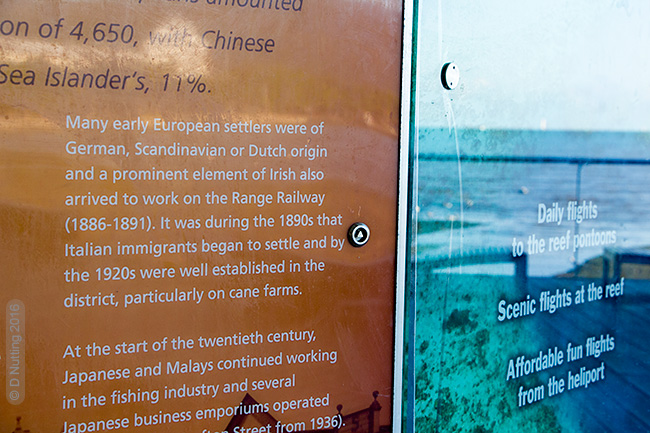
On the impressive Esplanade in the city of Cairns in North Queensland is this information board that tells of the history of the area. It also mentions the German immigrants.
In the farming communities, until around 1900, the social and moral focus was their Lutheran church rather than German associations. German associations played a bigger role in the towns. Prior to World War I there were many German placenames in the areas of German settlement (during the war the state government changed most of the German names - see a List of German placenames in Australia). As late as 1891, in some Queensland districts the proportion of Germans marrying another German was as high as 80%.
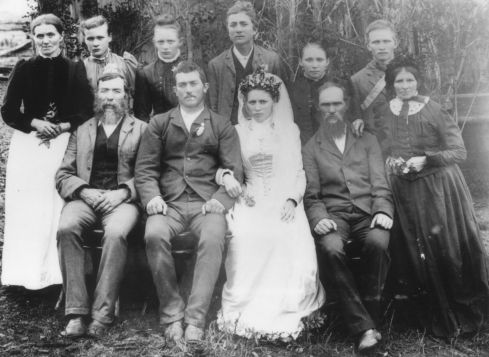
German wedding at Hatton Vale in 1892
Photo: John Oxley Library, neg #19287
By 1900 there were 600 German-speaking families in Brisbane, and Germans were active in all walks of life, from members of parliament to varied types of businesses.
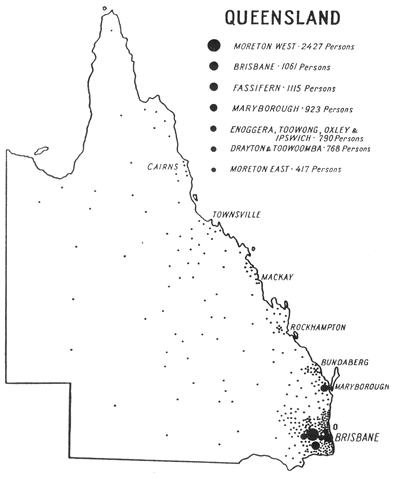
Map: Distribution of the Germans in Queensland around 1900
Source: Borrie, Wilfried. (1954). Italians and Germans in Australia / A Study of Assimiliation. Melbourne: F.W. Cheshire.
'Fernberg'
'Fernberg', Queenslands Government House, has a German background. Johann Heußler, the immigration agent (who later became a member of the Legislative Council of Queensland), built his large home Fernberg (meaning "distant mountain") in 1864/1865 on 9 hectares of land bought from the Government in 1862. The Heußler family occupied Fernberg until 1872 when financial difficulties forced them to sell it. The Queensland government wanted a new Government House and bought Fernberg for £10,000 on 30 June 1911 (and retained the original name Fernberg).
♦ Notes:
1. Information brochure, available at Das Neumann Haus.
2. Lodewyckx (1932), p.63
3. Tampke (2006), p.87
♦ References:
Gassan, Kay. (1994). Where the eagle nested: a tribute to our German pioneers. Maryborough (Qld): Wise Owl Research Publishers.
Jurgensen, Manfred. & Corkhill, Alan. & University of Queensland. Department of German. (1988). The German presence in Queensland over the last 150 years : proceedings of an international symposium August 24, 25 and 26, 1987 University of Queensland, Brisbane, Australia. St. Lucia [Qld.] : Dept. of German, University of Queensland
Lodewyckx, Prof. Dr. A. (1932). Die Deutschen in Australien. Stuttgart: Ausland und Heimat Verlagsaktiengesellschaft. pp.59-64
Meyer, Charles. (1990). A History of Germans in Australia 1839-1945. Clayton (Victoria): Monash University. pp.65-81
Tampke, Jürgen and Colin Doxford. (1990). Australia, Willkommen. Kensington (NSW): New South Wales University Press. pp.108-119