Names
Australian Placenames of German Background
Hermannsburg (Ntaria), Northern Territory
The Australian community known as Hermannsburg is located 125 kilometres west-southwest of Alice Springs in Central Australia. Its namesake In Germany Hermannsburg is a village in the modern-day state of Lower Saxony, 78 kilometres northeast of the state capital of Hanover.
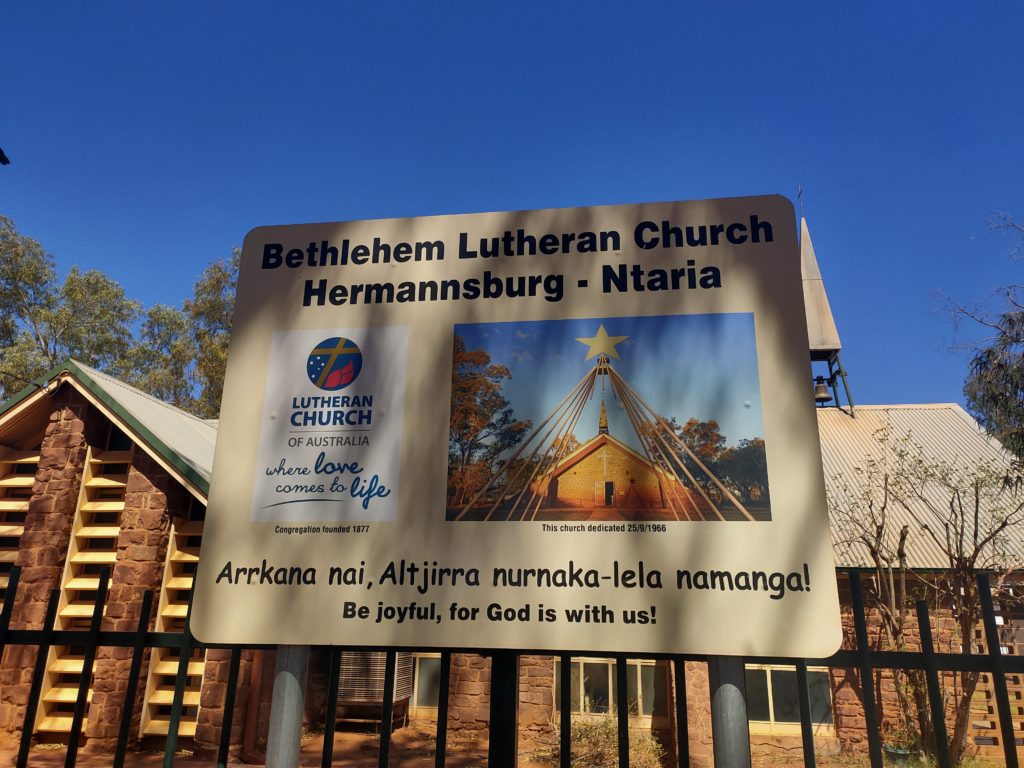
Sign at the church which shows both the German name and the Western Aranda name.
Photo source: www.justeverydaytravellers.com
The village of Hermannsburg in Central Australia was established by Lutheran missionaries in 1877, and was named after the village in Germany where they had received their training. At the German village of Hermannsburg was a mission seminary established by Pastor Louis Harms in 1849, and which developed into the Hermannsburg Mission, which sent hundreds of missionaries to other countries, mainly in Africa, but also Australia and Papua New Guinea.[1]
The Lutheran communities of the Barossa Valley heard of the successful crossing of Australia from south to north and back by the explorer John McDouall Stuart, and of the large numbers of Indigenous people living in the desert centre of the continent. They asked the mission seminary at Hermannsburg, Germany, to send missionaries to ‘christianise’ the native people of central Australia.
A large party of men, horses, cattle and sheep left Bethany in the Barossa Valley under the leadership of Georg Heidenreich, Hermann Kempe and Wilhelm Schwarz. After a long and very difficult journey they finally established the settlement named Hermannsburg on the Finke River south of the MacDonnell Ranges.
Over the years, the missionaries did not have a lot of success in baptising Indigenous Australians, the Aranda people, and the climate and geography were very challenging for them. ‘The summers brought regular bouts of dysentery and inflamed eyes and the winters brought viral and pulmonary infections.’[2] Another factor that made life difficult for them was the arguments and quarrels about religious principles and doctrine that their church leaders in the Barossa Valley and in Adelaide engaged in.
Eventually more and more members of the Lutheran mission at Hermannsburg became ill or too weak and had to leave Central Australia. The mission was empty for three years before the missionary Carl Strehlow arrived in 1894 with a new team, and he ran the mission competently until 1922, when he became ill and was transported south by his family to find medical help. He died at Horseshow Bend before he reached medical attention.[3]
Other missionaries continued the mission work, and the Aranda people of Hermannsburg in the present day honour the Lutheran missionaries of the past for learning the Aranda language and not trying to suppress the Indigenous language, and for trying to protect the Aranda from aggressive white farmers in Central Australia.[4]
The Hermannsburg mission land was handed back to Indigenous ownership in 1982 under the Aboriginal Land Rights Act 1976, and the area of the historic precinct is now under heritage protection. Although the name Hermannsburg is probably more widely known outside of Central Australia, the Indigenous name for the area, Ntaria, has equal status with the name Hermannsburg.
The Northern Territory was part of South Australia from 1863 to 1911. In 1911 the Northern Territory was separated from South Australia and came under the control of the Federal government. In 1917 the government of South Australia passed a law to change German place names in South Australia. Perhaps the Australian place name Hermannsburg would be less well-known today if Hermannsburg had still been under South Australian control in 1917.
◀ Placenames in the Northern Territory & Western Australia...
♦ Notes:
1. Tampke (1995), p.56
2. Tampke (1995), p.64
3. Tampke (2006), pp.66-70
4. Warren Williams, Indigenous singer who grew up in Hermannsburg, spoke about the missionaries in Hermannsburg in an interview in an episode of ABC television's 'Back Roads' series. Series 2, episode 6 (broadcast in 2016).
♦ References:
Appleton, Richard. & Appleton, Barbara. (1993). The Cambridge Dictionary of Australian Places. Cambridge: Cambridge University Press. pp.135-136
Reed, A. W. (1973). Place names of Australia. Frenchs Forest (NSW): Reed Books. p.115
Tampke, J. (1995). “Our duty to convert men-eaters and cannibals”: German Lutheran missionaries and their work in Australia and New Guinea before 1914. Journal of the Royal Australian Historical Society, Vol. 81, No. 1, June 1995, pp.53–70.
Tampke, Jürgen. (2006). The Germans in Australia. Port Melbourne (Victoria): Cambridge University Press