Inge King
sculptor
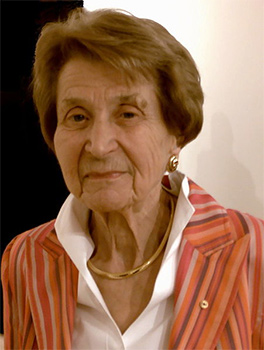

Inge King (1915-2016), whose full name at birth in Berlin was Ingeborg Viktoria Neufeld, was a German-Australian artist best-known as a leader in the development of non-figurative sculpture in Australia (non-figurative sculpture is a kind of abstract sculpture where there is no attempt or intention to represent forms or figures realistically).
She trained in Germany (Berliner Kunstakademie) until her Jewish background made it necessary for her to leave Nazi-controlled Germany, and she managed to get to Britain, where she was able to train in London (Royal Academy of Arts) and in Scotland at Glasgow (Glasgow School of Art). In the late 1940s she lived for a short while in Paris and in New York before moving to Australia in 1951 with her Australian printmaker husband, Grahame King, whom she had met at an artists’ colony in London in the late 1940s.
In Melbourne she first worked as a jewellery maker and sculptor, using wood and stone, and in the early 1950s she was co-founder of a group of sculptors in Melbourne known as 'The Group of Four'. Around 1959 she got into welding and steel. She became well-known for large commissioned works - her first major commission for a piece of public sculpture was her winning design for the RAAF Memorial in Canberra (1971)[1]
Her best-known work is Forward Surge (prominently located on the plaza outside the Melbourne Arts Centre), commissioned in 1974 by the Victorian Arts Centre, and completed in 1975. "Its monumental scale, defiant monochrome black finish, and tough and uncompromising form, marked a major achievement in modernist scuplture".[2] King viewed her work as being part of the landscape and was happy to see children physically interacting with them.[3] With Forward Surge's large curves and waves of steel King was happy to see people walking through the sculpture and using it as a meeting place. Forward Surge required a lot of planning and King asked specialist engineers for help in the preparation.[4] In The Age newspaper in 2014 Sonia Harford reported that King's "large sculptures are in parks and next to freeways. Red Rings sits beside EastLink. Students eat lunch near the Sun Ribbon at Melbourne University. The Shearwater sculpture spreads its wings at Southbank and Heide Museum of Modern Art hosts Rings of Saturn."[5]
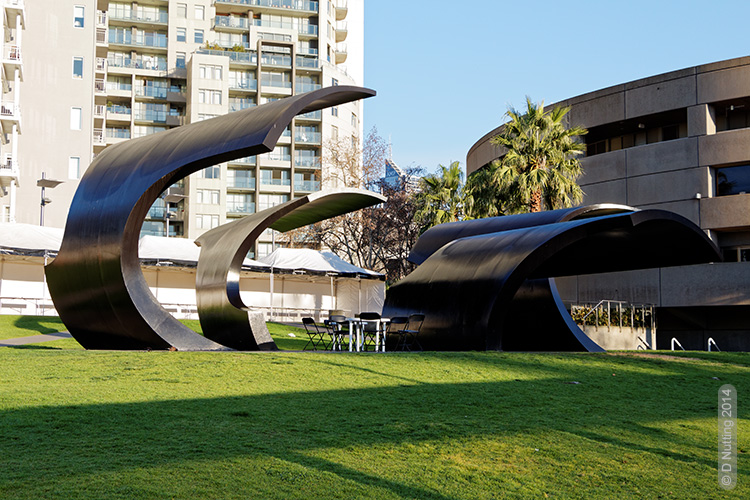
Forward Surge outside the Arts Centre in Melbourne.
King believed that the Australian landscape greatly influenced her work – if she had stayed in Europe her work might have been entirely different.[6] She held many solo exhibitions and her scultures are in many galleries, also at the Australian Embassy in Washington DC in the USA.[7]
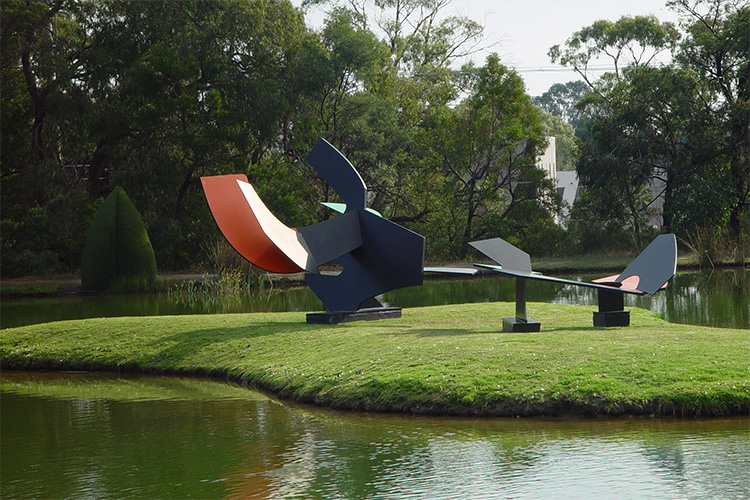
Inge King's 1991 steel sculpture Island Sculpture, at the McClelland Sculpture Park in Langwarrin, Victoria.
Photo source: Robin Whittle, CC BY-SA 2.5 AU, via Wikimedia Commons

King taught sculpture at RMIT University from 1976 to 1987 and she was awarded the Order of Australia medal in January 1984.
♦ Notes:
1. McCulloch (1994), p.390 / Northover (2014), pp.24-25
2. Grishin, Sasha. (2013). Australian art : a history. Carlton (Victoria) : The Miegunyah Press., p.470
3. Northover (2014), pp.24-25
4. Williams, Donald (Donald Sidney). (2002). In our own image : the story of Australian art 1788-1989 / Donald Williams. 4th edition. Sydney: McGraw-Hill. p.186
5. Harford, Sonia. (2013, August 17). Sculptor's monumental efforts celebrated in show of her life's work. The Age. Accessed on 22/04/2014 at The Age website.
6. Northover (2014), pp.24-25
7. McCulloch (1994), p.390
♦ References:
McCulloch, Alan & McCulloch, Susan. (1994). The encyclopedia of Australian art / Alan McCulloch. St Leonards, N.S.W. : Allen & Unwin. p.390
Northover, Kylie. (2014, April 19). Formed by nature. Spectrum (in The Saturday Age), pp.24-25