Jennings-Germans
In 1951 the construction firm A.V. Jennings received a contract from the federal government to build 1,850 houses in Canberra within two years. As time went on it became clear to A.V. Jennings that progress towards this target was not looking good, and at that time it was difficult to attract carpenters and builders to work in Canberra. A.V. Jennings got permission to recruit unmarried qualified builders from Germany.
AV Jennings placed ads in newspapers, trade journals and on radio across Germany as it sought the best tradesmen for the positions. They described the high wages, living conditions and opportunities available in Australia, and noted “The German tradesmen in Australia will be able to lead a quite different and happier life than here in Germany”.[1]
Canberra Museum & Gallery
The German builders’ fare for the journey to Australia was deducted from their wages. Most of them were not impressed by the very basic level of accommodation provided for them in barracks and hostels. Some builders even broke their contract and disappeared. The union supported the “Jennings Germans” and the local newsletter of the union regularly included a German-language page of information and news (the newsletter also contained an Italian-language page and a Polish-language one).[2] The Jennings Germans built many public and private homes in Canberra (in suburbs such as Yarralumla, Ainslie, O’Connor, Turner and Deakin), as well as parts of the Australian National University, embassies, schools, shops and churches.[3]
A newspaper report
Complete text of the article:
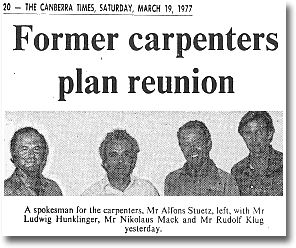
The article as it appeared in the newspaper
Canberra Times, 19/03/1977
A group of 150 German carpenters who were brought to Canberra 25 years ago will hold a reunion at Easter.
The three-day 25th anniversary reunion will be held at the Harmonie German Club. Mr A. Stuetz, of Hawker, a member of the group said that many were now businessmen, builders, public servants and building inspectors. Fifty-four were still living in the Canberra-Queanbeyan district.
"In the early months of 1951 A. V. Jennings Pty Ltd placed advertisements in several German newspapers for joiners and carpenters to work on a large building project in Australia for a period of two years", Mr Stuetz said.
"More than 1,000 applied and we all had to sit a trade test".
The 150 selected then sailed for Melbourne. Some were unable to speak any English, others could manage only a few words. They had very little knowledge of Australia.
"We knew it was a big country with a low population", Mr Stuetz said.
"…Everyone was disappointed on their arrival here. The living conditions at the hostels were not really good and the men were faced with a hot dry summer after having escaped Germany's winter".
Most of the men who migrated wanted to see something of the world. Others wanted to improve their life-style and make more money.
"Australia's wages were double those in Germany", Mr Stuetz said.
Some of the first houses the "German carpenters" built are still standing in O'Connor, Ainslie and Yarralumla, which was then called Westridge.
Sir Albert Jennings, in a book compiled for the reunion by a committee of the carpenters, says that the "achievement of many of you in successfully entering business in your own right indicates the foresight, initiative and courage shown when undertaking a journey so far from your homeland under unsettled conditions".
In the same publication the Minister for Immigration and Ethnic Affairs, Mr MacKellar, says, "One would have to look afar to find a better example of migration than that of the 150 German carpenters". They came at a time when Australia was suffering a grievous housing shortage and life was not as comfortable as it is today.
Mr Fred McCauley, of the Building Workers Industrial Union says, "The value of your joint contribution to the building industry and of the new culture infused into our society is impossible of assessment in monetary terms".
In another article, Mr Allen Jack, who selected the 150 men, wrote, "Upon reflection, at this time, I believe that the Jennings scheme proved to be a resounding success, not only for those directly involved but for all of us in this country, who have derived so much benefit from the many skills and cultures brought by these men and their fellow newcomers."
(Reproduced with permission of the Canberra Times)
♦ Notes:
1. Canberra Museum & Gallery. Building a Life. The Jennings Germans story. Opportunity calls.
2. Brown, Nicholas. (2014). A history of Canberra. Port Melbourne, VIC : Cambridge University Press. p.136
3. Canberra Museum & Gallery. Building a Life. The Jennings Germans story. Life after Jennings.
♦ References:
Canberra Museum & Gallery. (n.d.) Building a Life. The Jennings Germans story. (Website of an exhibition)
Cloos, Karl. (2000). To build a nation's capital : a migrant's story / by Karl A. Cloos. Mawson, A.C.T. : K. Cloos
Stuetz, Alfons. (1986). History of the Jennings' Germans 1951 to 1986 / compiled and edited by Alfons Stuetz. Canberra : A. Stuetz
See also an article written (in German) by a Jennings-German for this website.