German stonemasons
The rail line from Melbourne to Bendigo
Somewhere between 200-400 German stonemasons arrived in Victoria in 1859, many of them on the ships P.C. Kinch and Olympia. The company Cornish and Bruce was building the Melbourne to Bendigo railway line for the Victorian colonial government, and stonemasons in Victoria had recently fought a successful industrial campaign to introduce an eight-hour working day. Stonemasons were important for the construction of bridges, viaducts and tunnels along the railway line. Victoria’s stonemasons refused to work a ten-hour day. Cornish and Bruce were known for their ruthless attempts to reduce wages and lower the working conditions of the thousands of men who were looking for work.[1]
After conflict with the Stonemasons Society in Victoria, Cornish and Bruce sent an agent, Julius Lippmann, to Germany to recruit a large number of stonemasons for the work on the railway project. Herr Lippmann arranged their shipping tickets and drew up a contract (containing 12 clauses) for the Germans to sign. When the stonemasons arrived in Victoria, the local stonemasons explained to the Germans who were supposed to replace them what the working conditions with Cornish and Bruce really should be, and explained that the contract meant lower wages than what they should be.
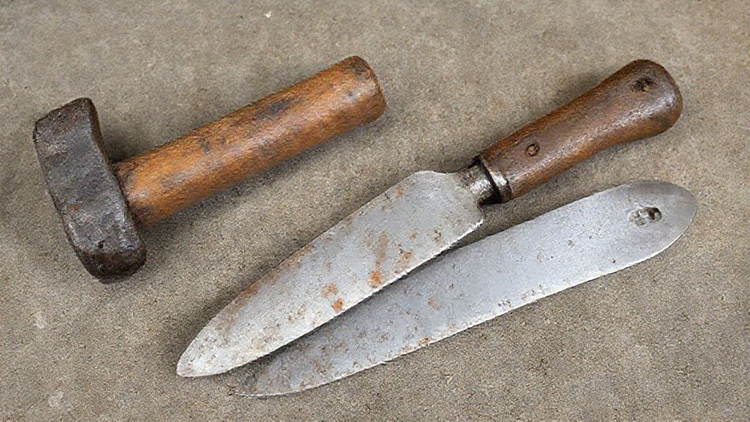
The presence of the German stonemasons caused a bit of a stir in the construction industry in Melbourne. There were English stonemasons who were concerned about the Germans and wanted to warn them that working conditions for Cornish and Bruce were (in their view) unfair. There were English stonemasons who resented the competition that the imported stonemasons represented. English bricklayers issued a challenge to their German counterparts, each English bricklayer to take on three Germans in a test of their work. The English did manage to finish half of the task despite this self-imposed handicap, but the quality of their work was considered to be not as good as the Germans' work.[2]
A court decision meant that the German masons had to fulfil the contract that they had signed with Cornish & Bruce. One or two of them refused to work under the contract and were given some jail time. Others did not work for Cornish & Bruce again after their contracts expired.[3] The influence of these German stone masons can be seen in the masonry techniques used in sections of the railway line.[4]
Taradale Viaduct
In the late 1850s the population of Taradale was falling as the gold there petered out. The building of the railway viaduct at Taradale gave a new boost to the settlement's population as more than 200 German stonemasons were brought to Taradale. They were based there for a considerable period of time; apart from working on the viaduct itself they also worked on bridges and other structures for the railway in the nearby area. These structures demonstrate the nearly forgotten art of stone masonry.[5]
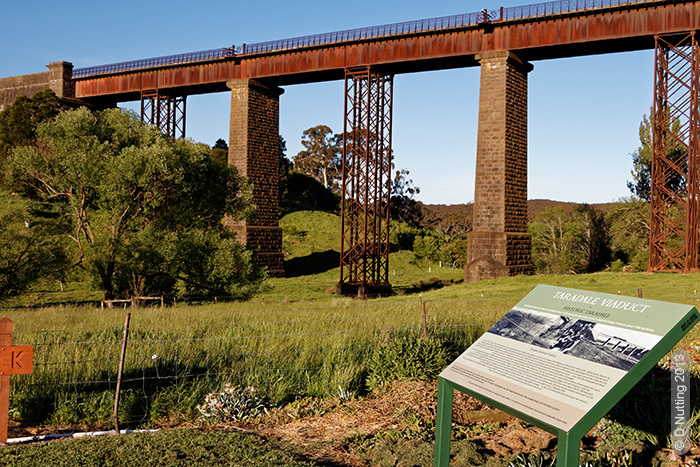
The Taradale Viaduct with an information plaque in the foreground that mentions the work of the German stonemasons.
Some of these German stonemasons built the tall stone pillars of the Taradale Viaduct. The viaduct crosses Back Creek and is 252 m long, including five spans of 36.5 m length. The height of the rails above the creek is 35 m.[6]
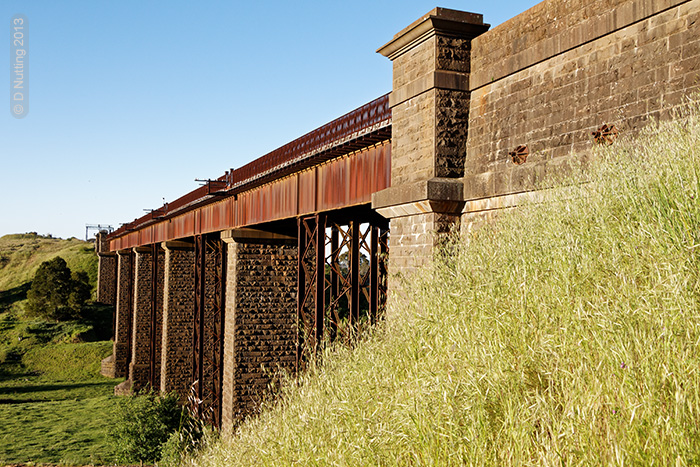
The Taradale Viaduct
The Argus newspaper described the viaduct in 1862 as follows: "Approaching the viaduct from the highway, the visitor is struck with its stately appearance, which will speak to future generations of Victorian enterprise in the year of grace, 1862."[7]
In 1933 intermediate framed steel tresses were installed in between the spans to reduce the stress on the girders caused by the heavier locomotives that had come into use.
Taradale's German Association
On April 15, 1860, a meeting took place at the Taradale Viaduct Store. The purpose of the meeting was to start a group called the "Deutscher Unterstützungs-Verein für kranke Brüder", which means an association for helping fellow Germans who were sick.
This group was created because there were many German workers in the area. These included a large number of the German stone masons and smiths who were building the Bendigo railway line, as well as local German miners.
The association had about 30 members and they held their meetings at the Viaduct Assembly Rooms. We know the group was still around in late 1861, but after that, there is no more information about what happened to it.[8]
The viaduct at Harcourt
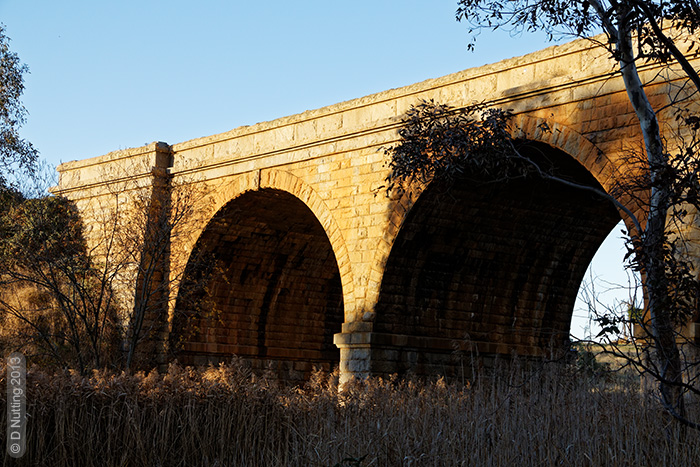
The Harcourt Viaduct, built 1859-1861.
The largest structure in the Harcourt area is the viaduct over Barkers Creek next to Symes Road. It’s an impressive and elegant bridge with its Roman-style arches and superb granite stonework, built from 1859-1861 by the German masons, who applied high standards in shaping and dressing the granite for the railway bridges. The masons were unemployed when the railway line was finished, but builders in the Harcourt area soon made use of the Germans' skills, and 24 of the old homesteads in the Harcourt area were built of Harcourt granite with the skills of these German masons.[9] One of those masons was Heinrich Lübke, who was recruited in Hamburg by Julius Lippmann and arrived in Victoria in 1859 on the ship P.C. Kinch. He was one of the few stonemasons to bring his family to Victoria and lived for a while at Harcourt before moving to northern Victoria.[10] (In the 20th century another German named Heinrich Lübke was the second president of the Federal Republic of Germany, from 1959-1969.)
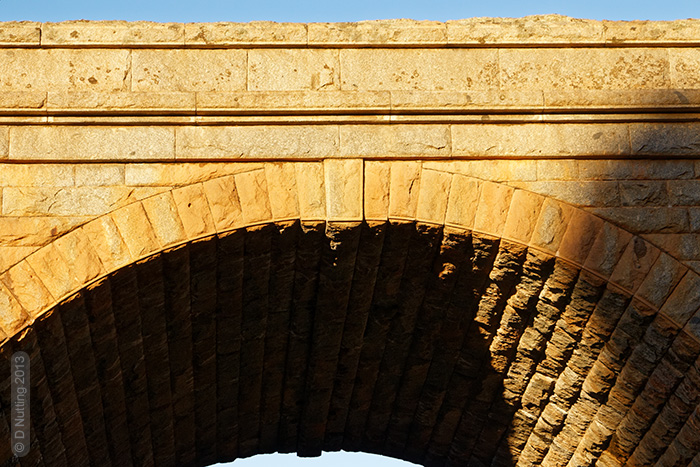
The Harcourt Viaduct - a close-up view of the masonry.
A heritage study described the popularity of the viaduct as follows: "This viaduct is significant as a community landmark. Its aesthetic qualities have made it the subject of many sketches, photographs and picture postcards since its construction."[11]
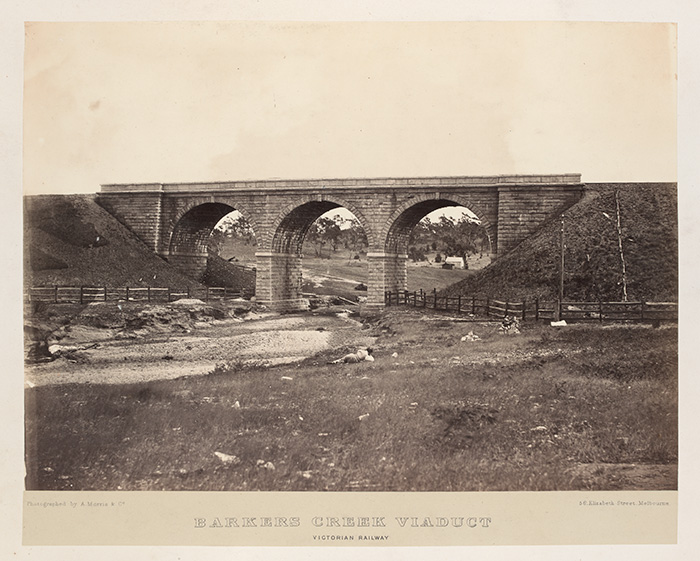
The Harcourt viaduct. Photographed by Alfred Morris and Company of Melbourne presumably not long after the viaduct was completed. State Library of Victoria, H3986.

The Harcourt Viaduct - a close-up view of the masonry.
It is thought that many of the German workers settled in Bendigo when the railway line was finished.
♦ Notes:
1. Evans, Jim., (editor.) & Bendigo Historical Society (issueing body). (2012). Melbourne to Bendigo railway, 1862-2012. Bendigo, Victoria: Bendigo Historical Society Inc.
p.14 / Maxwell, John. (1969). 'Bruce, John Vans Agnew (1822–1863)', Australian Dictionary of Biography, National Centre of Biography, Australian National University. Online at <https://adb.anu.edu.au/biography/bruce-john-vans-agnew-3094/text4583>, published first in hardcopy 1969, accessed online 13 December 2025.
2. Bradfield (1983), p.67
3. Cusack, Frank. (2002). Bendigo : a history / Frank Cusack. (Revised edition). Bendigo (Vic.) : Lerk & McClure. p.152
4. Twigg & Jacobs (1994), p.98
5. Carr, Howard. (2006). The Calder Highway : Melbourne to Mildura: opening the Victorian inland. Barkers Creek (Vic.): Howard A. Carr. p.50
6. Australian Railway Historical Society (Victorian Branch - Research Group). (1962). 100 years to Bendigo : commemorating the Centenary of the opening of the railway from Melbourne to Bendigo, 20th October, 1962. Melbourne : Australian Railway Historical Society.
7. THE RAILWAY WORKS.—TARADALE VIADUCT. The Argus. Melbourne, Vic. 10 January 1862. page 5. National Library of Australia. Online at <https://trove.nla.gov.au/newspaper/article/5708290>
8. Darragh, T. (2000). "The Deutsche Vereine of Victoria in the Nineteenth Century". In: Mitchell, Ellen. (editor). (2000). Baron von Mueller's German Melbourne. Plenty Valley Papers, Vol 3. Bundoora (Victoria): La Trobe University. p.71
9. Everist, Richard. (2006). The traveller's guide to the goldfields : history & natural heritage trails through Central & Western Victoria / supervising editor, Richard Everist. Geelong West, Vic : Best Shot! Publications Pty Ltd. p.227 / 'Harcourt Granite'. (n.d.). Harcourt Heritage. Harcourt, Victoria. Online at <https://heritage.harcourt.vic.au/harcourt-granite/>.
10. 'Pioneers of Harcourt'. (n.d.) Harcourt Heritage. Harcourt, Victoria. Online at <https://heritage.harcourt.vic.au/pioneers-of-harcourt/>
11. Twigg & Jacobs (1994), p.132
♦ References:
Bradfield, R.A. (1983). Owen Jones : labour pioneer on the Castlemaine goldfield. Castlemaine : Castlemaine Mail.
Twigg, Karen & Jacobs, Wendy. (1994). Shire Of Metcalfe Heritage Study. Volume 3. Ballarat: for the National Estate Committee (Victoria) and the Shire of Metcalfe.