Victoria
Westgarthtown
A 19th century German settlement in the north of Melbourne
In December 1849 the German Immigration Committee in Melbourne decided to establish a German settlement that could be a base for German immigrants. The Committee members had seen the success of German settlements in South Australia. So the Melbourne businessman William Westgarth and Captain Stanley Carr (a rich Scot who was visiting Melbourne at the time and who had lived in Germany for 25 years) bought 640 acres (259 hectares) of land 16 km north of Melbourne. The land is now part of the suburbs of Thomastown and Lalor.
Ziebell's Farm
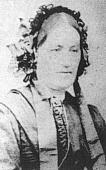
Sophia Ziebell
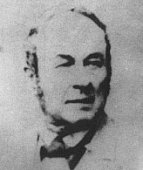
Christian Ziebell
Christian and Sophia Ziebell (aged 54 and 51 respectively when they arrived in Australia) built this farmhouse between 1851-56, with 61 cm thick walls. It is the oldest German immigrant building in Victoria. Ziebell's farm was the largest in the settlement, and Christian and Sophia shared the house with their eight adult children, two of whom were married. The building is a typical North German farmhouse. Like the other houses of the Westgarthtown settlement it has a steep roof (in Germany these roofs allowed snow to fall off them).
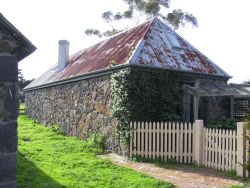
The Ziebell house is L-shaped. The photo above shows the northern wing of the building.
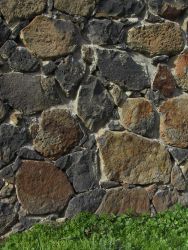
External wall
There were lots of large stones in the paddock near the house, both on the surface and below it. The Ziebells saved time in building by not cutting the stones into square shapes. They fitted the stones together according to their shapes. The gaps between stones were filled with rubble and with mortar made of mud and lime. The weather-worn stones that the Ziebells took from the surface of the paddock are brown and red in colour. The dark blue stones were dug out from below the surface of the paddock.
The house was lived in by generations of the Ziebell family until 1972. Electricity, water (the house has a well), gas and sewerage were never connected to the house. The Ziebell house has been bought and restored by the City of Whittlesea; the other original bluestone homes in the settlement are private homes.
The picture at left shows clearly the different coloured stones of the external wall of the Ziebell house.
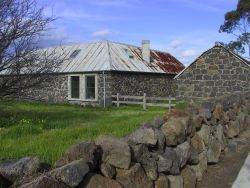
The Ziebell house and a shed
The Ziebell's cart shed (at the right in the photo above) housed chickens and carts in the 20th century. Its walls were built in the same way as the house. The stone fences around the house are simple examples of dry stone walling.
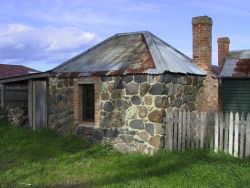
Smokehouse
In the smoke house (above) the Ziebells made soap (from a mixture of mutton fat, resin and caustic soda) and smoked bacon, ham and other meats. The building also had a bake oven in which they made the farm's bread.
The school
After the first few years the Westgarthtown farms were running successfully and the families could start building a school and a church on four hectares that they had set aside in 1850. A schoolhouse made of bluestone was built and teaching and learning started in it on the 1st October 1855. The settlers save money by transporting all the building materials themselves (bluestone, bricks, lime, timber and roofing iron).
Gottlieb Renner was the first teacher and the school was officially known as State School No. 428, named Mecklenberg (many of the Westgarthtown immigrants had come from the region Mecklenburg in the north-east of present-day Germany). Notice the spelling of the school name, Mecklenberg, with an “e” in the final syllable, unlike the name of the region in Germany.[1]
The government withdrew financial support for the school in 1862, mainly because not enough English was being taught. At the end of 1862 most pupils transferred to the recently opened Thomastown school.[2] The New Mecklenburg Lutheran School operated until 1876.[3]
The placename
When the Westgarthtown settlement was established in 1850, the area was known as Keelbundora, after the parish in which it was located. From 1851 the name Dry Creek was often used for the area, and for a few years the name of the school New Mecklenburg was used to refer to the area as well. By 1860 the name Westgarthtown became established. The name Germantown was also used, primarily by outsiders.[4]
The Church
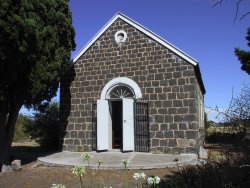
Lutheran church of Westgarthtown
The church (known as Thomastown Lutheran Church, after the suburb in which it's located) is the second-oldest Lutheran church building in Australia, opened on 17th November 1856. (The church at Lobethal in the Adelaide Hills, South Australia, is older, though no longer used for regular services, due to the modern church built opposite it, to house a larger congregation.) The Westgarthtown church is the oldest continuously used Lutheran church in Australia. English-language services started by 1903. German-language services were re-introduced in the early 1950s, due to the arrival in Australia of many German-speaking immigrants after World War Two. German services stopped during the mid-1970s.[5]
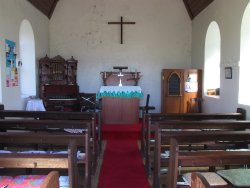
You can see by the bluestone blocks that the church was built by professional stonemasons, unlike the Ziebell farmhouse. The church was very important to the settlers and therefore was built in the middle of the 259-hectare settlement. Both the exterior and the interior of the church are simple and modest in style.
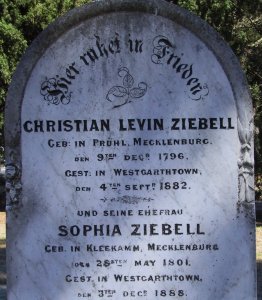
Ziebell gravestone in the Westgarthtown cemetery. It states where Sophia and Christian were born (geb.) and where they died (gest.)
Burials in the Westgarthtown Lutheran cemetery are restricted to congregation members and descendants of the original settlers.
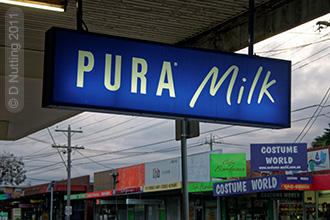
Dairying remained the main farming activity at Westgarthtown right up until the 1970s. One of the original land purchasers at Westgarthtown was Johann Gottlob Siebel. The history of Victoria's biggest dairy company, Pura Milk, goes back to Johann's descendant Albert, who bought Kruger's dairy in Murray Rd Preston in 1934 in order to sell Westgarthtown's milk, and re-named it the Pura Dairy. Albert Siebel had only one milk cart in the beginning and delivered only to a few nearby streets, however, the business grew slowly and steadily.[6]
Jack Ziebell
Among Christian Ziebell's descendants is the well-known footballer Jack Ziebell (player for the North Melbourne club in the national Australian Football League [AFL]). He became captain of the club in 2017. Jack grew up in the Albury/Wodonga area (one of the areas where German-speaking settlers played a significant role in the nineteenth century).

Jack Ziebell trying to evade Darcy Byrne-Jones during the AFL round six match between North Melbourne and Port Adelaide on Saturday, 28 April 2018 at Etihad Stadium in Melbourne, Victoria.
♦ Photo: Wikimedia Commons / Flickerd
It was not until 2015 that Jack Ziebell learned of the Ziebell farmhouse in 'Westgarthtown', thanks to research carried out by Robert Wuchatsch and journalist Ben Collins. On a visit to the farmhouse organised by football magazine AFL Record, Ziebell said: "This has been a pretty extraordinary experience." Up until that point, Jack had thought he had some Danish background. Robert Wuchatsch's research revealed that Jack's ancestors came from the village of Brüel in north-eastern Germany, about 18 km east of Lake Schwerin, in the early 1800s, and that Christian Ziebell was Jack's great-great-great-great-uncle.[7]
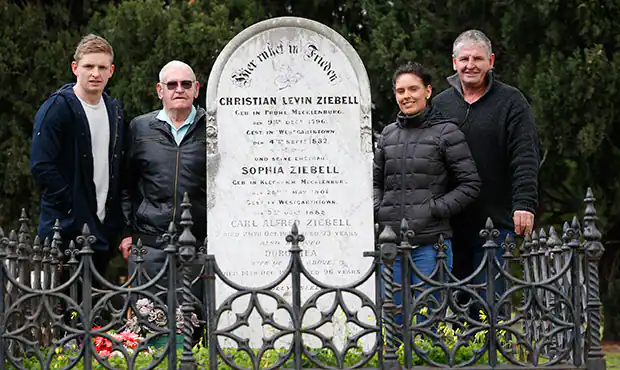
Jack Ziebell with grandfather Ian, sister Elle and father Gary next to Christian Ziebell's grave
(Photo appears here courtesy of the AFL Record)
See also the Westgarthtown website
The Westgarthtown heritage site is well worth a visit, and tours can be arranged by contacting the Friends of Westgarthtown.
♦ Notes:
1. Wuchatsch (2004), p.10
2. Victoria. Education Department. & Blake, L. J. (1973). Vision and realisation : a centenary history of state education in Victoria. Melbourne: Education Department of Victoria. Vol.3, p.33
3. Wuchatsch (2004), p.10
4. Wuchatsch (2004), p.10
5. Wuchatsch (1985), p.33, 114; Wuchatsch (2004), p.11
6. Wuchatsch (1985), pp.102-103. According to the website of PURA Milk: “The PURA brand was established in 1934 when German farmer Albert Siebel purchased a dairy in Preston, Victoria and named it PURA Dairy." - www.pura.com.au/about-us/ (accessed 28/09/2011).
7. Collins, Ben. (2015 August 9). The mark of Ziebell: from Rhine to the Roos. In: AFL Record. Melbourne: Sports Entertainment Network.
♦ References:
de KRETSER, L. (2001, June 27). 'Germans make their mark'. Herald Sun. pp.40 & 49 (two-page photo spread)
Wuchatsch, Robert. (1985). Westgarthtown. The German settlement at Thomastown. (Self-publication)
Westgarthtown. (1998). Booklet, published by Heritage Council Victoria and the City of Whittlesea.
Wuchatsch, Robert. (2001). Personal communication.
Wuchatsch R, D Harris et al. (2004). Westgarthtown – A History and Guide. Melbourne: Friends of Westgarthtown Inc. (A revised and enlarged edition of the 1998 booklet)