Governor Arthur Phillip
The half-German commander of the 'First Fleet'
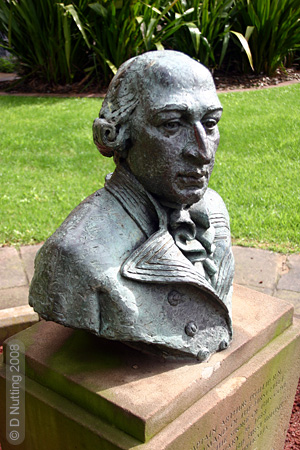
A bronze bust of Governor Arthur Phillip in Sydney.[1]
Arthur Phillip (1738–1814) was a British Royal Navy officer who served as the first governor of the Colony of New South Wales. He was half-German; his father, Jacob Phillip, was a language teacher who had moved from Frankfurt-am-Main to London, and his mother Elizabeth was English.[2] He played the key role in the organisation of the settlement/invasion of the area that came to be known by Europeans as Sydney.
In his successful book The Fatal Shore about Britain's system of sending convicts to Australia, Robert Hughes wrote that Arthur Phillip looked like “a Kapellmeister in some little Bavarian court”.[3] (Kapellmeister = the director of music ensembles for a prince or nobleman). The Australian historian Alan Atkinson wrote a book about the history of Europeans in Australia and claimed that Phillip had facial features that did not look like an Englishman (an “un-English physiognomy”).[4]
When Arthur Phillip left school he worked for a little while on a whaling ship in the Arctic Sea, then joined the Royal Navy and fought during the Seven Years' War. When that war ended Phillip became a farmer in the county of Hampshire. In the mid 1770s he served in the Portuguese navy with the permission of Britain's Royal Navy. Phillip was multilingual - apart from English he spoke German, French and Portuguese, and in 1784-85 he served his country by spying in France, watching activities in French ports and dockyards, where his language skills were useful. The British government believed that a renewal of war against France could come sometime soon.[5]
When the British government chose Arthur Phillip to lead the First Fleet to New South Wales in order to establish a penal colony there for British convicts, he did not have a "star" profile in the navy, but the government probably considered him to be reliable, hard-working and "a safe pair of hands". His planning for the departure of the First Fleet shows meticulous attention to detail, compassion for the convict men and women, and in contrast to his superiors a great deal of foresight and anticipation of the problems and challenges that needed to be addressed before transplanting a large number of British men and women to a little-known land on the other side of the world.[6] The historian Michael Pembroke, speaking in a documentary about Phillip in 2015, said: “It’s like today sending a group of citizens, against their will, to establish a colony on the moon.”[7]
In his humorous book about Australian history David Hunt claimed that Arthur Phillip's love of detail and his fascination for rules and regulations can be traced to the fact that Phillip was half-German.[8]
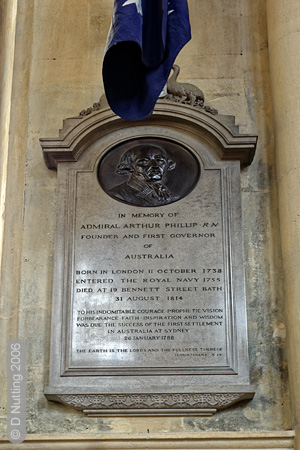
A memorial tablet honouring Phillip in the Bath Abbey church. It includes a bronze relief portrait of Admiral Arthur Phillip.
The First Fleet (11 ships) arrived at Botany Bay on 18th January 1788, but Phillip thought it was unsuitable for settlement because of its sandy soil and the lack of a reliable supply of fresh water, and he soon found Sydney Harbour, which he was very impressed with, and on 26th January he moved the fleet to Sydney Cove.
Arthur Phillip took a great interest in the life and language of the Indigenous Australians[9] and made a great effort to establish friendly relationships with them – this was part of his instructions from the British government, but it was also his own personal aim. He and his officers really wanted to be friends with the Indigenous people of the Eora Nation, however, he and his officers could not at all think of themselves as invaders of land already occupied by others.[10] On the 7th September 1790 an Indigenous man launched a long spear at Arthur Phillip at Manly Cove, and the first part of the spear passed right through Phillip’s upper body, but it did not damage any vital organs.[11] Phillip was taken back to Government House in a boat and recovered after a few weeks. He expressly forbad any retaliation by his soldiers, despite his near-death experience.[12] However, later in his time at the colony frustration led to Phillip being less lenient towards Indigenous Australians of the Sydney region.
Warren Mundine, a leading advocate for Indigenous affairs, said this of Arthur Phillip in an interview in 2015: “There’s no doubt about it, in regard to our Indigenous history, that he was an invader, but at the same time he was a very enlightened man, a man ahead of his time. He was a man who did genuinely want to reach out and work with Aboriginal people, but unfortunately he was a man trapped of his times as well, in that he was here as a military officer to build a colony and make it successful.”[13]
Arthur Phillip wrote up the first physical description of the dingo when he encountered these animals in New South Wales. His description was later formalised by a zoologist in the homeland of Arthur Phillip's father. Friedrich Albrecht Anton Meyer of the University of Göttingen included Phillip's information in his academic work entitled Systematisch-summarische Uebersicht der neuesten zoologischen Entdeckungen in Neuholland und Afrika nebst zwey anderen zoologischen Abhandlungen - published in Leipzig in 1793.[14]
After four years of governing the colony Phillip returned to England and he lived his final years of retirement in the English city of Bath, where he died in 1814. A memorial tablet to Phillip in Bath Abbey Church was unveiled in 1937.
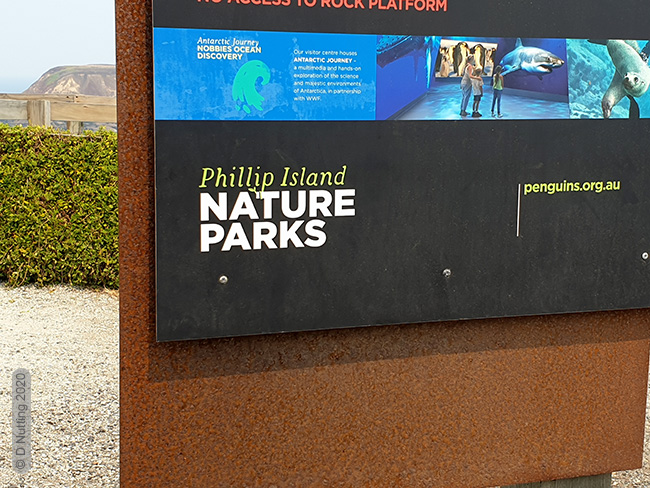
Named after Arthur Phillip: a sign on Phillip Island in Westernport Bay, Victoria.
A number of places in Australia bear Phillip's name, including Port Phillip Bay, an island very well-known in Victoria (Phillip Island in Westernport Bay), a little-known island close to Norfolk Island (Phillip Island), the federal electorate of Phillip (1949–1993), the suburb of Phillip in Canberra, Phillip Bay (a suburb on the eastern shore of Botany Bay NSW), a high school in Parramatta, and the Governor Phillip Tower building in Sydney. Apart from several streets in the Sydney area there are also public parks named after Arthur Phillip, such as Cook+Phillip Park in College Street in Sydney, Phillips Park in Lurnea NSW and Governor Phillip Reserve in St Ives NSW.[15]
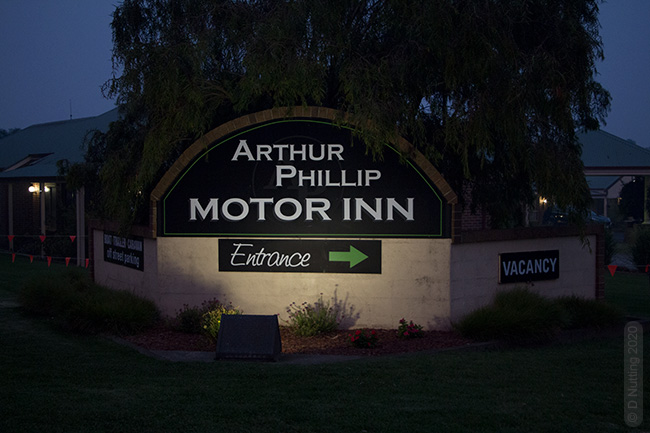
Named after Arthur Phillip: a motel in Cowes on Phillip Island, Victoria.
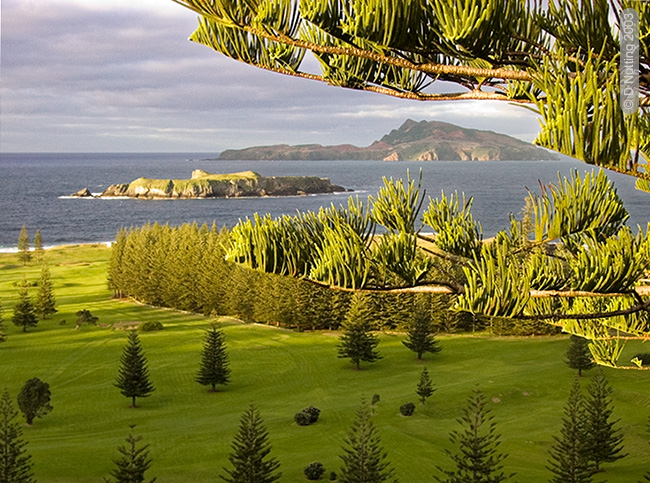
Named after Arthur Phillip: Phillip Island (seen in the far background) is an uninhabited island located 6 km south of Norfolk Island in the Southwest Pacific. It is part of the Australian territory of Norfolk Island. From the colony at Sydney, Governor Arthur Phillip ordered the establishment of a second convict penal settlement on Norfolk Island.
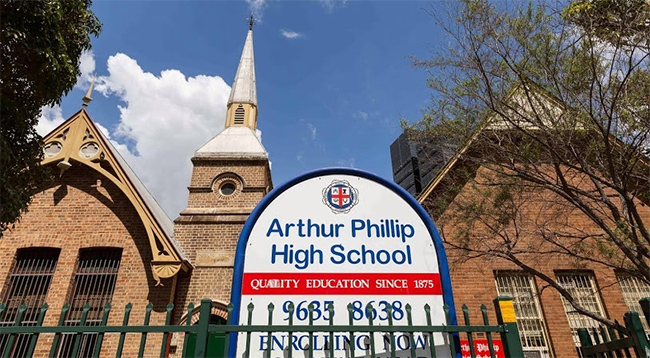
Named after Arthur Phillip: Arthur Phillip High School in Parramatta, NSW. The sign is no longer there since the school moved into a high-rise building.
♦ Notes:
1. At the time of this photo the bust was still located in First Fleet Park, The Rocks, Sydney, but it now stands at the front of the Museum of Sydney. Artist Jean Hill sculpted the bust in 1952/1953.
2. Mundle (2014), pp.35-36, 39
3. Hughes, Robert. (1987). The Fatal Shore. London: Collins Harvill Press. p.67
4. Atkinson, Alan. (1997). The Europeans in Australia : a history. Vol. 1: The Beginning. Melbourne: Oxford University Press. p.94
5. Pembroke (2013), pp.111, 114-115, 122-123
6. Fletcher (1967) / Mundle (2014), p.72
7. In: Bevan (2015)
8. Hunt, David. (2013). Girt: the unauthorised history of Australia, volume I: From megafunna to Macquarie. Collingwood (VIC): Black Inc. p.98
9. Fletcher (1967)
10. Pembroke (2013), pp.205-206
11. Pembroke (2013), pp.210-212
12. Pembroke (2013), pp.212-213
13. Bevan (2015)
14. Outred, Jacqueline. (2014, April 15). Dingo declared a separate species. Australian Geographic. Accessed on 31/8/2022, online here.
15. See also: Doyle, Gillian. (2022). A compendium of memorials honouring Governor Arthur Phillip, founder of Australia. Fellowship of First Fleeters. Sydney. p.3 (PDF) Accessed on 25/04/2025 online here.
♦ References:
Bevan, Scott. (Presenter). (2015). Arthur Phillip: Governor, Sailor, Spy. Documentary. Originally broadcast on June 30, 2015. Australian Broadcasting Corporation (ABC).
Fletcher, B. H. 'Phillip, Arthur (1738–1814)', Australian Dictionary of Biography, National Centre of Biography, Australian National University. Published first in hardcopy 1967, accessed online here on 5 February 2020.
Moyal, Ann. (2017). 'Arthur Phillip: 1788. The Foundation Year'. Australian Dictionary of Biography, National Centre of Biography, Australian National University, <https://adb.anu.edu.au/essay/21/text34967>, originally published 21 August 2017, accessed 31 August 2022.
Mundle, Rob. (2014). First Fleet. Sydney (N.S.W.): HarperCollins Publishers.
Pembroke, Michael Andrew. (2013). Arthur Phillip : sailor, mercenary, governor, spy / Michael Pembroke. Richmond, Victoria : Hardie Grant Books