Names
Australian Placenames of German Background
Germantown, Tasmania (east coast)
In the mid-1850s the colonial government in Tasmania was worried about the declining number of workers in the island colony. Two reasons for this decline were: convict transportation to Tasmania ended in 1853 and this meant that landowners no longer had access to cheap convict labour; and the gold rushes in Victoria and in New South Wales meant that many workers in Tasmania went to mainland Australia to try their luck at finding gold. The colonial authority in Tasmania set up an assisted passage scheme in order to recruit immigrants to the colony. Landowners contributed to the cost of the immigrants’ journey to Tasmania, and the immigrants had to commit to staying in Tasmania for a set period of time or to working for a minimum time period for a landowner who hired them.[1]
In May 1854, Ludwig Carl Wilhelm Kirchner, who had started working as an immigration agent for the colonial government of New South Wales in 1848, went to Germany to recruit immigrants for Tasmania. He produced a brochure praising Tasmania as a place to live and work. He recruited 665 German immigrants, who arrived on four ships in 1855.[2] 267 arrived at Hobart Town on the America on 23 July 1855.[3] The government then sent about 50 immigrants from the America to Tasmania’s east coast, to the area around Falmouth. Michael Steel was an Englishman who inherited the farm named Thompson Villa near Falmouth (Thompson Villa was later renamed Enstone Park), but Steel himself was not much good at farming.[4] He hired the Becker, Lohrey, Nicolai, Schmidt and Strochnetter families as tenant farmers.[5]
These families and the many other German immigrants, both assisted and unassisted, who left their homeland in the mid 1850’s, made a substantial contribution to the development of rural Tasmania, its east coast in particular.[6]
Tim McManus
Steel leased out some of his land to each family, and they had to do work for him whenever required. They were all farming families and brought those skills with them from Germany.[7]
Once the compulsory period of indenture work for Michael Steel finished, by the early 1860’s, Heinrich (Henry) Lohrey Snr., moved away from Thompson Villa and established himself and his family on the slopes of South Sister (a mountain above St Mary’s) at what was to become Germantown.[8] Later German immigrants, who arrived in the early 1870s as a result of the work of the immigration agent Friedrich Buck, settled at Germantown because other German settlers were already there and because land was available there.[9]
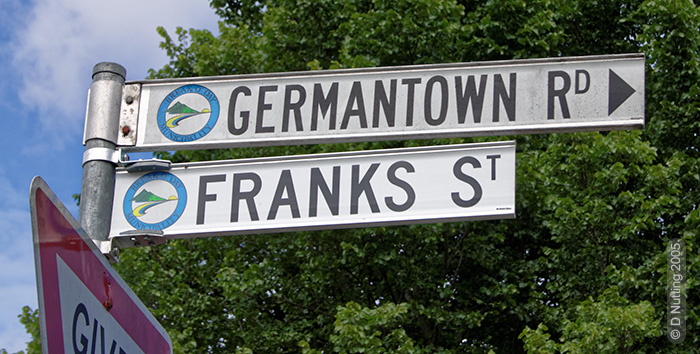
Sign at Germantown Road, Fingal Valley.
Dr Andrew Lohrey, a writer and former Speaker of the Tasmanian House of Assembly, and cabinet minister, is a descendant of Heinrich and Catherine Lohrey and grew up on the family farm at Germantown. He honoured his great, great grandparents by setting up a memorial plaque at the small Germantown cemetery in 1981.
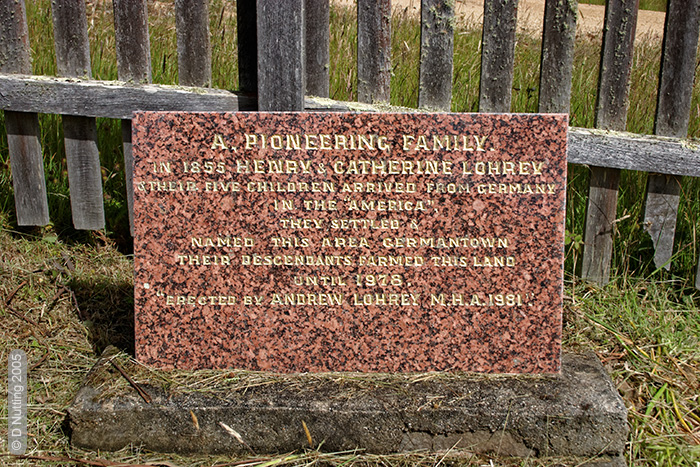
The Lohrey memorial in the cemetery at Germantown.
The plaque reads:
A pioneering family.
In 1855 Henry and Catherine Lohrey & their five children arrived from Germany in the America. They settled & named this area Germantown. Their descendants farmed this land until 1978. Erected by Andrew Lohrey M.H.A. 1981.
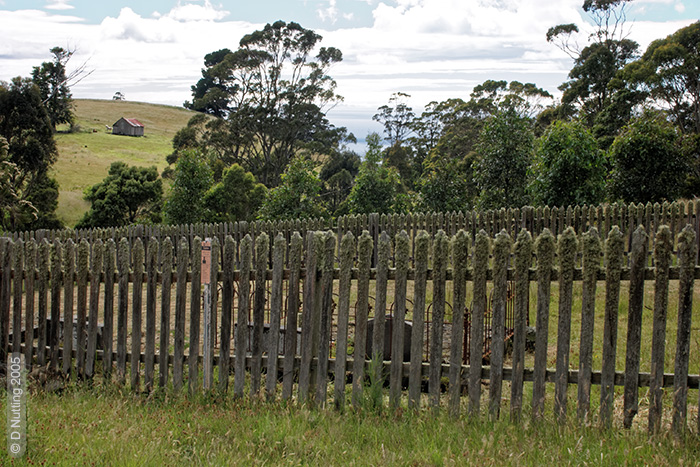
The view from the Germantown cemetery across the valley beyond.
♦ Notes:
1. Watt (2020), p.4
2. Watt (2019), p.222
3. Watt (2020), p.4
4. THE EARLY DAYS OF FALMOUTH (1935, August 3). The Mercury (Hobart, Tas. : 1860 - 1954), p. 5. Retrieved May 24, 2022, from <http://nla.gov.au/nla.news-article30098993>
5. Watt (2020), p.4
6. McManus (1993), p.100
7. McManus (1993), p.101
8. McManus (1993), p.161
9. Watt (2019), p.229
♦ References:
McManus, Tim. (1993). "Thanks to providence": a history of Falmouth, Tasmania, and its people. Falmouth (Tasmania): T. McManus
Watt, Michael. (2019). The German and Scandinavian presence in Tasmania: A methology for ethnic studies based on integrating local and family histories. In Tasmanian Ancestry, Volume 39, Number 4, March 2019. Tasmanian Family History Society Inc.
Watt, Michael. (2020). German Settlers on Tasmania’s East Coast. In former TIMES, issue 15, December 2020. The Glamorgan Spring Bay Historical Society Inc.