Ludwig Leichhardt
| Introduction | The Bushman | Failure of Second Expedition |
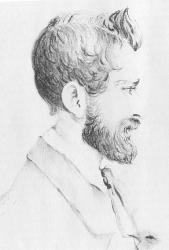
Leichhardt
In 1848 Ludwig Leichhardt and his companions vanished during his second attempt at crossing Australia from east to west. No trace of his expedition has been found. Nine separate extensive but unsuccessful searches were conducted over the next century. With no evidence whatsoever of Leichhardt's fate, his disappearance created heroic mythology and resulted in a number of poems and novels (in German also), including Nobel Prize winner Patrick White's Voss of 1957. Leichhardt left extensive and well-regarded records and publications about his travels.
Having gained a broad knowledge of natural science in Europe, and keen to explore the nature of Australia, Leichhardt emigrated to Australia in 1841 at the recommendation of an English friend. His initial triumph of exploration was a 14-month journey of 4,800 km from Moreton Bay on the east coast to Port Essington on the north coast (on the Coburg Peninsula north-east of Darwin). People had already believed him dead when he returned to Sydney in 1846. He was greeted as a hero, having completed what was up to that time the longest and most daring exploration since Europeans had been in Australia. His discoveries of good pastoral land were welcomed. Ludwig Leichhardt is a legend in Australian history - you can read a list of things and places named after Leichhardt.
Another sign of Leichhardt's reputation in Sydney can be seen in the facade of one of the most significant government buildings, which was completed in central Sydney in 1892. The Department of Lands building is heritage-listed and one of the most imposing pieces of Victorian-era architecture in Sydney. Each of the four facades of this large three-storey public building has niches or recesses built into the wall and these niches contain statues of explorers and parliamentarians who made a major contribution to the development of Australia. This includes a statue of Ludwig Leichhardt, with the name "Dr Leichhardt" inscribed on the base of the pedestal. The facade of the building has not been changed since it was completed.
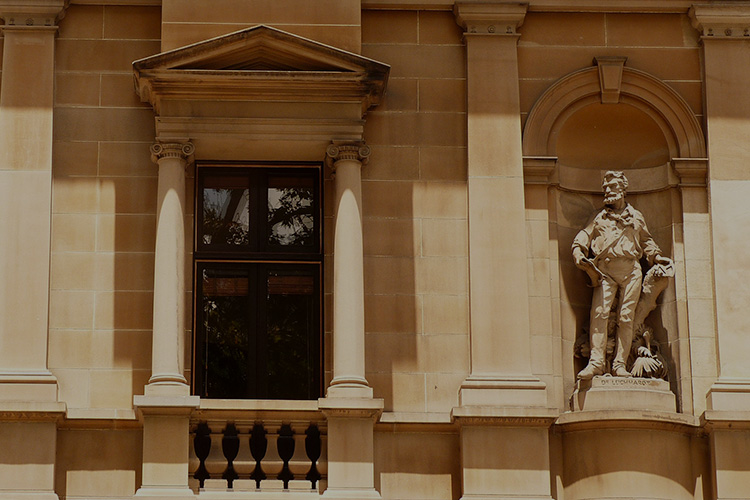
The statue of Leichhardt in the facade of the Department of Lands building, Sydney
Photo source: Sardaka (talk) 08:59, 7 January 2011 (UTC), CC BY 3.0, via Wikimedia Commons
_Department_of_Lands_3.JPG)
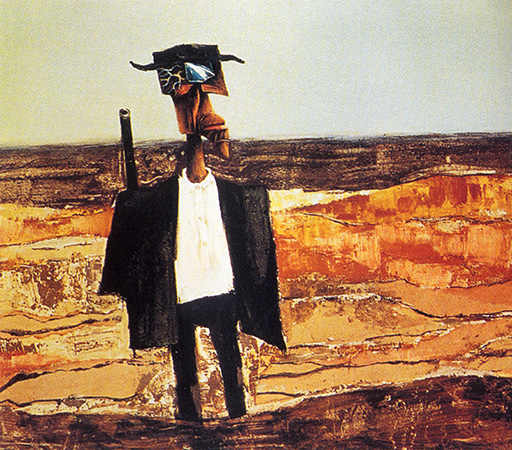
Leichhardt in modern art:
The Last Days of Leichhardt by Albert Tucker, 1964.
Harold Mertz Collection,
University of Texas, Houston
Leichhardt's life in Europe before coming to Australia involved studies
and travels that were useful for his journeys in Australia. You can read
about it by downloading the document in the following link:
leichhardteurope.pdf
(PDF file, 130Kb)
For the 200th anniversary of Leichhardt's birth (October 2013) Deutsche Post and Australia Post jointly issued a commemorative stamp which featured a portrait of Leichhardt from around 1846. This joint issue highlighted the historical scientific ties between Germany and Australia and honoured Leichhardt's contributions to natural sciences.
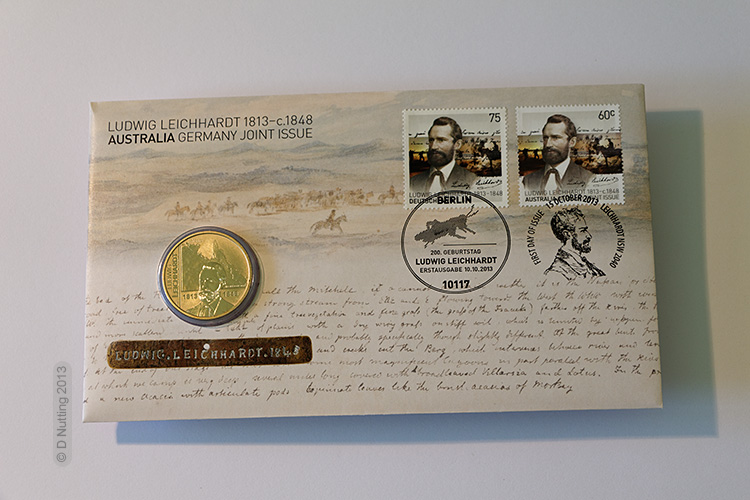
The first day cover of Australia Post, featuring both the German stamp and the Australian stamp.
Cover design: Jo Muré, Australia Post Design Studio
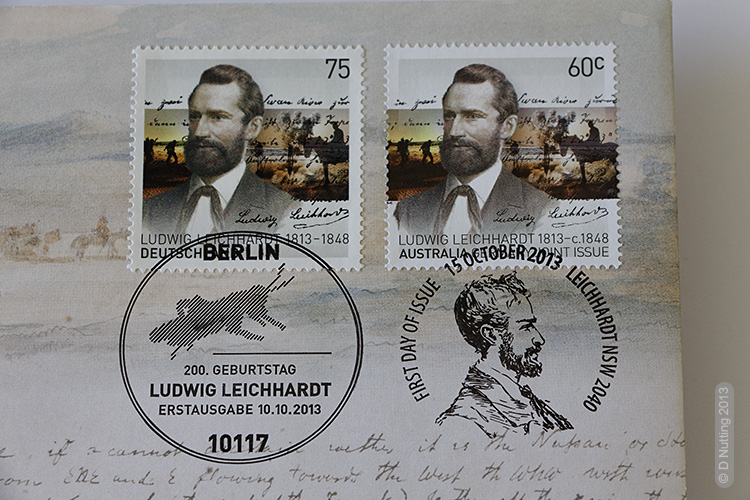
The first day cover of Australia Post, featuring both the German stamp and the Australian stamp. (Detail)
Stamp design: Gary Domoney
See also:
Leichhardt Online - Portal for F.W. Ludwig Leichhardt - original writings and documents (Lower Saxony's State and University Library at Göttingen)
Leichhardt-Land (website in Germany - focus on Leichhardt's home region)
♦ References:
Lodewyckx, Prof. Dr. A. (1932). Die Deutschen in Australien. Stuttgart: Ausland und Heimat Verlagsaktiengesellschaft. pp.200-202
New South Wales State Heritage Register. (2018). Lands Department Building, entry number 744. State of New South Wales (Department of Planning and Environment).
Roderick, Colin. (1988). Leichhardt, the dauntless explorer. North Ryde (NSW): Angus & Robertson
Tampke, Jürgen and Colin Doxford. (1990). Australia, Willkommen. Kensington (NSW): New South Wales University Press. pp.39-49