Names
Adelaide - a German name!
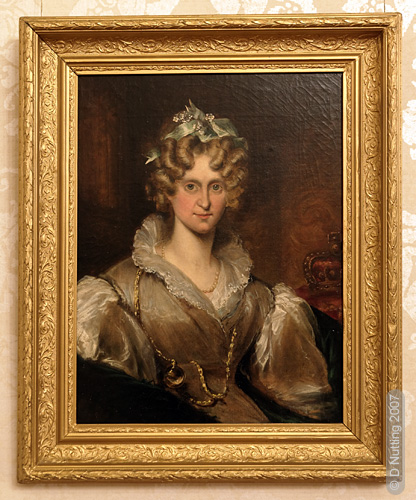
Oil painting: Portrait of Queen Adelaide
In the Queen Adelaide Room of the Adelaide Town Hall
Prinzessin Adelheid Amalie Luise Therese Carolin was born in the castle of Meiningen, Germany, in 1792. In July 1818 she married the heir to the British throne, and she changed the spelling of her name from Adelheid to Adelaide. In 1830 William was crowned King William IV of Great Britain, and Adelaide was crowned Queen of Great Britain and Hanover. When the Colony of South Australia was officially proclaimed in 1836, its new capital city was named after Queen Adelaide.
The oil painting on this page shows Queen Adelaide at the age of 57. In 1954 Queen Elizabeth II gave Adelaide Town Hall the portrait on permanent loan from her collection at Windsor Castle.
Queen Adelaide was gracious, frugal, patient and tactful. She had a beautiful speaking voice, was fluent in four languages, and her kindness won her the love and respect of the Royal family and of the British people.[1]
Prince William and Princess Adelaide were not able to produce an heir to the throne. Two daughters died as babies and four other babies were still-born. However, Princess Adelaide became the favourite aunt of her little niece, Princess Victoria, and she held many events for the entertainment of children.[2]
William was king for only seven years before he died. Some of the public reforms that took place during his reign had been Adelaide’s suggestions.[3] After William’s death she travelled through much of Britain’s countryside and donated much money to children’s charities. She was particularly keen to help disadvantaged children.[4]
'Adelaide' stayed Adelaide
During the First World War a South Australian government committee researched South Australia's placenames and identified names of German origin or of German background. Then the South Australian parliament passed a law in 1917, to change 69 "enemy" placenames. It is interesting that the government did not change the name of Adelaide, the capital city. The South Australian historian Ian Harmstorf is not sure if the committee simply overlooked the name or if they considered that changing Adelaide's name would be "too big a chestnut to handle".[5]
In the late 1960s the linguist Michael Clyne interviewed bilingual speakers of German in the Adelaide Hills and in the Barossa Valley (areas settled by German immigrants in the mid-19th century). He noted that 73% of the interviewees pronounced the name of the state capital, Adelaide, in its German form like Adelheid.[6]
(See also German Placenames in Australia)
A famous name in literature
An abbreviated form of Queen Adelaide/Adelheid's German name became known in many parts of the world when one of the best-selling books ever written, the famous children's story Heidi by the Swiss author Johanna Spyri was published in 1880, 31 years after Queen Adelaide's death. The book's original German title was Heidis Lehr- und Wanderjahre, and it tells about the events in the life of a 5-year-old girl in her paternal grandfather's care in the Swiss Alps. Heidi's parents are no longer alive and her aunt Dete takes her away from her beloved Alps to Frankfurt in Germany to be a hired friend/companion to the wealthy invalid girl Klara Sesemann, who cannot walk. The strict housekeeper of the Frankfurt household, Fräulein Rottenmeier, initially can't believe it when Heidi tells her that her name is Heidi, but Aunt Dete steps in and explains that the name which Heidi formally received at baptism was Adelheid, the same name as her mother. (Dete says in the original German text: "Es ist Adelheid getauft worden, wie seine Mutter, meine Schwester selig"[7] [The child was christened Adelheid after her mother, my blessed sister.])
A train traveller
In the 1830s the railways were taking off in Britain and becoming more and more popular as a new means of transport. Queen Adelaide has an additional place in history - she was the first member of a royal family to travel by train, and the first royal train carriage in the world was built for her - the first carriage built for the exclusive use of a member of the British Royal Family was built in 1842 by the London and Birmingham Railway for Queen Adelaide. This carriage is now on display in the National Railway Museum in York, England.[8]
.jpg)
Queen Adelaide's historic royal train carriage
Photo source: Alan Wilson, CC BY-SA 2.0, via Wikimedia Commons
.jpg)
♦ Notes:
1. Story of Adelaide, p.16
2. Story of Adelaide, p.18
3. Story of Adelaide, p.20
4. Story of Adelaide, p.22
5. Harmstorf, Ian. (1994). The German Experience in South Australia. In: Insights into South Australian History, vol. 2, South Australia’s German History and Heritage. Historical Society of South Australia Inc. p.36
6. Clyne, M.C. (1968). Decay, Preservation and Renewal: Notes on Some Southern Australian German Settlements. In: A.U.M.L.A. No. 29, May 1968. p.39
7. Spyri, Johanna. (2005). Heidis Lehr- und Wanderjahre. Urbana, Illinois: Project Gutenberg. Retrieved September 21, 2024, from <https://gutenberg.org/ebooks/7511>.
8. Faith, Nicholas. (2014). The World the Railways Made. London: Head of Zeus. (Paperback edition, 2019). p.21
♦ Reference:
Queen Adelaide Society (S.A.) (2004). The story of Adelaide. Adelaide: Queen Adelaide Society.