Gold in Victoria
›German Gully‹-Ortsnamen auf Goldfeldern in Victoria
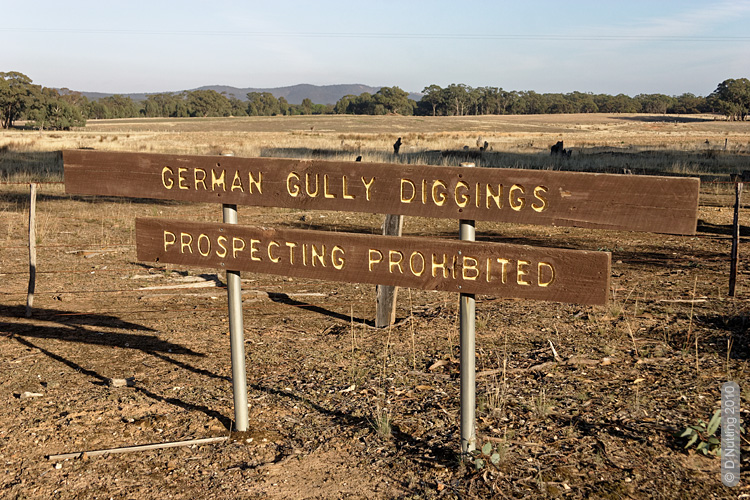
Auf den Goldfeldern arbeiteten oft Goldsucher in Gruppen zusammen, je nach ihrer Nationalität. ›Gullies‹ in der Landschaft wurden häufig benannt nach der nicht-britischen Nationalität entweder der Goldsucher, die in ihnen arbeiteten, oder des ersten Entdeckers von Gold dort.[1]
›German Gully‹-Goldfeld, bei Dunolly, 1854
John Tully schrieb in seinem Buch Dunolly and Tarnagulla Goldfields (Pomonal (Victoria): Redman Press, 1988), dass Ortsbezeichnungen wie Long Gully, Surface Gully und German Gully auf vielen Goldfeldern vorkamen.
| Jahr | Ort |
|---|---|
| 1852 | German Gully, Fryerstown (Castlemaine-Gegend) |
| 1853 | German Gully, McIvor-Heathcote-Goldfeld |
| 1854 | German Gully, Maldon |
| 1854 | German Gully, Dunolly |
| 1854 | German Gully, Yandoit |
| 1855 | German Gully, Moliagul |
| 1856 | German Gully, Taradale |
| 1858 | German Gully, nordöstlich von Stawell |
| 1859 | German Gully, Creswick |
| 1859 | German Gully, Tarnagulla |
| ~1860 | German Gully, Goldfeld von Baw Baw, Gippsland |
| 1860 | German Gully, Inglewood |
| 1860 | German Gully, Bowman's Forest (circa 20 km östlich von Wangaratta) |
| 1861 | German Gully, circa 8 km nördlich von Moonambel in der Pyrenees-Gegend |
| 1863 | German Gully, Dunolly (Heinrich Ellmers Claim) |
| 1864 | Prussian Gully, in The Whipstick (nördlich von Bendigo) |
♦ Einzelnachweise:
1. Bate, Weston. (1999). Victorian Gold Rushes. Ballarat (Vic.): The Sovereign Hill Museums Association. S.28
Diese ›German Gully‹-Liste beruht auf Informationen in: Flett, James. (1970). The History of Gold Discovery in Victoria. Melbourne: Hawthorn Press.