Queensland
German Settlement in Queensland in the 19th Century - Overview
Part 1 | Part 2
In 1837, a Sydney clergyman named John Dunmore Lang recruited two German missionaries and several lay brothers from the Gossner Mission – a missionary training institution in Berlin - for the task of converting the aborigines in the Moreton Bay area to Christianity. This missionary group founded a mission station near present-day Brisbane in 1838, which they named Zion's Hill.[1] Later on (1850s up to 1882) the settlement was known as 'German Station', and since 1882 the place has had the name Nundah. Despite their best efforts during unimaginable hardships, they were unsuccessful in their endeavour to convert the indigenous people.
The members of the mission were: Johann Peter Niquet [mason] (with wife Maria); August Rode [cabinet-maker] (with wife Julia); Johann Leopold Zillmann [blacksmith] (with wife Clara); Gottfried Haussmann [farmer] (with wife Wilhelmina); Wilhelm Hartenstein [weaver] (with wife); Friedrich Theodor Franz [tailor] (with wife Maria); Gottfried Wagner [shoe-maker]; August Albrecht [shoe-maker]; Ludwig Döge [gardener]; Moritz Schneider [medical missionary]; Wilhelm Schmidt [ordained missionary] (with wife); Christoph Eipper [ordained missionary] (with wife Harriet).[2]
Ludwig Leichhardt, the famous explorer, was a guest at the German Mission for a while in 1843 and in a letter to a friend in Sydney he wrote a positive description of the small community of missionaries and their families. The men were “excellent, tolerably well-educated men” and their wives were hard-working. The children were “the most obedient, the least troublesome children I have seen in this colony or elsewhere.” He stressed how kind the missionaries always were to the indigenous Australians.[1]
After several years the NSW government decided to stop its financial support of the mission and the missionaries had to manage on their own. Some of them were skilled tradesmen, and others took up farming in the area.[3]
The names of many of the Zion’s Hill missionaries are commemorated in the names of streets in the area around the Brisbane suburb of Nundah, and in suburbs a little further away, for example Rode Road in Chermside and Wavell Heights; Zillman Water Holes, Zillmere, and Zillman Road in Hendra; Gerler Road in Hendra; Franz Road in Clayfield and Hendra; Wagner Road in Clayfield; Nique Court at Redcliffe; Haussmann Court in Meadowbrook (Loganlea) and Haussmann Lane at Upper Caboolture.[2]

Sign in Zillmere in Queensland - the name was derived from "Zillman's Waterhole" (Johann Leopold Zillmann).
Queensland separates from NSW
Queensland became a separate colony from New South Wales in 1859. In 1861 there were only about 2,000 Germans in Queensland, and they were mainly in the cities, working as labourers and tradesmen. The gold rushes of the early 1850s had made Australia a popular destination for many Europeans, and in 1852 regular migrant shipping services started up from the port of Hamburg. However, up until the early 1860s few German immigrants went to Queensland; Germans leaving Europe heard little about Australia's north, communications between the southern parts of Australia and the north were poor, people didn't have much experience with sub-tropical agriculture, and gold fever drew people to Victoria and New South Wales.
Heußler - immigration agent
The first Queensland Government set up a committee under Dr John Dunmore Lang (head of the Presbyterian Church in Australia). This committee sent Johann Christian Heußler, a successful German businessman in Brisbane, to Germany to recruit immigrants for Queensland. He was able to offer immigrants attractive deals, including free ship's passage, good wages, and the right to select land to the value of £12 once their compulsory period of service (usually 2 years) to a local employer was over. The employer had paid for their ship's passage. Heußler did a good job and Germans arrived in Queensland in large numbers over the next decade and more, mainly in family groups. This period was, though, a time of particularly high emigration from Germany (overpopulation in some states, fear of being caught up in Prussia's wars against Denmark, Austria and France), and Queensland's immigration program benefited from this.[5]
As labourers they were popular with employers: their limited knowledge of English made it difficult for anyone wanting to stir up unrest between them and their employers, they looked "the same" as their neighbours of British origin, and they were Christian, which suited Dr Lang.
"Quälsland" and 'German fools'
The first homes they built were made of mud and thatch, but once their first crops had been sold, they built more solid slab wall and shingle-roofed houses. Germans moved into the first areas that were opened up by the Government for agricultural settlement, and some of these areas were hilly and clearing the scrub for cultivation was very hard work, all done with hand-tools in those days (whatever they could carry in with them). Crops had to be protected (usually by the children) from wallabies, rats and birds. Apparently the German settlers sometimes referred to Queensland as Quälsland (land of torment)! This type of terrain made the land more suitable for small mixed farms, and most of Queensland's Germans came from a rural farming background, whereas most British migrants were from cities.
Around 1864, closed German settlements emerged in the Rosewood area, west of Ipswich. The tick scrub there was almost impenetrable, and the first pioneers who took up the axe there at that time were ridiculed by the English as "German fools" (the British colonists thought the land there was too difficult to work with). Nevertheless, the small German farms there flourished. The Germans worked with persistence and grit to make a success of their small rural allotments.[6]
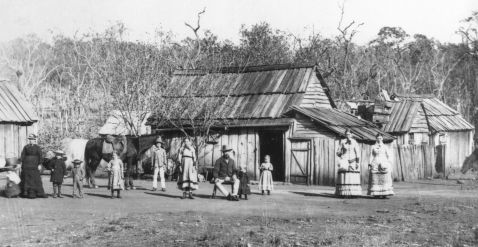
German settlers at Rosewood (south-west of Brisbane), 1880s. Behind the buildings in the photo can be seen the dense acacia scrub of the area; clearing it was very hard work.
Photo: John Oxley Library, neg #60641
Sir Thomas McIlwraith (3-times Premier of Queensland between 1879-1893), said in the Queensland Parliament:[7]
Having disembarked from the ships and spent one or two days in the Immigration Depot, the German immigrants disappear. One hears or sees nothing of them for 18 months or a couple of years, when some fine day they return from the bush in their own attractive turn out, wife and children seated high, and all well-dressed and happy-looking.
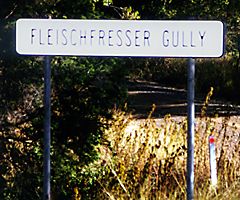
Fleischfresser Gully, a hamlet in the Laidley area, named after the Fleischfresser family
Many road signs in the Laidley area bear witness to the German settlers who established farms there in the 19th century. The farms are located adjacent to the road, and the letter boxes show that the same families still live there.
♦ Notes:
1. Lang, John Dunmore. (1861). Queensland, Australia : a highly eligible field for emigration, and the future cotton-field of Great Britain: with a disquisition on the origin, manners, and customs of the Aborigines. London : Edward Stanford. pp.394-395
2. Langbridge, Catherine. & Sloan, Robert. & Ganter, Regina. (o.J.). Zion Hill Mission (1838-1848). In: German Missionaries in Australia - A web-directory of intercultural encounters. <http://missionaries.griffith.edu.au/qld-mission/Zion-Hill-Mission-1838-1848>
3. Lodewyckx (1932), pp.59-60
4. Jenzen, Gerald. (2020, 19th August). (Friedrich-Vern-researcher). Personal communication (email) - Vern's marriage certificate.
5. Bennett, Trudy. (2012, 1st June). A Colourful Character. John Oxley Library (blog). (Article about Johann Christian Heussler) <www.slq.qld.gov.au/blog/colourful-character>
6. Lodewyckx (1932), S.62 / Evans, Raymond. (2007). A history of Queensland. Cambridge & Port Melbourne : Cambridge University Press. p.91
7. Meyer (1990), pp.68-69 / Mühling, E. (1898). Führer durch Queensland. Brisbane, Nord-Australische Zeitung. p.78
♦ References:
Gassan, Kay. (1994). Where the eagle nested: a tribute to our German pioneers. Maryborough (Qld): Wise Owl Research Publishers.
Jurgensen, Manfred. & Corkhill, Alan. & University of Queensland. Department of German. (1988). The German presence in Queensland over the last 150 years : proceedings of an international symposium August 24, 25 and 26, 1987 University of Queensland, Brisbane, Australia. St. Lucia [Qld.] : Dept. of German, University of Queensland
Lodewyckx, Prof. Dr. A. (1932). Die Deutschen in Australien. Stuttgart: Ausland und Heimat Verlagsaktiengesellschaft. pp.59-64
Meyer, Charles. (1990). A History of Germans in Australia 1839-1945. Clayton (Victoria): Monash University. pp.65-81
Tampke, Jürgen and Colin Doxford. (1990). Australia, Willkommen. Kensington (NSW): New South Wales University Press. pp.108-119