Victoria
Georg von Neumayer
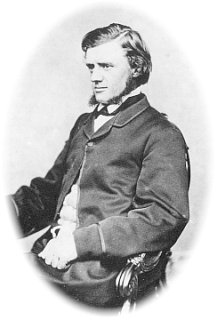
Georg von Neumayer
by Frederick Frith
(La Trobe Picture Collection, State Library of Victoria, H3850)
On the 5th August 1852 Georg Balthasar von Neumayer (1826-1909), astronomer and geophysicist, arrived in Sydney on the Reiherstieg at the age of 26. He was a qualified seaman who carried out geological and magnetic investigations during travels in Australia after the crew of the Reiherstieg deserted the ship for the goldfields. He spent eight weeks on the Victorian goldfields.
Returning to Germany, he found support and money for his plan to build and organise in Melbourne an observatory for geophysics, magnetism and nautical science on Flagstaff Hill. King Maximilian II of Bavaria and the British Association for the Advancement of Science gave him funds, and Johann Godeffroy, a Hamburg senator and owner of a shipping company, gave Neumayer free transport for himself and all the observatory equipment on the ship La Rochelle.
Neumayer arrived in Melbourne in 1857. Neumayer played a role in the establishment of a magnetic and meteorological observatory on Flagstaff Hill. It appears that it was his decision to move the Observatory in 1862 from Flagstaff Hill to the present-day site next to the Botanical Gardens. He made numerous astronomical observations on the meridian pier at this new Observatory to determine the latitude of it. His home was in Domain Road, South Yarra, not far from the new Observatory. Astronomy was an important science in a colony that relied so much on the navigation of sailing ships.
Perhaps Neumayer's greatest achievement in Australia was the magnetic survey of Victoria which he completed between the years 1858-64. In conducting this survey (almost alone) he travelled approximately 17,700 km on foot or on horseback. In 1859 he was made a member of Victoria's "Exploration Committee" (which organised the Burke and Wills expedition). In 1864 the Royal Society of Victoria (an intellectual and scientific society) made him a life member, and in the same year Neumayer left his directorship of the observatory and returned to Germany.
Neumayer was director of the German Hydrographic Office in Hamburg (which he co-founded) from 1876-1903 and contributed to the development of German polar research. Germany's research station in Antarctica is named after him, as is a crater on the moon. Neumayer Valley, a cattle station south-west of Normanton in north Queensland and a nearby parish are also named after him (named on 15th February 1862 by the explorer William Landsborough, who was searching for traces of the Burke & Wills expedition). You can read about Neumayer Station in the Antarctic in the website of the Alfred-Wegener-Institute.
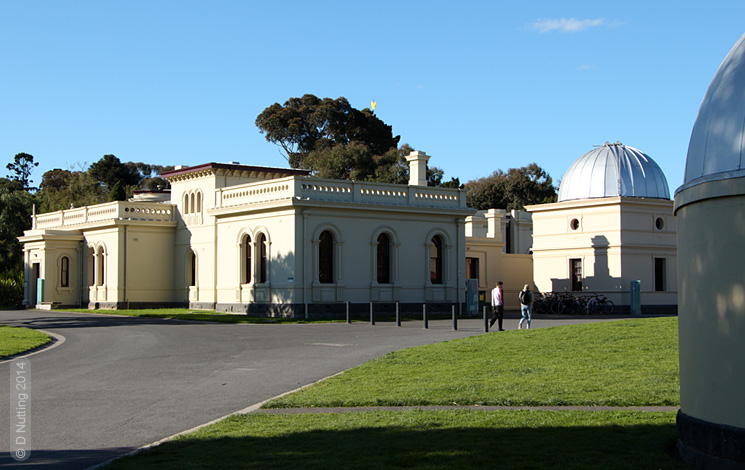
The Observatory next to the Botanical Garden
♦ References:
Lodewyckx, Prof. Dr. A. (1932). Die Deutschen in Australien. Stuttgart: Ausland und Heimat Verlagsaktiengesellschaft. pp.204-207
Swan, R. A. (1974). 'Neumayer, Georg Balthasar von (1826–1909)', Australian Dictionary of Biography, National Centre of Biography, Australian National University [accessed 09/05/2014].
Voigt, Johannes H. (1987). Australia-Germany. Two Hundred Years of Contacts, Relations and Connections. Bonn (Germany): Inter Nationes. pp.52-54