Victoria
JF Krummnow and the Herrnhut Commune
1) Krummnow in South Australia
2) In Victoria - founding of Herrnhut commune
3) Years of success
4) Hill Plain commune moves to Herrnhut
5) Krummnow's death
In 1876 numbers were boosted again by the arrival of members of another commune. This commune had been started a year before at Hill Plain, about 65 km from Benalla in north-eastern Victoria, by Maria Magdalena Engelliebe Heller. She was born Dorothea Ernestine, but later took the name Maria Magdalena Engelliebe. After receiving a divine message, she had emigrated with 75 followers from Silesia (now part of Poland). She is supposed to have had prophetic visions of things that came true. She is also described as ugly, with a rough and unpleasant manner.
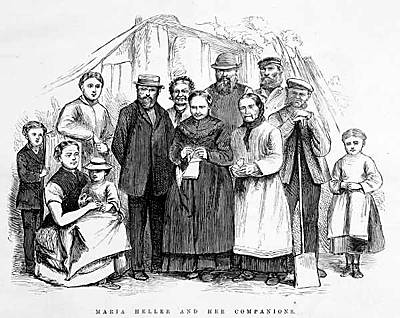
Maria Heller and her companions, Hill Plain 1875
(Maria Heller is standing in the centre)
(La Trobe Picture Collection, State Library of Victoria)
Heller's people appear to have had limited farming skills. The people of the commune soon became destitute and could not produce sufficient food for themselves. An Inspector Smith of the Benalla police visited the commune in December 1875 and discovered many people suffering from scurvy. A doctor reported that the little food they did have was of poor quality. Food and medicine was sent to the commune from Benalla.[1]
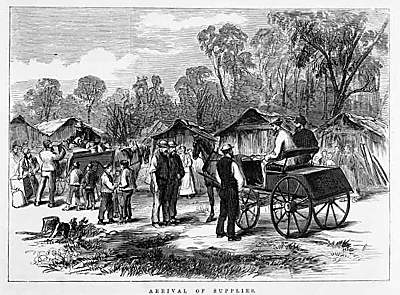
Arrival of supplies at Hill Plain
(La Trobe Picture Collection, State Library of Victoria)
The Hill Plain commune soon experienced food problems, and Maria Heller accepted Krummnow's invitation that they join his people at Herrnhut. Very soon there was disagreement between the two of them about leadership in the commune, and Maria Heller took her people out of the commune. She and they were accepted into the congregation of the Tabor Lutheran Church by Pastor Schürmann. In German church newspapers (Lutherischer Kirchenbote) he tried to improve the controversial (if not bad) reputation she had acquired in Victoria. On 30th November 1876 34-year-old Maria Heller was married by Pastor Schürmann to the tailor Ernst Scholz in the Lutheran church at Hochkirch (known today as Tarrington). Scholz had been a member of her commune at Hill Plain.[2]
Maria Scholz is said to have treated her husband Ernst and his father Karl with contempt. Nevertheless Ernst treated her well, and apparently considered her to be too holy to work. She always received the best food that was available, even when food was scarce back at the Hill Plain commune. She is said to have become very obese later in her life.[3]
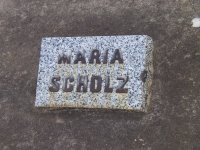
Gravestone of Maria Heller,
South Hamilton cemetery
Heller died in 1906.
♦ Notes:
1. Meyer (1978), pp.210-212
2. Metcalf & Huf (2002), pp.82-83
3. Metcalf & Huf (2002), pp.83, 122
♦ Information summarised from:
Huf, Betty (2001, January). Personal communication (local historian).
Metcalf, Bill, & Betty Huf (2002). Herrnhut. Australia's First Utopian Commune. Carlton Sth (Victoria): Melbourne University Press.
Lodewyckx, Prof. Dr A. (1932). Die Deutschen in Australien. Stuttgart: Ausland und Heimat Verlagsaktiengesellschaft. pp.137-144
Meyer, C. (1978). Two Communes in 19th Century Victoria. In: Victorian Historical Journal, Vol. 49, (No.4).